Establishing secure connection…Loading editor…Preparing document…

Master Lease Agreement

This template is fully customizable. Edit the text, fill out the fields, and send it for signature. Give it a try!
Master Lease Agreement

What a Master Lease Agreement Covers

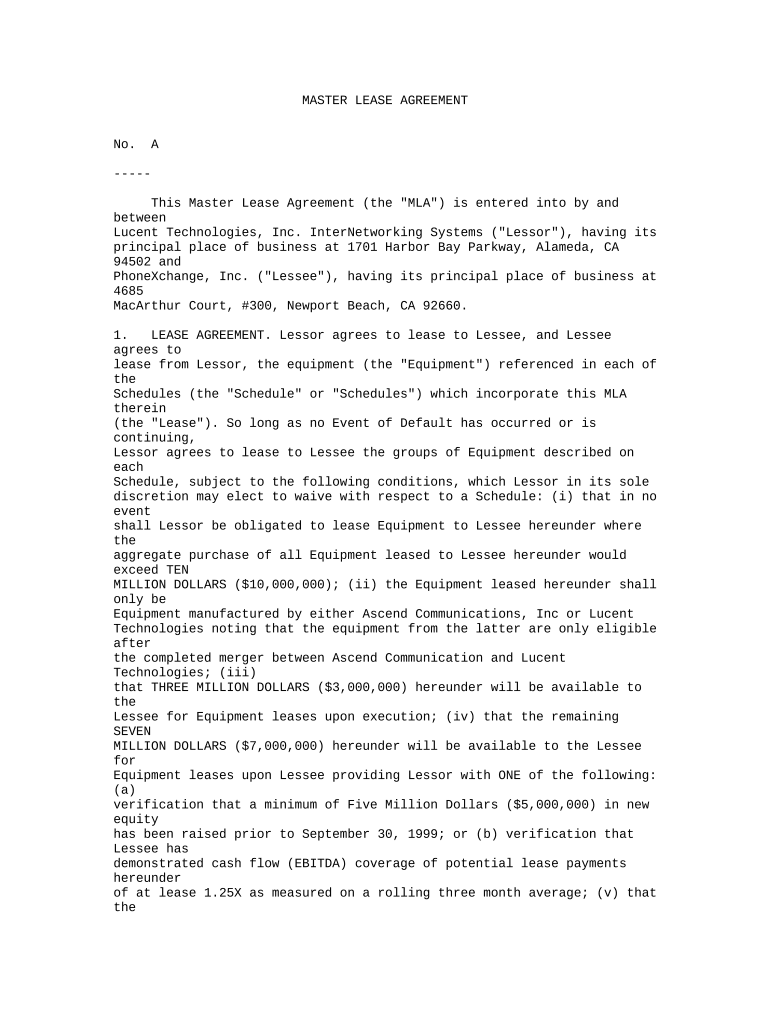
A Master Lease Agreement is a single, overarching contract that governs multiple leases of related assets or properties between the same parties. It sets uniform terms — rent, duration, maintenance responsibilities, insurance, default remedies, assignment rules, and amendment procedures — while attaching unit-specific exhibits or schedules for individual locations or items. Common in commercial real estate and equipment leasing, the Master Lease simplifies portfolio administration, centralizes dispute resolution mechanics, and reduces repetitive negotiation for each subsequent lease within the covered portfolio.

Why use a Master Lease Agreement

A Master Lease Agreement standardizes terms across a portfolio, reduces repetitive drafting, and centralizes risk allocation. It improves administrative efficiency, makes renewal and amendment mechanics predictable, and helps lenders and investors evaluate portfolio-level exposure and remedies without reviewing dozens of separate contracts.

Why use a Master Lease Agreement

Typical parties who complete a Master Lease Agreement

Common users include corporate landlords, equipment lessors, property managers, franchisors, and institutional investors who handle multiple leased assets.

  • Commercial landlords managing multi-property portfolios and enforcing standardized tenant terms across locations.
  • Equipment leasing firms consolidating schedules and repossession remedies under a single contractual framework.
  • Institutional investors and portfolio managers tracking cash flow, covenants, and portfolio-level defaults efficiently.

Who signs and executes this agreement

Property Manager

A property manager uses a Master Lease Agreement to apply uniform lease terms, coordinate maintenance obligations, and enforce default provisions across multiple units. This reduces administrative overhead, clarifies tenant responsibilities, and streamlines rent collection and reporting for large portfolios.

Equipment Lessor

An equipment lessor bundles serially leased machines under one agreement to standardize payment terms, insurance responsibilities, and repossession procedures. That approach speeds deployment, supports bulk financing, and provides consistent remedies if a lessee defaults on any scheduled item.

Core sections to include in a professional Master Lease

A robust Master Lease Agreement combines general portfolio terms with unit-specific exhibits. The following elements protect both parties and reduce later disputes.

Parties

Identify full legal names, entity types, and contact addresses for lessor and lessee; include registered agent details for entities.
Premises/Assets

Reference exhibits or schedules that list each leased unit by address, parcel ID, or serial number and any applicable area measurements.

Term & Rent

Specify lease term, commencement dates, renewal mechanics, rent amounts, escalation formulas, and invoicing/payment instructions.

Maintenance & Repairs

Allocate responsibility for maintenance, routine repairs, capital improvements, and delineate timing and approval processes.

Insurance & Indemnity

Detail required insurance types, minimum coverages, additional insured endorsements, and indemnity obligations for loss allocation.

Defaults & Remedies

Define events of default, cure periods, recovery remedies, acceleration rights, security interests, and repossession procedures when applicable.

Security and compliance considerations

Encryption: TLS 1.2/1.3 in transit; AES-256 at rest
Audit Trail: Timestamped logs, IP address, signer events
HIPAA BAA: Available when handling protected health information
ESIGN / UETA: Legal validity under federal and state law
21 CFR Part 11: Compliant for FDA-regulated electronic records
Access Controls: Role-based permissions and multi-factor options

Potential penalties and legal risks

Invalid Execution: Missing signatures can void enforceability
Tax Exposure: Withholding or reporting failures may trigger penalties
Tenant Liability: Ambiguous terms increase dispute risk
Notarization Failure: Missing notary may hinder filing or enforcement
Data Breach: Unauthorized access risks HIPAA/CCPA violations
Operational Delay: Incomplete exhibits postpone occupancy or billing

Common drafting and preparation mistakes

  • Failing to attach specific exhibits for each leased unit leads to ambiguity about rent amounts, square footage, and permitted uses, which often results in enforcement disputes or breach claims.
  • Using inconsistent governing-law clauses or omitting dispute resolution mechanisms increases litigation risk and may force related claims into multiple forums.
  • Neglecting insurance and repair obligations creates coverage gaps; clearly assign who insures, deductibles, and response times to avoid post-loss disagreements.
  • Copying terms from unrelated agreements without tailoring to asset type (real estate versus equipment) can produce unenforceable covenants or impractical operational duties.

Step-by-step: completing a Master Lease Agreement

Follow these sequential steps to prepare, review, and execute a Master Lease Agreement accurately and consistently across the covered assets.

  • 01
    Gather Parties: Confirm legal names and entity types for all parties.
  • 02
    Define Assets: List units or equipment in attached schedules or exhibits.
  • 03
    Set Terms: Specify rent, term, renewal, and payment schedule.
  • 04
    Finalize Execution: Obtain signatures, notarization, and distribute executed copies.

How to configure an online signing workflow

Match online workflow settings to the Master Lease's required signer order, authentication, and archival rules before sending for signature.

Field Configuration
Signer Order Sequential order; enforce signer sequence
Authentication Email + SMS code; use KBA if required
Conditional Fields Show exhibits only when applicable
Archived Copies Auto-send signed PDF to stakeholders

Platform and technical requirements for e-signing

Use a platform that supports PDF and DOCX uploads, cloud storage integrations, secure audit trails, and configurable authentication.

  • Formats: PDF, DOCX, HTML, XLSX supported
  • Integrations: Salesforce, NetSuite, Google Workspace, Box
  • Security: AES-256 at rest; TLS 1.2/1.3

Where to send, file, or record an executed Master Lease

After execution, distribute signed copies to stakeholders, record any instruments that affect title, and store the master file in a secure records system.

  • Send Copies: Distribute executed PDFs to lessor, lessee, and legal counsel.
  • Record Instruments: Record leases or easements where required by county recorder.
  • Notify Lenders: Provide notice to secured parties as appropriate.
  • Archive: Store signed originals in secure long-term repository.

Key dates and deadlines to track

Track effective dates, rent commencement, notice windows for renewal or termination, and record-retention deadlines tied to tax and regulatory rules.

Effective Date:

Date parties agree; starts lease obligations

Rent Commencement:

Specify start date for rent payments

Notice Periods:

Include cure and termination notice timelines

Renewal Deadlines:

Detail notice window for exercising renewals

Record Retention:

Keep executed agreements per retention schedule

Key milestones from negotiation through portfolio administration

A Master Lease typically follows distinct stages from drafting to ongoing administration; tracking these milestones keeps the portfolio compliant and operational.

01

Negotiation & Drafting

Finalize core commercial terms and exhibit templates.

02

Execution & Notarization

Obtain signatures, and notarize or witness where required.

03

Recording (if required)

Record leases or interests affecting title with county recorder.

04

Ongoing Administration

Manage payments, renewals, amendments, and default monitoring.

eSignature vendor comparison for Master Lease execution

Common vendor criteria relevant to Master Lease workflows include per-user pricing, trial availability, bulk send, audit trails, HIPAA support, and any envelope caps that affect high-volume sending.

signNow DocuSign Adobe Sign PandaDoc HelloSign
Starting Price $8/user/mo $15/user/mo $14/user/mo $19/user/mo $15/user/mo
Free Trial 7-day free trial Varies Varies Varies Varies
Bulk Send Yes Yes Yes Yes No
Audit Trail Yes Yes Yes Yes Yes
HIPAA Compliant Yes Yes Yes No No
Envelope Cap No cap 100 envelopes/user/year Varies Varies Varies

Real-world examples of Master Lease usage

These brief cases illustrate how organizations use portfolio-level leases with digital execution to improve turnaround and compliance.

Martin Properties — Tim Martin

Martin Properties used e-signature workflows for portfolio lease execution to reduce in-person signings and speed occupancy approvals.

  • Faster execution, fewer signature errors.
  • "I can process and execute all of these documents online with 100% compliance and built-in security. Whether on mobile or working offline, I can get forms back to their necessary parties efficiently."

Optica Ventures — Brian Fitzgibbons

A small commercial operator standardized lease language across assets to simplify tenant onboarding and accounting.

  • Improved consistency across locations.
  • "The interface is simple and easy-to-use for our team; more importantly, it is just as easy for our customers."

Practical drafting and execution tips

Adopt these best practices to reduce disputes and maintain clear portfolio governance over leased assets.

Use clear exhibits
Attach a separate exhibit for each leased asset with identifying details, permitted uses, and rent allocation to avoid ambiguity during enforcement or accounting reconciliation.
Specify amendment mechanics
Set a single amendment process within the Master Lease (written amendment signed by both parties) and require exhibits to be attached or referenced to maintain consistent change control.
Confirm signatory authority
Require corporate resolution or officer certification when an entity signs; this prevents later challenges to authority and supports record admissibility.
Preserve records securely
Store executed agreements and exhibits in a secure, access-controlled repository with audit logs and backup for the full retention period.

Frequently asked questions about Master Lease Agreements

Answers to common legal, execution, and technical questions when preparing or signing a Master Lease Agreement.


Need help? Contact support

be ready to get more
Join over 28 million airSlate SignNow users