Title & Caption
Clear caption and a title such as 'Motion for Exemption From Mediation/ADR Order' so the clerk and parties understand the filing's purpose at a glance.
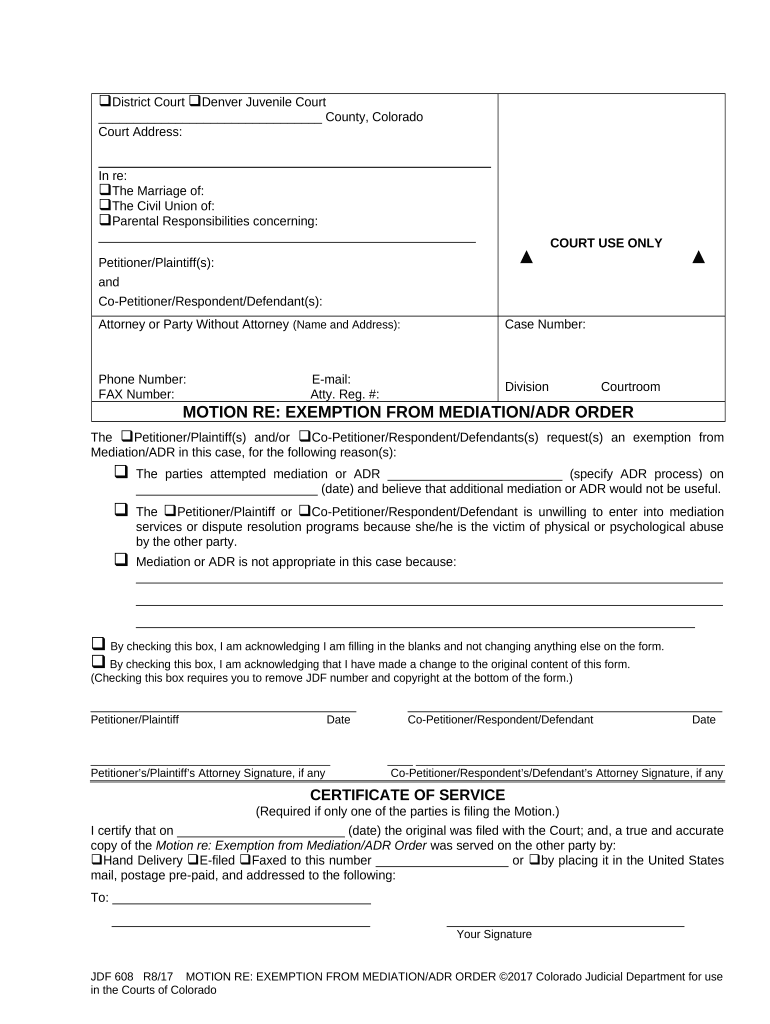
An exemption motion focuses the court on why ADR would be impractical or harmful in your case, preserves time-sensitive remedies, and avoids unnecessary costs when mediation cannot address core legal questions or third-party rights.

The motion should identify the moving party, describe the exemption grounds, and propose an order for the court to adopt; opposing parties will have an opportunity to respond under local scheduling rules.
A party without counsel may file this motion to protect time-sensitive rights or preserve emergency relief when ADR would delay access to a hearing. Include clear factual detail and proof of service to avoid procedural denial.
Counsel files the motion on behalf of a client when ADR conflicts with statutes, court orders, or when mediation cannot resolve threshold legal issues. Provide citations to local rules and supporting affidavits or exhibits.
| Field | Configuration |
|---|---|
| Document Template | Pre-populate caption, case number, and signature blocks for reuse. |
| Signature Method | Choose eSignature or handwritten signature based on court rules. |
| Certificate of Service | Add automated service confirmation and timestamp. |
| Storage | Archive final order and motion in secure repository. |
Preserve exportable audit logs and printable signed PDFs to satisfy court record requests and to support reproducibility if the court requires a certified copy.
Clear caption and a title such as 'Motion for Exemption From Mediation/ADR Order' so the clerk and parties understand the filing's purpose at a glance.
Concise factual narrative describing why mediation is impractical, including dates, prior ADR efforts, or emergency circumstances that justify exemption.
Cite statutes, local rules, or case law supporting exemption and explain why those authorities apply to the present facts.
Attach declarations, exhibits, or orders establishing urgency, third-party rights, or other substantive reasons mediation would be futile.
Show how and when opposing counsel and parties were served to establish procedural compliance with the court's rules.
Provide a short proposed order the court can adopt to exempt the case from ADR and modify any scheduling orders accordingly.
Opposing parties often have 14–21 days to respond; confirm the local rule for the specific court.
Hearing dates may be scheduled 2–8 weeks after filing, subject to judicial calendar congestion.
Allow time for proper service before a hearing; same-day service may be insufficient.
Judge's written order may be issued at hearing or by subsequent written ruling.
For immediate relief, file a separate emergency motion or ex parte application per local rules.
Motion, exhibits, and proposed order finalized for filing.
E-file with court and serve all parties per rule.
Opposing counsel files a response within the prescribed time.
Judge issues order granting or denying exemption.
| signNow | DocuSign | Adobe Sign | PandaDoc | HelloSign | |
|---|---|---|---|---|---|
| Starting Price | $8/user/mo | $15/user/mo | $14/user/mo | $19/user/mo | $15/user/mo |
| Free Trial | 7-day free trial | Varies by plan | Varies by plan | Varies by plan | Varies by plan |
| Bulk Send | Yes (Business Premium) | Varies by plan | Varies by plan | Varies by plan | Varies by plan |
| Audit Trail | Yes | Yes | Yes | Yes | Yes |
| HIPAA Compliant | Yes (BAA) | Varies by plan | Varies by plan | Varies by plan | Varies by plan |
A party sought exemption because unresolved title and lien disputes required judicial determination before settlement could occur
Plaintiff requested exemption due to imminent loss of unique property requiring immediate injunctive relief