Establishing secure connection…Loading editor…Preparing document…

Membership Certificate

This template is fully customizable. Edit the text, fill out the fields, and send it for signature. Give it a try!
Membership Certificate

What a Membership Certificate Is and when it’s used

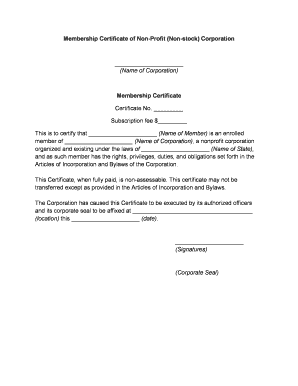
A Membership Certificate is an official document issued by an organization to confirm an individual or entity’s membership status, privileges, and term. It typically lists the member’s legal name, membership level or class, an assigned membership identification number, effective and expiration dates, and any special rights or benefits tied to the membership. Organizations use certificates for verification, access control, governance records, and member communications. Electronic versions include metadata and audit trails that record issuance and signature events for future validation.

Why a clear, well‑crafted Membership Certificate matters

A properly prepared Membership Certificate provides formal proof of status, reduces disputes about entitlement or privileges, and supports audit or regulatory needs. It creates a single source of truth for verifying membership, facilitating onboarding, renewals, and third‑party checks.

Why a clear, well‑crafted Membership Certificate matters

Who issues and who receives Membership Certificates

Organizations, administrators, and members rely on certificates for identity, access, and recordkeeping.

  • Professional associations and licensing boards issue certificates for credential verification and continuing education tracking.
  • Trade and industry organizations use certificates to grant member discounts, portal access, and voting rights.
  • Clubs, nonprofit chapters, and corporate membership programs provide certificates to confirm enrollment and privileges.

Recipients use certificates for proof of status with vendors, employers, regulators, and event organizers.

Core parts of a professional Membership Certificate

A certificate should be concise and unambiguous, combining identification, authority, timeframes, and proof of issuance so recipients and third parties can verify status quickly.

Member Name

Full legal name of the individual or entity, matching government ID or corporate registration to avoid verification issues.
Membership ID

Unique identifier or account number assigned by the issuer to link the certificate to records and transaction history.

Term Dates

Effective date and expiration or renewal terms that define when rights and obligations begin and end for the member.

Privileges

Concise list of entitlements, access levels, voting rights, or discounts associated with the membership level.

Authorized Signature

Signature, printed name, title, and date from an authorized issuer; electronic signatures must include an audit trail.

Security Metadata

Document control data such as issuance ID, issuance date, audit trail reference, and verification instructions.

Required data elements at a glance

Full Legal Name: Exact legal name
Membership ID: Unique identifier
Issuing Organization: Official issuer name
Effective Date: MM/DD/YYYY format
Expiration/Term: End date or renewal terms
Signature Block: Signer name, title, date

Step-by-step: issuing a Membership Certificate

Follow these core steps to create, authorize, and distribute a clear, verifiable certificate.

  • 01
    Prepare Template: Create a standard certificate template with fixed fields.
  • 02
    Populate Data: Enter verified member information and membership ID.
  • 03
    Add Signature Fields: Place signature, date, and verifier fields with required auth methods.
  • 04
    Distribute: Send to the member and archive the signed copy.

Typical digital workflow settings for online completion

Configure these settings to reduce errors and ensure consistent issuance when using electronic workflows.

Field Configuration
Authentication Email link, SMS code, or KBA
Template Locked fields with editable member entries
Expiration Auto-expire signing links after set days
Reminders Automatic reminder schedule for unsigned docs

Where to send and how to file the certificate

Decide distribution and archival steps to maintain verification and compliance trails for members and third parties.

  • Issue Certificate: Generate signed PDF with audit metadata.
  • Send to Member: Deliver by secure email or signing portal.
  • Archive Records: Store signed copy in secure records system.
  • Provide Verification: Offer a verification URL or reference ID.

Technical considerations for eSigning and storage

Choose platforms and formats that support secure signing, audit trails, and long‑term file integrity.

  • Formats: PDF, DOCX, and HTML supported
  • Integrations: Salesforce, NetSuite, Google Workspace
  • Security: TLS 1.2/1.3 and AES-256

Ensure the platform supports searchable archives, exportable audit trails, and any required compliance controls for your industry.

Common timing rules and processing expectations

Be clear about issuance timing, renewal notices, and expected response windows to avoid lapses or disputes.

Issue on Enrollment:

Issue certificate when membership is accepted and payment cleared.

Renewal Notice:

Provide renewal notice at least 30 days before expiration.

Data Updates:

Update certificate within 30 days of member data changes.

Signed Copy Retention:

Archive signed copy immediately after final signature.

Verification Response:

Provide verification within five business days when requested.

Common mistakes to avoid when preparing certificates

  • Entering informal or abbreviated names that do not match government IDs, causing verification failures and access denials.
  • Omitting or mismatching the authorized issuer’s name, title, or signature, which can invalidate the certificate in third‑party checks.
  • Failing to set clear effective or expiration dates, creating ambiguity over member rights and renewal obligations.
  • Using unsecured delivery methods or skipping an audit trail, which undermines evidentiary value in disputes.

Risks and consequences of incorrect or missing certificates

Access Denial: Member may be denied benefits
Contract Dispute: Ambiguity can trigger legal challenges
Regulatory Risk: Noncompliance where certificates are required
Reputational Harm: Public disputes or member complaints
Operational Delay: Verification backlogs and manual checks
Data Exposure: Insecure handling may breach privacy rules

Comparing eSignature options for issuing Membership Certificates

Overview of common plan differences to consider when selecting an eSignature provider for certificate issuance and recordkeeping.

signNow DocuSign Adobe Sign PandaDoc HelloSign
Starting Price $8/user/mo $15/user/mo $14/user/mo $19/user/mo $15/user/mo
Free Trial Yes, 7-day trial No No Yes, limited Yes, limited
Bulk Send Yes Yes Yes Yes No
Audit Trail Yes Yes Yes Yes Yes
HIPAA Compliant Yes Yes Yes No No

Frequently asked questions about Membership Certificates

Answers to common legal, technical, and operational questions when creating or using a Membership Certificate.


Need help? Contact support

be ready to get more
Join over 28 million airSlate SignNow users