Establishing secure connection…Loading editor…Preparing document…

Michigan Deed Trustee

This template is fully customizable. Edit the text, fill out the fields, and send it for signature. Give it a try!
Michigan Deed Trustee

What a Michigan Deed Trustee Form Is and when it’s used

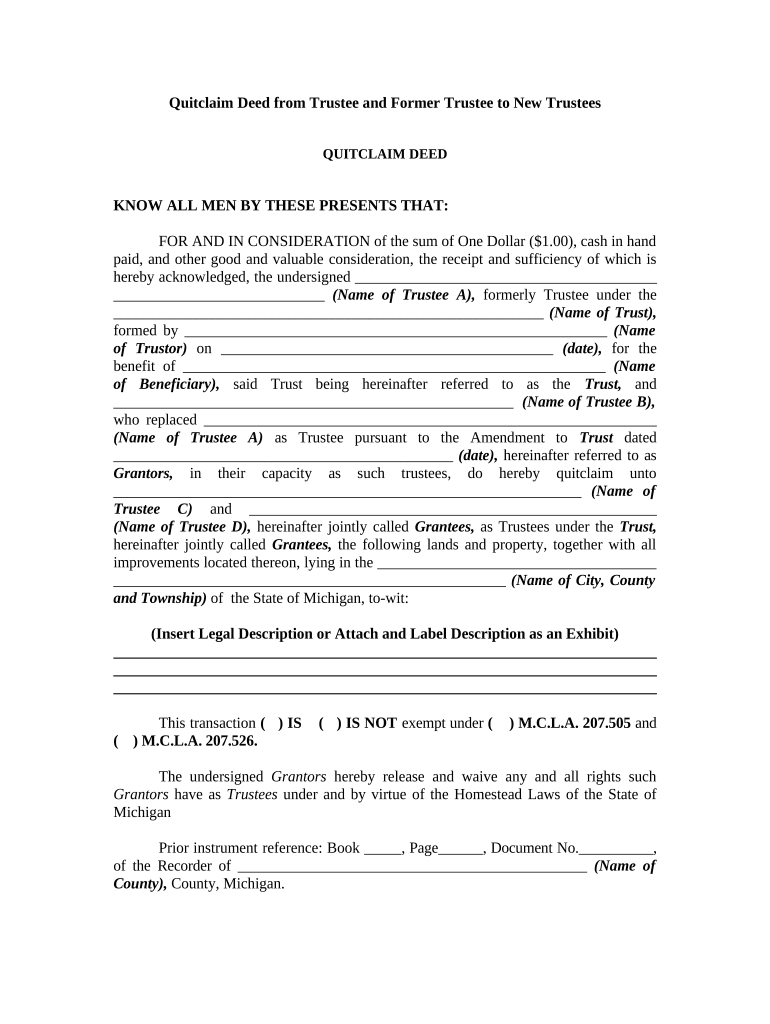
A Michigan Deed Trustee is a conveyance document executed by a trustee to transfer legal title to real property on behalf of a trust or following a trustee sale or foreclosure. It records the trustee's authority, the grantee, the consideration, and the full legal description required for county recording. Because deeds affect property title and priority, they must include a proper notary acknowledgement and be submitted to the county register of deeds for the county where the property is located. Recording creates public notice and protects the grantee’s interest against later claims.

Why a properly prepared Trustee Deed matters

A correct Michigan Trustee Deed ensures clear title transfer, preserves recording priority, and reduces the risk of rejection by the register of deeds. Accurate execution protects the grantee, prevents future title defects, and supports downstream transactions such as financing or resale.

Why a properly prepared Trustee Deed matters

Who commonly completes or receives this deed

These parties are typically involved with a Michigan Trustee Deed.

  • Trustees and trust administrators who hold legal authority to convey property on behalf of a trust.
  • Title companies and escrow officers handling recording, title insurance, and closing tasks for the grantee.
  • County register of deeds staff and municipal tax offices that process recordings and update public records.

Each party has a distinct role: trustee executes, title handles clearance, and county staff performs recording to create public notice.

Core parts of a professional Michigan Trustee Deed

A complete deed contains standard sections that support legal validity and recording. Each element should be clearly labeled and match associated supporting documentation.

Trustee Capacity

A clear statement that the signer is acting as trustee, with citation to the trust instrument or statutory authority confirming power to convey title.
Granting Clause

Language that conveys title to the grantee, specifying whether the transfer is fee simple, quitclaim, or includes any covenants of title.

Legal Description

Complete metes-and-bounds or lot-block description as recorded in county plat records; tax parcel numbers alone are insufficient for recording.

Consideration

The amount or description of consideration exchanged, or a statement of nominal consideration if a gift or trustee sale.

Notary Acknowledgement

Acknowledgement block with notary signature, seal, and date matching the execution date required by county recording offices.

Execution Block

Trustee signature line with printed name, capacity (e.g., Trustee), and the trust name; include space for witness lines if state or local rules demand them.

Essential fields to include on the deed

Grantor / Trustee: Full legal name
Trust Name: Exact trust designation
Grantee: Full legal name or entity
Legal Description: Parcel metes-and-bounds
Parcel ID: County tax identification
Notary Block: Acknowledgement with seal

Step-by-step: Completing and recording a Michigan Trustee Deed

Follow these sequential steps to prepare, execute, and record the trustee deed correctly.

  • 01
    Prepare Draft: Assemble deed language and legal description.
  • 02
    Verify Authority: Confirm trustee powers in the trust instrument.
  • 03
    Sign In Presence: Execute the deed before a notary public.
  • 04
    Record Document: Submit to county register of deeds for recording.

How to set up an online signing workflow for this deed

Configure a digital workflow that mirrors the signed paper process and preserves audit information required for legal validity.

Field Configuration
Upload Document Use final PDF with legal description and execution blocks
Signer Order Set trustee first, notary as in-person or RON if allowed
Authentication Email + SMS code or stronger ID proofing for trustee
Audit Trail Enable full timestamps, IP logs, and signed certificate

Where to file and the recording process

Recording a trustee deed establishes public notice and priority; submit to the county register of deeds in the property's county.

  • Prepare Filing: Assemble deed, any transfer tax forms, and recording cover sheet.
  • Submit to County: Deliver in-person, mail, or as permitted electronically.
  • Pay Fees: Include recording fee and any transfer taxes.
  • Receive Copy: County returns recorded copy with stamp and recording number.

Digital signing and e‑submission considerations

Electronic execution can streamline signing but must meet identity, notary, and recording rules.

  • Authentication: Use multi-factor or KBA for signer identity
  • RON Support: Ensure state and county permit remote notarization
  • Audit Trail: Retain full signing metadata and certificate

Confirm local county register of deeds accepts electronically notarized documents before relying on eSubmission or RON workflows.

Timing and processing expectations for deed recording

Timely recording preserves priority; local processing times and fee posting vary by county.

Execution Date:

Date when trustee signs and notary acknowledges the deed.

Recording Deadline:

Record as soon as practicable to protect priority; prompt submission recommended.

Processing Time:

County turnaround varies from same day to several weeks.

Tax Implications:

Transfer may trigger local transfer tax or reassessment.

Retain Originals:

Keep executed original until county returns recorded copy.

Common preparation errors to avoid

  • Using an incomplete or abbreviated legal description that does not match county records, causing recording rejection.
  • Failing to confirm trustee authority in the trust instrument, which can invalidate the transfer and create title exceptions.
  • Mismatched names between the deed, trust document, and government IDs that trigger title company exceptions or delays.
  • Omitting the notary acknowledgement or using an acknowledgement that does not meet county form requirements.

Risks and consequences of incorrect or missing information

Title Defect: May create cloud on title
Recording Rejection: Document may be refused by county
Tax Exposure: Possible transfer tax or reassessment
Loss of Priority: Later claims may take precedence
Fraud Allegations: Challenge to trustee authority possible
Increased Costs: Attorney and cure expenses likely

Primary signers and their authority

Trustee — Authorized Signer

The trustee signs in a representative capacity. Confirm authority by attaching a certified copy of the trust or a trustee’s certificate showing appointment and grant of power to convey real property.

County Recorder — Filing Official

The county register of deeds reviews formality, accepts fees, and assigns a recording number and stamp; their acceptance is the operative record of public notice and priority.

Supporting documents commonly filed or provided

Attach or have readily available supporting documents to speed recording and title clearance.

Title Commitment

Prepares the title insurance preliminary report showing exceptions and requirements the deed must meet before insurance is issued.

Trustee’s Affidavit

Affidavit attesting to trustee identity, signature authenticity, and absence of knowledge of restrictions or claims.

Mortgage Release

Recorded mortgage satisfaction or release documents if the property is being conveyed free of encumbrances.

Transfer Tax Form

Local transfer tax or documentary stamp filings required by some counties at the time of recording.

eSignature vendor comparison for executing and routing deeds

Compare starting price and core capabilities relevant to executing trustee deeds and managing notarization or audit trail requirements.

signNow DocuSign Adobe Sign PandaDoc HelloSign
Starting Price $8/user/mo $15/user/mo $14/user/mo $19/user/mo $15/user/mo
Free Trial Yes, 7-day trial No No No No
Bulk Send Yes Yes Yes Yes No
Audit Trail Yes Yes Yes Yes Yes
HIPAA Compliant Yes Yes Yes No No

Frequently asked questions about Michigan Trustee Deeds

Answers to common issues that arise during preparation, notarization, and recording of a trustee deed in Michigan.


Need help? Contact support

be ready to get more
Join over 28 million airSlate SignNow users