Caption and Parties
A clear caption identifies the petitioner, respondent (licensing authority), case or file number if known, and the court or administrative office where the petition is filed.
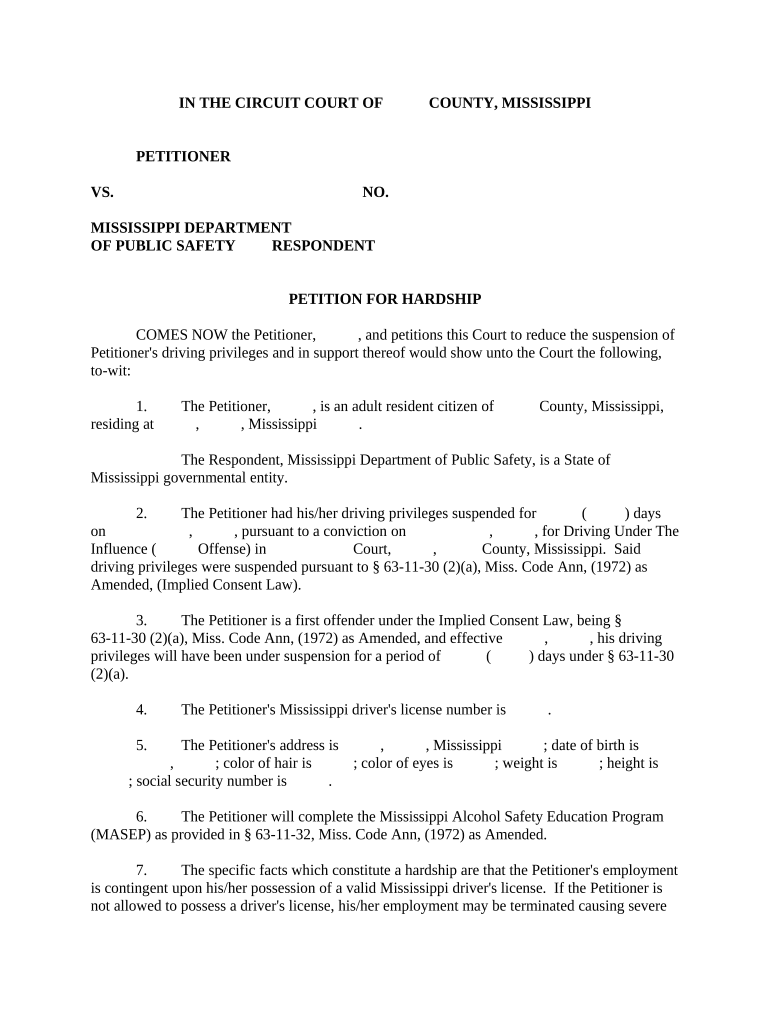
A properly prepared hardship petition can restore essential mobility by authorizing limited driving for work, medical appointments, or caregiving. It reduces financial and personal disruption while preserving public-safety safeguards through conditional privileges and monitoring.

Courts, licensing agencies, or administrative hearing officers then evaluate the petition against statutory standards and public-safety considerations.
| Field | Configuration |
|---|---|
| Signers and Roles | Petitioner signs; attorney or representative optional |
| Authentication | Email link or SMS code for signer verification |
| Document Format | PDF preferred; include searchable text when possible |
| Notifications | Auto-notify filer on receipt and decision |
Ensure the chosen system meets state electronic filing rules and preserves a tamper-evident record of signatures and attachments for later review.
A clear caption identifies the petitioner, respondent (licensing authority), case or file number if known, and the court or administrative office where the petition is filed.
A concise, factual narrative explaining how the suspension causes significant hardship, including dates, affected dependents, and why alternative transportation is not adequate.
A summary of the driving history, reason for suspension, any remediation steps taken, and evidence of rehabilitation or compliance with court-ordered requirements.
Document attachments such as employer letters, medical records, school schedules, or receipts that corroborate the hardship claims and the need for restricted driving privileges.
A draft order or suggested terms for restricted driving (hours, routes, monitoring) that the petitioner proposes to minimize public-safety risks.
A signed verification, sworn if required, certifying the truth of the petition’s statements and listing contact information for follow-up.
File as soon as hardship arises; some programs require filing within 30 days of notice.
Hearing commonly scheduled within 30–60 days after filing, depending on docket and agency workload.
Most offices require supporting documents at or before filing to be considered timely.
Administrative decisions are typically issued within 14–45 days after hearing.
Appeal or reconsideration timeframes commonly run 10–30 days from the decision.
Assemble form, narrative, and supporting evidence before filing.
Submit to the correct licensing office, clerk, or administrative division.
Present evidence and testimony at scheduled administrative or court hearing.
Obtain written decision and follow any conditional requirements immediately.
| signNow | DocuSign | Adobe Sign | PandaDoc | HelloSign | |
|---|---|---|---|---|---|
| Starting Price | $8/user/mo | $15/user/mo | $14/user/mo | $19/user/mo | $15/user/mo |
| Free Trial | Yes, 7-day trial | No | No | Yes, limited | Yes, limited |
| Bulk Send | Yes | Yes | Yes | Yes | No |
| Audit Trail | Yes | Yes | Yes | Yes | Yes |
| HIPAA Compliant | Yes | Yes | Yes | No | No |
| Envelope Cap | No cap | 100 envelopes/user/year | Varies | Varies | Varies |