Establishing secure connection…Loading editor…Preparing document…

Missouri Trust

This template is fully customizable. Edit the text, fill out the fields, and send it for signature. Give it a try!
Missouri Trust

What a Missouri Trust Is and when it applies

A Missouri Trust is a written legal arrangement under which a person (the settlor) transfers assets to a trustee to hold and manage for beneficiaries according to trust terms. Trusts may be revocable or irrevocable, can govern real property transfers and financial assets, and are governed by Missouri trust and probate statutes when administered in-state. Proper execution and funding determine whether a trust serves its intended purpose, including asset management, incapacity planning, and potential probate avoidance for transferred property.

Why a Missouri Trust is used in estate planning

A Missouri Trust centralizes asset management, clarifies successor decision-making, and can reduce or avoid probate for titled property. It also provides continuity if the settlor becomes incapacitated and enables more detailed distribution terms than a simple will.

Why a Missouri Trust is used in estate planning

Who typically creates or signs a Missouri Trust

The Missouri Trust is most often prepared by individuals with estate planning needs or by professionals acting on their behalf.

  • Settlor or grantor executing the trust, often an individual with significant assets or specific distribution goals.
  • Trustees named to manage assets and duties; institutions or individuals acting per the trust terms.
  • Beneficiaries and successor trustees who review terms and may need to acknowledge funding or acceptance.

Step-by-step: completing a Missouri Trust

Follow these steps in order to execute and fund a Missouri Trust correctly.

  • 01
    Draft terms: Define beneficiaries, trustee powers, distribution triggers, and governing law.
  • 02
    Confirm identity: Verify signer capacity with ID and documentation before execution.
  • 03
    Sign and notarize: Execute signatures and obtain notarial acknowledgment when recommended.
  • 04
    Fund the trust: Transfer title to assets, record deeds, and retitle accounts in the trust's name.

Essential components of a professional Missouri Trust

A complete trust includes clear definitions, fiduciary powers, administrative provisions, and instructions for funding and distribution.

Trust ID

Formal trust name and effective date stated clearly to avoid confusion with other instruments and to anchor administration duties.
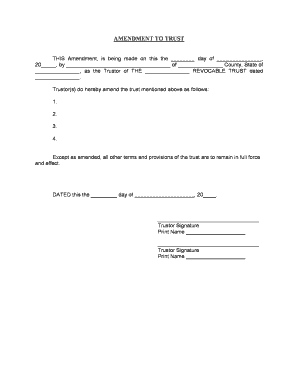
Trustee Powers

Detailed trustee authorities, including investment, distribution, borrowing, and delegation powers tailored to the settlor's intent.

Beneficiary Terms

Precise beneficiary designations, distribution timing (outright, staggered, or contingent), and conditions for discretionary distributions.

Funding Directions

Instructions for transferring real estate, bank accounts, securities, and personal property into the trust with supporting exhibits.

Administrative Rules

Accounting, trustee compensation, successor trustee appointment, bond waivers, and dispute resolution provisions to streamline administration.

Governing Law

Statement that Missouri law governs interpretation and administration, and specify venue for trust-related disputes.

Required trust information at a glance

Settlor Name: Full legal name
Trust Name: Complete trust title
Effective Date: MM/DD/YYYY
Trustee Details: Name and contact
Beneficiary List: Names and shares
Asset Description: Specific identifiers

Common risks and potential legal consequences

Improper Funding: Assets remain probatable
Name Mismatch: Title transfer delays
Missing Notarization: Recordation refused
Ambiguous Terms: Litigation risk
Tax Reporting: Penalty exposure
Unclear Trustee Power: Administration disputes

Digital signing and technical compatibility for trust documents

Choose platforms that support PDF/DOCX, notarization workflows, and secure storage to preserve evidentiary value for trust execution.

  • File Formats: PDF, Word DOCX supported
  • Integrations: Salesforce | NetSuite | Google Workspace support
  • Security: TLS 1.2/1.3 and AES-256 at rest

Typical electronic execution workflow for a trust

Electronic workflows follow defined steps to collect signatures, notarize if needed, and capture audit evidence for enforceability.

  • Prepare document: Upload and place signature, initial, and notary fields
  • Authenticate signer: Use email link, SMS code, or stronger ID verification
  • Sign and notarize: Obtain notarial acknowledgment or remote notarization session
  • Store and distribute: Provide signed copies and preserve audit trail

Key timing considerations when executing and funding a trust

Certain administrative tasks have practical deadlines; plan execution and funding to avoid lapses or tax timing issues.

Effective Date:

Set on execution; determines start of trustee duties

Funding Completion:

Transfer assets promptly to avoid probate exposure

Deed Recording:

Record property transfers as soon as feasible to protect title

Tax Filings:

File any required fiduciary returns by applicable deadlines (e.g., Form 1041)

Trustee Notifications:

Notify beneficiaries and successor trustees per trust provisions

Practical tips for accurate and efficient Missouri Trust completion

Follow these habits to reduce errors, preserve enforceability, and simplify administration.

Use consistent legal names
Ensure settlor, trustee, and beneficiary names match government IDs and account records to avoid title and tax mismatches. Confirm spelling, suffixes (Jr./Sr.), and consistent use of middle names.
Fund the trust promptly
After execution, retitle bank and brokerage accounts, assign deeds, and update beneficiary designations where permitted. Unfunded trusts leave assets subject to probate and undermine planning objectives.
Document notarization
Obtain appropriate notarial acknowledgments or RON sessions when recommended. Retain notary journals or recordings as permitted to support later authenticity challenges.
Keep complete records
Maintain original signed documents, notices to beneficiaries, account retitling proofs, and tax filings. Good records reduce disputes and facilitate trustee transitions.

How a Missouri Trust compares with a last will

A brief comparison showing common distinctions between a trust and a last will for estate transfer planning.

Criteria Missouri Trust Last Will
Probate generally avoids probate subject to probate
Privacy private administration public probate record
Execution Formalities notary recommended two witnesses typical
Post-Death Control flexible distributions court-supervised distribution

Common eSignature vendor comparison for completing trust documents

A neutral pricing and capability snapshot for eSignature vendors commonly used to execute legal documents, including trust instruments.

signNow DocuSign Adobe Sign PandaDoc HelloSign
Starting Price $8/user/mo $15/user/mo $14/user/mo $19/user/mo $15/user/mo
Free Trial 7-day free trial No No Yes, limited Yes, limited
Bulk Send Yes Yes Yes Yes No
Audit Trail Yes Yes Yes Yes Yes
HIPAA Compliant Yes Yes Yes No No

Frequently asked questions about the Missouri Trust

Answers to common practical and technical questions about executing, notarizing, and administering a Missouri Trust.


Need help? Contact support

be ready to get more
Join over 28 million airSlate SignNow users