Establishing secure connection…Loading editor…Preparing document…

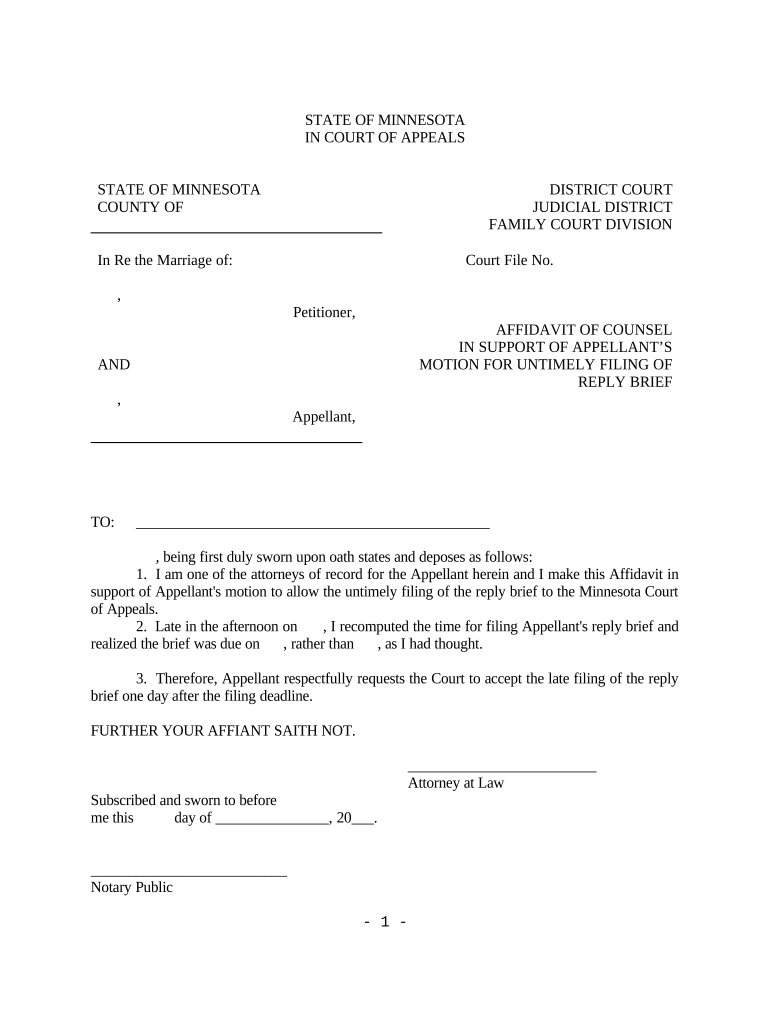
Minnesota Affidavit of Counsel in Support of Appellant’s Motion

This template is fully customizable. Edit the text, fill out the fields, and send it for signature. Give it a try!
Minnesota Affidavit of Counsel in Support of Appellant’s Motion

What the Minnesota Affidavit of Counsel in Support of Appellant’s Motion Is

The Minnesota Affidavit of Counsel in Support of Appellant’s Motion is a sworn written statement by appellate counsel that supplies facts, procedural history, or legal basis supporting a motion filed in an appellate proceeding. It is prepared to assist the appellate court in assessing a pending motion, clarifying factual assertions, and documenting counsel’s representations under oath. The affidavit typically accompanies the motion and is signed, dated, and notarized as required by court rules; it should be concise, accurate, and limited to matters within counsel’s knowledge or supported by cited record references.

Why this Affidavit Matters in Appellate Practice

A clear, properly executed affidavit supports a motion’s factual foundation, helps the court evaluate urgency or prejudice, and reduces disputes about uncontested facts. Well-prepared affidavits can prevent delays, avoid unnecessary evidentiary hearings, and preserve the appellate record.

Why this Affidavit Matters in Appellate Practice

Who Typically Prepares and Relies on This Affidavit

Counsel for appellants, appellate practice teams, and supervising partners commonly prepare the affidavit when a motion requires sworn factual support.

  • Appellate counsel who must establish factual assertions for a motion in the court of appeals or supreme court.
  • Trial counsel providing record references or factual confirmation for issues on appeal.
  • Paralegals or litigation support staff who assemble cited exhibits and record citations for counsel review.

Key Signers and Roles

Lead Appellate Counsel

Lead appellate counsel signs and attests to statements of fact and representation history. The affidavit should reflect counsel’s direct knowledge, cite the record, and state the basis for any factual assertions to avoid later credibility or perjury issues.

Supervising Partner

A supervising partner or firm officer may review and co-sign if required by firm practice; their involvement confirms supervisory review and that factual statements were verified against the trial record and client instructions.

Core Elements to Include in the Affidavit

A complete affidavit contains identification, a statement of oath, concise facts, record citations, signature and notarization, and a certification of accuracy under penalty of perjury.

Caption

Match the court caption and docket number exactly as used in the underlying appellate filing to ensure the affidavit attaches to the correct matter.
Declarant Identity

State the name, firm, role, and contact information of counsel attesting to the facts and clarify whether counsel relies on client communications or personal knowledge.

Statement of Facts

Provide only concise factual statements directly relevant to the motion; avoid argument or extensive legal analysis that belongs in the brief.

Record Citations

Cite specific record document numbers, page ranges, or transcript references so the court can verify the factual assertions without additional requests.

Oath/Notary

Include an oath or affirmation clause and a notary block consistent with Minnesota notary practice to validate the sworn statement.

Signature Block

Counsel signs, prints name, date, and includes bar number; ensure the printed name matches professional registration records to avoid identity questions.

Step-by-Step: Preparing and Submitting the Affidavit

Follow a clear sequence to draft, verify, sign, notarize, and file the affidavit so the appellate clerk accepts it without procedural objection.

  • 01
    Draft: Compose concise factual paragraphs tied to record citations.
  • 02
    Verify: Confirm facts with the trial record and client where appropriate.
  • 03
    Sign and Notarize: Sign in the presence of a notary or use authorized RON procedures.
  • 04
    File: File with the appellate clerk and serve opposing counsel as required.

How the Affidavit Works Within an Appellate Motion

This workflow explains how the affidavit interacts with the motion, record, and court decision process so practitioners understand its procedural role.

  • Attach to Motion: Affidavit accompanies the motion as supporting sworn facts.
  • Clerk Review: Clerk verifies caption, signature, and notarization before docketing.
  • Service: Serve opposing counsel with the motion and affidavit per appellate rules.
  • Court Consideration: Judge relies on affidavit for uncontested facts or schedules a hearing if disputed.

Digital Workflow Setup for Online Completion and Filing

Configure an online workflow to collect counsel signature, notarization, and automated record citations to streamline submission.

Field Configuration
Affiant Name Field Required; automatic validation against bar roster where available
Record Citation Field Structured input for docket number and transcript citations
Signature Field Enable signer authentication and timestamp capture
Notary Attachment Attach notarization certificate or RON evidence file

Technical Requirements for eSigning and eSubmission

Ensure the chosen platform supports secure signer authentication, tamper-evident signatures, and attachment of notarization records.

  • File Formats: Accept PDF and PDF/A for court filings and long-term retention
  • Auth Methods: Support email, SMS code, or advanced authentication for signer attribution
  • Audit Trail: Provide IP, timestamp, and certificate of completion for court review

Timelines and Filing Considerations

Mind applicable appellate deadlines and clerk requirements; missing a filing window or service rule can result in denial or procedural delay.

Motion Timing:

File in accordance with the Minnesota Rules of Civil/Appellate Procedure applicable to the motion.

Service:

Serve opposing counsel contemporaneously per rule to preserve fairness and response rights.

Notarization Timing:

Notarize on or after the date counsel signs; do not backdate the affidavit.

Record Citation Check:

Verify all record references before filing to prevent clerical objections.

Clerk Processing:

Allow time for clerk review and potential deficiency notices; timelines vary by court.

Penalties and Legal Risks of an Incorrect or False Affidavit

Perjury Risk: Knowingly false statements can expose the affiant to perjury charges under Minnesota law (Minn. Stat. §609.48) and criminal prosecution.
Sanctions: Courts may impose sanctions, including monetary penalties or attorney discipline, for knowingly false or frivolous factual assertions.
Motion Denial: Procedural defects or unsupported facts can cause the court to deny the motion without hearing.
Ethics Exposure: Counsel may face professional responsibility inquiries for misrepresentations or failure to verify factual claims.
Evidence Exclusion: Improperly authenticated exhibits or uncertified transcripts may be excluded from consideration.
Record Integrity: Inaccurate affidavits risk contaminating the appellate record and undermining credibility on appeal.

Common Preparation Mistakes to Avoid

  • Including argumentative legal analysis instead of concise factual statements tied to the record.
  • Failing to notarize or using an incorrect notary block that does not match state requirements.
  • Citing incorrect record numbers or transcript pages that prevent verification by the clerk or judge.
  • Using imprecise language (e.g., 'to the best of my recollection') when contemporaneous record verification is available.

Security and Compliance Considerations for Electronic Affidavits

Encryption: TLS 1.2/1.3 in transit; AES-256 at rest
Audit Trail: Timestamped logs with IP and action history
Certifications: SOC 2 Type II and ISO 27001 available
HIPAA Support: HIPAA-compliant workflows available with a signed BAA
ESIGN/UETA: Conforms to ESIGN and UETA legal standards
21 CFR Part 11: Controls and auditability suitable for regulated records

Pricing comparison of common eSignature platforms for affidavit workflows

Compare vendor starting prices, trial availability, bulk send, audit trail, and HIPAA compliance when choosing an eSignature provider for affidavit and court filing workflows.

signNow DocuSign Adobe Sign PandaDoc HelloSign
Starting Price $8/user/mo $15/user/mo $14/user/mo $19/user/mo $15/user/mo
Free Trial 7-day trial Varies Varies Varies Varies
Bulk Send Yes Yes Yes Yes No
Audit Trail Yes Yes Yes Yes Yes
HIPAA Compliant Yes Yes Yes No No

Frequently Asked Questions and Troubleshooting

Answers to common questions about legal validity, notarization, eSubmission, and common procedural pitfalls for the Minnesota Affidavit of Counsel in Support of Appellant’s Motion.


Need help? Contact support

be ready to get more
Join over 28 million airSlate SignNow users