Establishing secure connection…Loading editor…Preparing document…
Montana District Court Fee Schedule
This template is fully customizable. Edit the text, fill out the fields, and send it for signature. Give it a try!
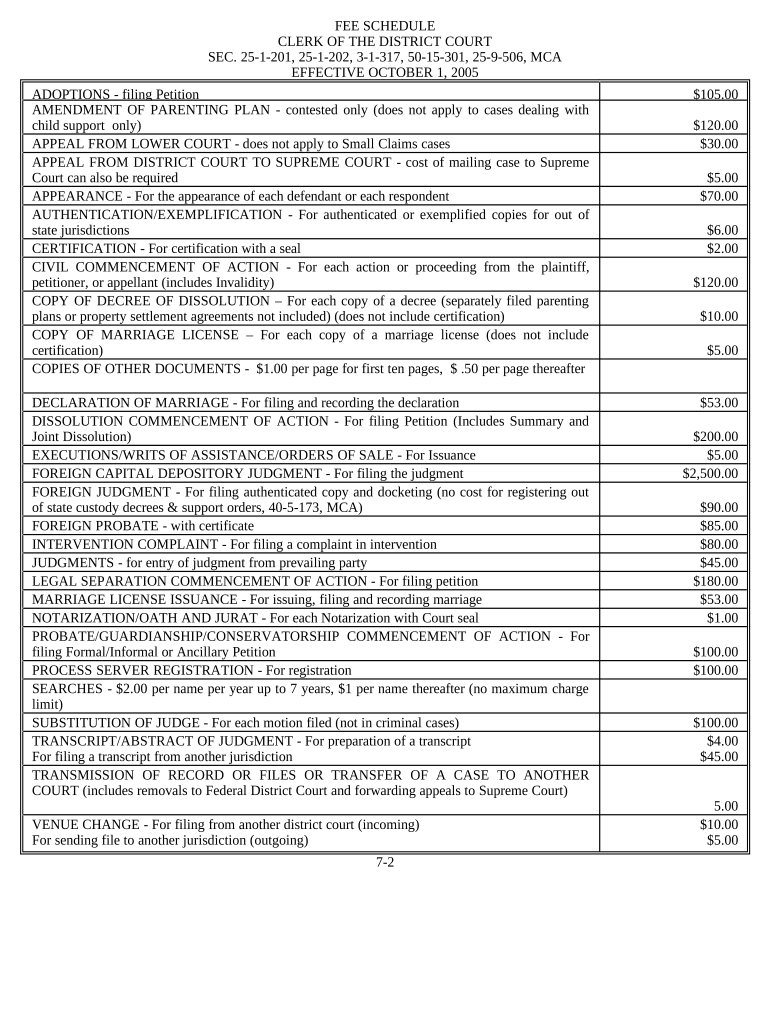
What the Montana District Court Fee Schedule Is and why it matters
Why understanding the fee schedule reduces filing risk
Accurate application of the fee schedule prevents filing rejections, unexpected costs, and procedural delay; it helps attorneys, self-represented litigants, and clerks confirm fee waiver eligibility and ensures correct court accounting.

Who typically completes or relies on this fee schedule
The Montana District Court Fee Schedule is used by attorneys, court clerks, and self-represented litigants when preparing or accepting filings.
- Civil and criminal attorneys verifying client expenses and filing choices, ensuring precise billing and timely submission.
- Court clerks confirming payment amounts, fee code entries, and waiver documentation to docket new filings correctly.
- Pro se litigants checking fee waiver rules, acceptable payment methods, and exact amount required for filing their documents.
Step-by-step: Completing a Montana District Court fee entry
-
01Confirm filing type: Identify complaint, motion, appeal, or other document type.
-
02Check applicable fee: Locate the fee line on the district or county schedule.
-
03Calculate total: Include docketing, certification, and any service fees.
-
04Attach proof: Include payment receipt or fee waiver with filing.
Configuring online submission for the fee schedule
| Field | Configuration |
|---|---|
| Case Number Field | Required, exact-match validation enabled |
| Fee Amount Field | Numeric format, two decimals enforced |
| Payment Attachment | Accept PDF receipt, image, or e-payment confirmation |
| Delivery Receipt | Automatic confirmation emailed to filer |
Where to file and how payments are submitted
-
In-Person Filing: Pay at the clerk's office with card, check, or cash.
-
Mail Filing: Include check and copy; allow mailing time for processing.
-
Court eFile: Upload documents and pay via the court's e-filing portal.
-
Third-Party E-filers: Use vendors that transmit filings and collect payments.
Technical considerations for eSubmission and signatures
Ensure your e-filing system accepts PDFs, produces audit trails, and preserves attached payment receipts.
- File Formats: PDF, Word DOCX accepted by many portals
- Audit Trail: Timestamps and signer identity recorded
- Integrations: Salesforce, NetSuite, Google Workspace supported
eSignature vendor comparison for completing fee schedules
| signNow | DocuSign | Adobe Sign | PandaDoc | HelloSign | |
|---|---|---|---|---|---|
| Starting Price | $8/user/mo | $15/user/mo | $14/user/mo | $19/user/mo | $15/user/mo |
| Free Trial | 7-day trial | Varies | Varies | Varies | Varies |
| Bulk Send | Yes | Yes | Yes | Yes | No |
| Audit Trail | Yes | Yes | Yes | Yes | Yes |
| HIPAA Compliant | Yes | Yes | Yes | No | No |
Consequences of incorrect or missing fee information
Filing Rejection:
Case not accepted
Processing Delay:
Docket and hearing delays
Fee Forfeiture:
No refund possible
Sanctions:
Court-imposed penalties
Appeal Impact:
Timeliness affected
Credibility Risk:
Administrative record problems
Common mistakes to avoid when preparing a fee schedule
- Using an incorrect filing code or fee line, which can cause clerks to misapply payments and delay docketing of the matter.
- Submitting mismatched names or case numbers that prevent the court from associating the payment with the correct case.
- Failing to attach payment confirmation or fee waiver documentation, resulting in rejection or return of the filing packet.
- Relying on outdated local schedules instead of the current county clerk list; fees occasionally change and must be verified before filing.
Practical tips for accurate and efficient fee submissions
Validate fee code and amount
Cross-check the district or county fee schedule before finalizing the filing packet. Confirm that the numeric amount matches the code for that specific filing type.
Attach receipts and waiver forms
Include payment confirmation, bank or credit card receipt, or completed fee waiver petition so the clerk can clear payment without follow-up.
Use standardized date formats
Enter dates as MM/DD/YYYY to avoid ambiguity and to ensure the clerk applies the payment to the correct filing date and deadline.
Keep an audit log
Retain copies of the submitted schedule, confirmations, and correspondence for at least the retention period specified by local and federal regulations.
Real-world examples of electronic fee processing and record keeping
Optica Ventures LLC
The interface is simple and easy-to-use for our team; more importantly, it is just as easy for our customers.
- Rapid adoption across remote clients.
- The result was fewer missing receipts and faster docketing because payment proofs were attached directly to filings and automatically archived for audit purposes.
Martin Properties
I can process and execute all of these documents online with 100% compliance and built-in security.
- Mobile signing reduced in-person trips.
- By attaching signed fee authorizations and proof of payment to each filing, the firm reduced clerical follow-ups and shortened time to acceptance.
How Montana District Court fees compare with county civil court schedules
| Criteria | Montana District Court | County Civil Court |
|---|---|---|
| Applicable Court | statewide district level | local county level |
| Typical Filing Types | felony, major civil | small claims, misdemeanors |
| Fee Adjustment Cycle | state set | county set |
| Electronic Filing | common | varies by county |
Frequently asked questions about the Montana District Court Fee Schedule
-
What if I attach the wrong fee amount?
If the court receives an incorrect amount, the clerk may reject or hold the filing until the balance is paid. Promptly contact the clerk's office to confirm required correction steps and whether a supplemental payment or refund procedure applies.
-
Can I file without paying if I request a waiver?
Many courts allow filing with a pending fee waiver application, but local rules vary. Include the completed waiver form and any required affidavit; the clerk will review eligibility before docketing without payment in most jurisdictions.
-
Are electronic signatures accepted on fee documents?
Electronic signatures are generally accepted under ESIGN and UETA for court-related fee authorizations, provided they meet intent, consent, attribution, and retention requirements and the court portal accepts e-signed attachments.
-
How long until the clerk posts my payment?
Processing time varies by county; many clerks post payments within one to three business days. High-volume periods or incomplete attachments may extend processing time and require follow-up.
-
What documentation proves payment?
A bank or card receipt, a stamped clerk receipt, or an electronic payment confirmation are acceptable proofs. Save copies in case of dispute or audit and attach them to the filing when required.
-
Who to contact if a fee was misapplied?
Contact the county clerk or the district court administrative office immediately. Provide case number, receipt, and filing details so the clerk can reallocate or refund the payment per local procedures.
be ready to get more
Join over 28 million airSlate SignNow users