Caption
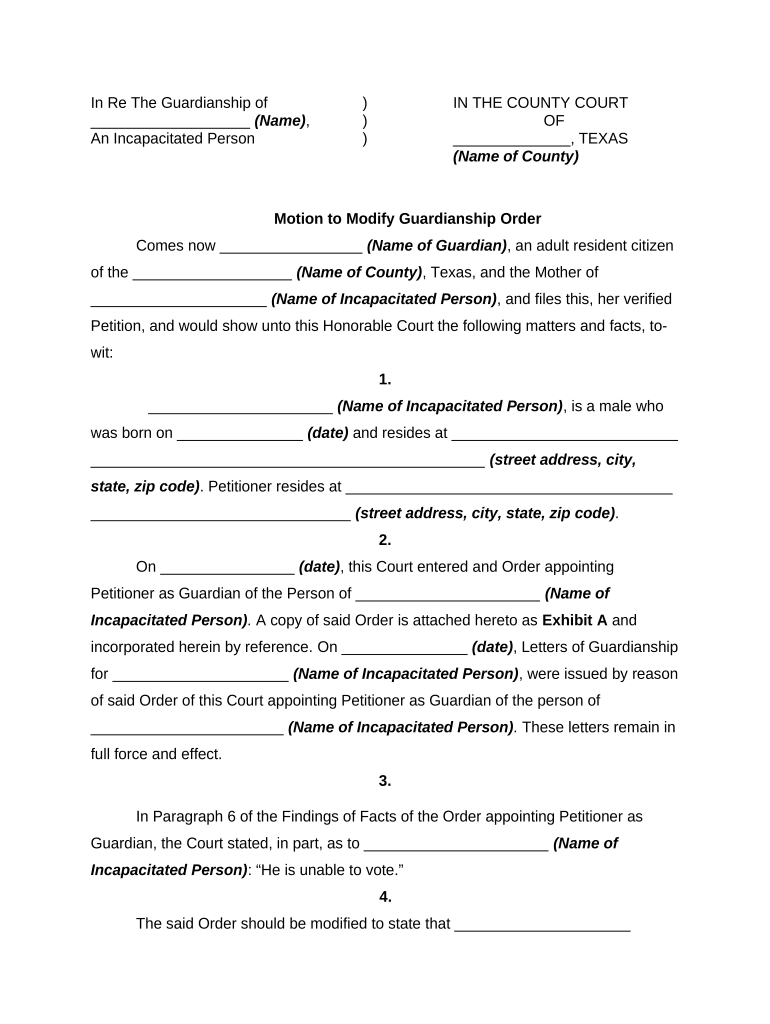
Court name, case number, title of document, and parties. A correct caption ensures the clerk files and routes the motion in the proper case file.
A complete, correctly framed motion reduces delays, preserves the proposed ward’s rights, and helps the court evaluate alternatives such as supported decision-making. Accurate filings improve the chance of appropriate temporary relief and limit the need for repeated hearings.

Petitions are usually prepared by family members, attorneys, or public guardians seeking legal authority to care for a person who is incapacitated or a minor without guardianship.
Selecting the correct petitioner type and stating standing clearly reduces procedural objections and helps the court verify service and notice requirements.
The petitioner is the person or agency filing the motion. Include role, contact details, relationship to the proposed ward, and a short factual statement establishing standing and motive for guardianship in the declaration.
The proposed guardian signs any consent forms and provides background information, criminal history disclosures, and a proposed care plan. The court evaluates suitability, conflicts of interest, and capacity to act as fiduciary.
Court name, case number, title of document, and parties. A correct caption ensures the clerk files and routes the motion in the proper case file.
Briefly explain why the court has jurisdiction (residence, domicile, or venue), citing relevant state probate or family code provisions where applicable.
Detailed factual allegations about incapacity, need for decision-making assistance, medical conditions, and examples of inability to manage personal or financial affairs.
Clear statement of the specific powers sought (medical, financial, placement authority), including any limitations or reporting obligations to the court.
Affidavits, physician reports, social worker assessments, and financial statements attached as exhibits to substantiate incapacity and need.
Proof that required parties were served according to state rules, including notice to relatives, the respondent, and public agencies as required by statute.
| Field | Configuration |
|---|---|
| Signature Block | Required | Signer must initial and date |
| Witness Field | Optional | Add conditional witness if state requires |
| Notary Acknowledgement | Include | Use RON or in-person per state rules |
| Exhibit Upload | Required | Attach PDFs and label sequentially |
Electronic signing can streamline collection of declarations and consent, but confirm court policies on e-filings and remote notarization before use.
Verify whether the receiving court accepts e-filed petitions, and whether remote online notarization (RON) is permitted for supporting affidavits in that jurisdiction.
Same-day to a few days in urgent cases depending on court availability
Usually 7–30 days before a scheduled hearing per local rule
Often within 7–30 days after filing for temporary orders
Often scheduled 30–90 days after filing depending on complexity
Periodic accountings or reports as ordered by the court
Assemble declarations, medical reports, and proposed orders for filing.
File the petition with the clerk and serve required parties.
Judge may grant temporary guardianship pending final determination.
Court issues final guardianship order, specifying scope and reporting.
| signNow | DocuSign | Adobe Sign | PandaDoc | HelloSign | |
|---|---|---|---|---|---|
| Starting Price | $8/user/mo | $15/user/mo | $14/user/mo | $19/user/mo | $15/user/mo |
| Free Trial | 7-day free trial | Varies by vendor | Varies by vendor | Varies by vendor | Varies by vendor |
| Bulk Send | Yes | Yes | Yes | Yes | No |
| Audit Trail | Yes | Yes | Yes | Yes | Yes |
| HIPAA Compliant | Yes | Yes | Yes | No | No |
A daughter files on behalf of an elderly parent with progressive dementia.
A county adult protective services agency petitions for an incapacitated adult with no family.