Establishing secure connection…Loading editor…Preparing document…

California Motion for Joinder

This template is fully customizable. Edit the text, fill out the fields, and send it for signature. Give it a try!
California Motion for Joinder

What the California Motion for Joinder Is

A California Motion for Joinder is a written request filed with a civil court asking the judge to add another party—such as a necessary or permissive party—to an existing lawsuit. The motion explains the proposed party's interest, the legal basis for joinder, and how joining the party serves judicial economy or protects rights. It typically includes a memorandum of points and authorities, a declaration or affidavit supporting factual assertions, a proposed order, and proof of service on existing parties and the proposed joinder.

Why Filing a Joinder Motion Matters

Joinder preserves claims and defenses, prevents duplicative litigation, and ensures all affected parties are before the court so relief is complete and enforceable.

Why Filing a Joinder Motion Matters

Who Typically Prepares or Files This Motion

Whether counsel or a pro se litigant files the motion, compliance with local rules, service requirements, and timing is essential.

  • Plaintiff attorneys seeking to add a necessary defendant to protect judgments and remedies.
  • Defense counsel adding a third-party or cross-defendant to apportion liability or contribution.
  • Self-represented litigants (pro se) who need to include another party to obtain complete relief.

Primary Roles Involved

Lead Counsel

An attorney for a moving party who drafts the motion, cites legal authority, coordinates supporting declarations, and handles e-filing and service under local court rules.

Court Clerk

The court official who accepts filings, assigns a hearing date if required, and posts filing receipts and docket entries; clerks enforce format and fee requirements.

Essential Parts of a Professional Joinder Motion

A complete joinder motion combines legal argument, factual support, procedural compliance, and clear orders so the court and parties can act without delay.

Caption

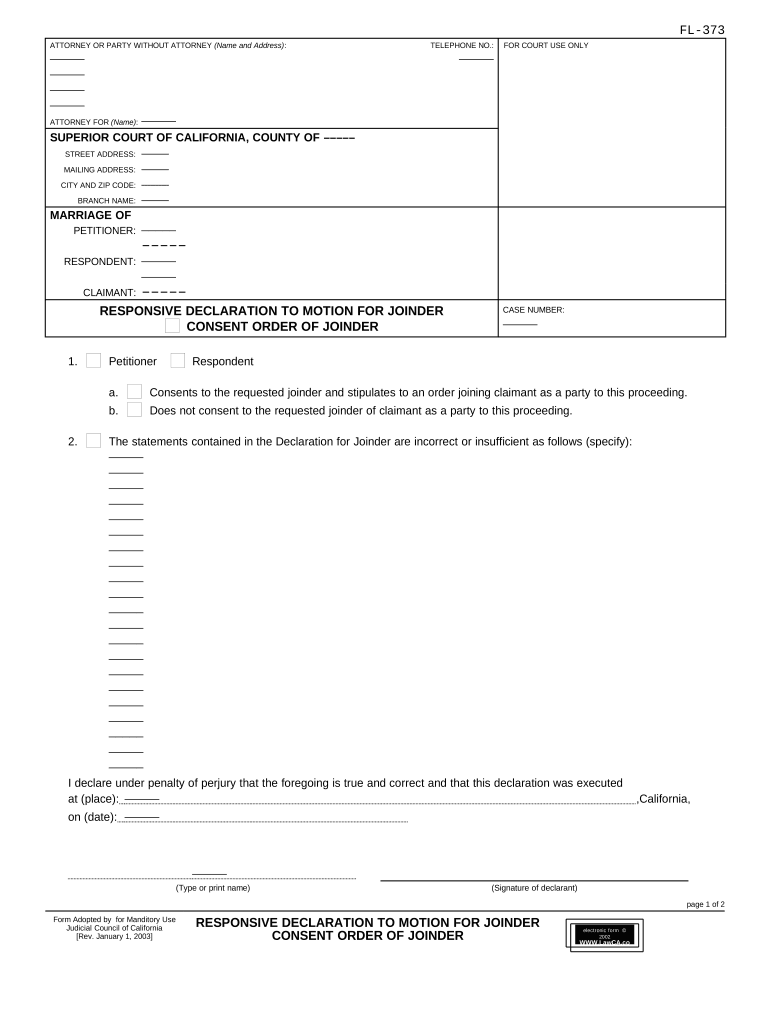
Case caption identifying court, parties, case number, and title of the motion; accuracy here ensures proper filing and docketing and avoids clerical rejection.
Notice of Motion

Statement of the motion's purpose, the requested hearing date or request to submit on papers, and the deadline for opposition under local rules.

Points and Authorities

Concise legal memorandum explaining statutory or rule-based grounds for joinder and relevant case law supporting why the court should grant the motion.

Supporting Declaration

One or more declarations under penalty of perjury presenting factual evidence establishing the proposed party's interest and the necessity or permissiveness of joinder.

Proposed Order

A draft order formatted for the judge that clearly states who is joined and any deadlines or obligations imposed on newly joined parties.

Proof of Service

Filed declaration or certificate showing timely service of the motion and supporting papers on all existing parties and the proposed joined party.

Step-by-Step: Preparing and Filing the Motion

Follow these steps in order to assemble a compliant motion package that the clerk will accept and that opposing parties can respond to.

  • 01
    Gather Case Info: Confirm caption, case number, and current docket status.
  • 02
    Draft Motion: Write notice, points and authorities, and proposed order.
  • 03
    Prepare Declarations: Attach factual declarations and label exhibits sequentially.
  • 04
    File and Serve: E-file with court and serve all parties per local rules.

How to Configure an Online Joinder Workflow

Set up a repeatable e-filing workflow to ensure consistent document formatting, attachments, and proof of service capture.

E-filing Provider Upload PDF to court e-filing portal or vendor used by the jurisdiction.
Document Format Use flattened PDF/A with bookmarked exhibits for reliability.
Signature Method Use authenticated eSignature or wet signature per local rules.
Service Method Select registered e-service, email if allowed, or process server.
Proposed Order Attach editable proposed order as separate PDF page for judge intake.

Where to File and Who to Notify

Filing and distribution follow the court's e-filing and service rules; check local rules for required timing and methods.

  • Court E-Filing: Submit the motion package via the court's electronic filing system or approved vendor.
  • Service on Parties: Serve all current parties and the proposed joined party by permitted service methods.
  • File Proof of Service: Upload or file the proof of service immediately after completing service.
  • Provide Proposed Order: Give the court a clean proposed order and a courtesy copy if required.

Technical Requirements for eFiling and eSubmission

Ensure documents meet the court's technical specifications for electronic submission and authentication before uploading.

  • File Format Support: PDF/A, flattened PDF preferred for exhibits and proposed orders.
  • Integration Options: Common integrations: court vendor portals, document management systems.
  • Authentication Methods: Email link, SMS code, or platform identity verification for signer attribution.

Common Deadlines and Timing Expectations

Local rules set opposition and reply deadlines; calendar hearing scheduling accordingly to avoid default timing conflicts.

Opposition Deadline:

Typically 14–30 days before hearing; check local rule for exact timing.

Reply Deadline:

Commonly 7–14 days before the hearing; earlier replies may be permitted.

Hearing Scheduling:

Hearing dates depend on court calendar; some courts accept submission on papers.

Proof of Service:

File immediately after service; late filing may affect consideration.

Continuance Requests:

Must be timely and often require meet-and-confer certification.

Key Milestones from Draft to Order

Track these milestones to monitor progress and anticipate hearing, opposition, and final order entry.

01

Draft Complete

Motion and supporting declarations finalized and reviewed.

02

E-File Submission

Documents submitted to the court and acceptance confirmed.

03

Service Complete

All parties, including proposed joined party, are served.

04

Order Entered

Court signs and files the order adding the party.

Frequent Preparation Errors to Avoid

  • Incomplete caption or wrong case number leads to clerical rejection and delays in docketing the motion.
  • Failing to attach a supporting declaration with factual detail weakens the motion and may prompt denial without a hearing.
  • Improper service on the proposed party or existing parties can render the joinder ineffective and subject to challenge.
  • Not checking local rules for required meet-and-confer or fee waivers can result in sanctions or rejected filings.

Consequences of Errors or Misjoinder

Denial of Motion: Court may deny joinder for procedural or substantive defects.
Delay in Case: Misfiled joinder can cause continuances and increased costs.
Sanctions Risk: Frivolous or untimely joinder motions may trigger sanctions.
Ineffective Service: Improper service can lead to default or dismissal complications.
Prejudice to Parties: Late joinder may prejudice existing parties and complicate trial preparation.
Fee Forfeiture: Incorrect fee payment or waiver errors can cause rejection.

Example Scenarios Where Joinder Is Appropriate

Two short examples show typical joinder use and how supporting materials are organized for court review.

Multi-Defendant Insurance Dispute

Plaintiff seeks to add an insurer with potential coverage obligations

  • Evidence: policy and correspondence exhibits
  • The motion attaches the policy and a declaration showing why the insurer's presence is necessary to resolve indemnity claims and avoid multiple suits.

Property Title Conflict

A lender and a prior grantor both claim interests in title

  • Evidence: recorded deeds and loan documents
  • The motion includes certified copies of recordings and a declaration explaining competing claims and why joinder prevents inconsistent judgments.

Best Practices for a Clear, Court-Ready Joinder Motion

Follow these practical drafting and procedural tips to improve acceptance and the likelihood of favorable judicial consideration.

Use a Clear Factual Roadmap
Organize declarations chronologically, label exhibits consistently, and summarize key facts in the opening paragraph of the motion so the judge can quickly grasp why joinder is required.
Cite Direct Authorities
Reference controlling statutes and case law concisely; avoid long doctrinal digressions and tie precedent directly to the stated facts and relief requested.
Confirm Service and E-Filing Rules
Verify the court's e-filing and service procedures before filing, including required cover sheets, proposed order formatting, and proof-of-service templates to avoid clerical rejections.
Prepare a Clean Proposed Order
Draft a narrowly tailored proposed order that specifies who is joined, any deadlines for the joined party, and how future pleadings should be captioned to minimize clerical edits by the court.

eSignature Vendor Comparison for Preparing and Submitting Joinder Documents

Choose an eSignature provider that supports secure PDF workflows, audit trails, and HIPAA or industry compliance where required; pricing and features differ across vendors.

signNow DocuSign Adobe Sign PandaDoc HelloSign
Starting Price $8/user/mo $15/user/mo $14/user/mo $19/user/mo $15/user/mo
Free Trial 7-day free trial Trial varies Trial varies Trial available Trial available
Bulk Send Yes Yes Yes Yes No
Audit Trail Yes Yes Yes Yes Yes
HIPAA Compliant Yes Yes Yes No No

Required Information to Include on the Motion

Case Caption: Court, parties, case number
Moving Party: Full legal name of movant
Proposed Party: Full legal name and entity type
Legal Grounds: Statutory or rule basis
Requested Relief: Exact joinder order language
Proof of Service: Method, date, and recipient list

FAQs About the California Motion for Joinder

Answers to common procedural and drafting questions when preparing a joinder motion in California or other U.S. jurisdictions.


Need help? Contact support

be ready to get more
Join over 28 million airSlate SignNow users