Establishing secure connection…Loading editor…Preparing document…

Motion to Set Hearing

This template is fully customizable. Edit the text, fill out the fields, and send it for signature. Give it a try!
Motion to Set Hearing

What a Motion to Set Hearing Is and When it’s Used

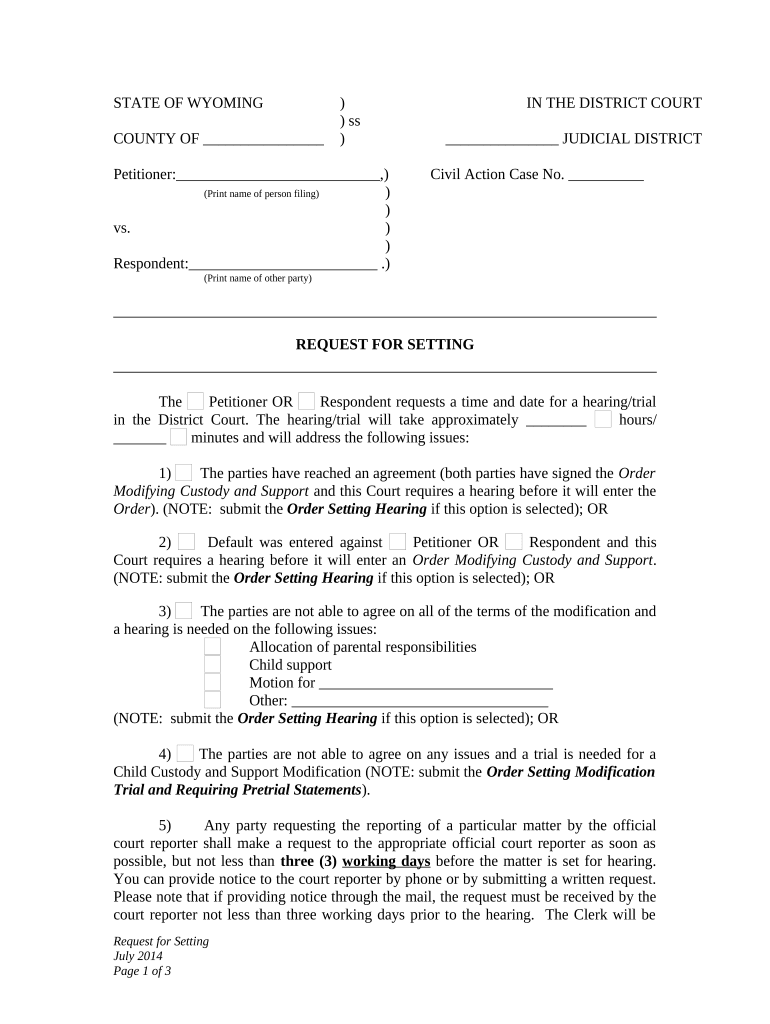
A Motion to Set Hearing is a formal written request submitted to a court asking the judge or clerk to schedule a hearing on a pending matter or motion. It identifies the moving party, the relief sought, the issues to be heard, and proposed hearing dates or windows. The Motion typically cites governing rules or statutes, states the grounds for expedited or standard scheduling, and explains service or notice provided to other parties. Courts may require local-format attachments, proof of service, and a proposed order setting the date and time.

Why Filing a Clear Motion to Set Hearing Matters

A well-prepared Motion to Set Hearing reduces delays, clarifies the scope of the hearing, and helps courts process calendar requests efficiently. Clear dates, service details, and a proposed order improve the chance of obtaining the slot you need and reduce the risk of continuances or rejection.

Why Filing a Clear Motion to Set Hearing Matters

Who Commonly Prepares and Files This Motion

Parties and counsel who need an in-court or remote hearing use this motion to ask the court to calendar an appearance.

  • Civil litigators and firm paralegals preparing hearing requests and proposed orders for judges.
  • Pro se parties who must request a hearing date and explain why court time is required.
  • Administrative or governmental attorneys scheduling agency or probate hearings where the court controls the calendar.

Filers should confirm local court rules for service, required attachments, and any form or electronic filing procedures before submitting.

Step-by-step: Preparing and Filing a Motion to Set Hearing

Follow these sequential steps to prepare, sign, serve, and file a Motion to Set Hearing with supporting materials.

  • 01
    Draft the Motion: State relief sought, legal basis, and preferred hearing dates.
  • 02
    Attach Exhibits: Include declarations, proposed order, and relevant exhibits.
  • 03
    Serve Parties: Serve opposing counsel per local service rules.
  • 04
    File and Confirm: E-file or submit paper copy and verify calendar entry.

How the calendar and filing flow typically proceeds

This sequence outlines the practical flow from drafting to confirmed hearing listing in most U.S. courts.

  • Prepare Filing: Draft motion, exhibits, proposed order, and certificate of service.
  • Sign and Execute: Attorney or party signs and dates the document before filing.
  • File with Court: Submit via the court's e-filing system or deliver a paper copy if required.
  • Clerk Schedules: Clerk assigns a hearing date or sets a calendar conference per local practice.

Configure an online workflow for this motion

Set up consistent fields and routing for rapid completion and e-filing when permitted by the court.

Field Configuration
Caption Pre-fill party and case number from case template
Hearing dates Require three date options in MM/DD/YYYY format
Proposed order Attach editable DOCX/PDF for clerk signature
Service checkbox Require selection of service method and date

Technical considerations for digital completion and filing

Confirm your court accepts e-filed motions and whether electronic signatures or scanned signatures are permitted.

  • File formats: PDF and DOCX are widely accepted
  • Authentication: Email, SMS, or account-based signer authentication
  • Integrations: Court ports and case management systems

When e-filing, maintain the native signed copy and the court-stamped filing receipt; check local rules for required headers or declaration wording.

Essential information to include on the motion

Case Number: Docket identifier
Party Names: Plaintiff and defendant
Relief Sought: What you are requesting
Proposed Dates: Three options suggested
Service Details: Method and date
Proposed Order: Attached for clerk signature

Key elements to include for a professional Motion to Set Hearing

Include these components to meet court expectations and speed calendaring decisions.

Clear Title

A concise document title clarifies the request for the clerk and judge and reduces processing delays when the caption matches the docket exactly.
Statement of Grounds

Briefly explain the legal and factual basis for the hearing request so the court can assess urgency and relevance without reading all attachments.

Proposed Schedule

Offering multiple specific dates and an estimated duration makes it easier for clerks to locate an available calendar slot and reduces continuances.

Exhibits and Declarations

Attach supporting affidavits or declarations that establish facts requiring live testimony or evidentiary hearing, formatted per local rules.

Proof of Service

Provide a certificate or declaration of service showing how and when opposing parties were notified to satisfy due process requirements.

Proposed Order

Supply a proposed order that includes lines for the hearing date, time, courtroom, and judge signature to simplify clerk processing.

Common mistakes to avoid when preparing the motion

  • Failing to follow local formatting rules, which can result in the clerk rejecting the filing or requiring correction.
  • Providing vague or unavailable hearing dates, which forces the court to continue the matter or deny expedited scheduling.
  • Omitting proof of service or failing to show notice to all required parties, potentially rendering the motion procedurally defective.
  • Not attaching a proposed order, increasing administrative work for the clerk and delaying entry of a hearing date.

Consequences of incorrect or incomplete motions

Denial or Delay: Hearing not scheduled
Sanctions Risk: Possible monetary or procedural sanctions
Default Exposure: Unopposed relief may be granted
Wasted Fees: Filing and service costs lost
Evidence Exclusion: Late exhibits may be barred
Refile Burden: Additional work and delay

Comparing eSignature vendors for executing and routing the Motion to Set Hearing

Basic vendor comparisons help budget for e-signature and workflow features used to prepare, sign, and share court filings; signNow appears first for direct comparison.

signNow DocuSign Adobe Sign PandaDoc HelloSign
Starting Price $8/user/mo $15/user/mo $14/user/mo $19/user/mo $15/user/mo
Free Trial 7-day free trial Varies by plan Varies by plan Varies by plan Varies by plan
Bulk Send Yes Yes Yes Yes Yes
Audit Trail Yes Yes Yes Yes Yes
HIPAA Compliant Yes Yes Yes No No

Practical examples of when you’d file this motion

Two short scenarios illustrate common reasons to request a scheduled hearing rather than seek relief on written papers alone.

Landlord-Tenant Dispute

A landlord seeks possession and requests an expedited hearing due to safety concerns

  • Court schedules a 30-minute hearing on an emergency basis
  • The motion includes an affidavit, photos, proposed order, and proof of service to support the expedited calendar request.

Discovery Dispute

Counsel requests a hearing to resolve a discovery impasse that affects trial timing

  • The parties provide three mutually available dates and time estimates
  • The motion attaches relevant emails, a conferral declaration, and a proposed order to streamline the court’s scheduling decision.

Frequently asked questions about Motions to Set Hearing

Answers to common procedural and technical questions about preparing, signing, and filing these motions.


Need help? Contact support

be ready to get more
Join over 28 million airSlate SignNow users