Establishing secure connection…Loading editor…Preparing document…

Motion for Summary Judgment

This template is fully customizable. Edit the text, fill out the fields, and send it for signature. Give it a try!
Motion for Summary Judgment

What a Motion for Summary Judgment Is and when it’s used

A Motion for Summary Judgment asks a court to decide all or part of a case without a trial because there is no genuine dispute of material fact and the moving party is entitled to judgment as a matter of law. In federal courts the motion is governed by Federal Rule of Civil Procedure 56; state courts apply their own summary judgment rules, often modeled on Rule 56. The motion relies on the existing record—depositions, affidavits, documents, and admissions—to show the absence of a triable factual issue and typically follows the close of discovery.

Why filing a Motion for Summary Judgment matters

A successful motion can resolve part or all of a case without trial, reducing litigation cost and delay. It narrows issues for trial, forces focused discovery on remaining disputes, and can produce a definitive ruling on legal questions before further expense is incurred.

Why filing a Motion for Summary Judgment matters

Who typically prepares and files this motion

Parties use the motion strategically to conserve resources and focus trial preparation on genuinely disputed issues.

  • Plaintiffs’ counsel seeking to eliminate defenses or secure full relief early.
  • Defense counsel asking to dismiss claims lacking factual support.
  • In-house legal teams coordinating evidentiary exhibits and declarations.

Core components to include in a professional motion

A complete motion combines a concise legal argument with a clear presentation of undisputed facts and admissible evidence so the court can rule without a trial.

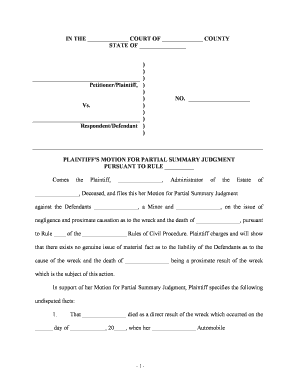
Case Caption

Complete caption including court, docket number, parties, and judge to ensure proper filing and docketing.
Statement of Facts

A numbered, concise statement of undisputed material facts with citations to specific record evidence and exhibit references.

Legal Standard

Short section stating the governing law (e.g., Fed. R. Civ. P. 56) and the burden of proof for summary judgment.

Evidence Exhibits

Sequentially labeled exhibits (depositions, documents, records) in PDF format with exhibit index and Bates or page ranges.

Affidavits / Declarations

Signed, admissible declarations under penalty of perjury establishing facts that require testimonial support.

Proposed Order

A short, plainly worded proposed order the judge can enter if the motion is granted, formatted for e-filing.

Essential information to include on every motion

Court Name: Full court title
Docket Number: Assigned case number
Party Names: Plaintiff(s) and Defendant(s)
Statement of Facts: Numbered facts with cites
Exhibit Index: PDF file list and labels
Signature Block: Attorney name, bar number

Step-by-step: preparing and filing the motion

Follow a disciplined sequence from record review to service and docketing to reduce procedural errors and opposition opportunities.

  • 01
    Gather Record: Collect deposition transcripts, discovery responses, and documents supporting facts.
  • 02
    Draft Motion: Write legal argument, facts, and citations; prepare exhibit attachments.
  • 03
    Finalize Evidence: Assemble exhibits as bookmarked PDFs and add sworn declarations.
  • 04
    File and Serve: E-file with the court and serve opposing counsel per local rules.

Configuring an online workflow for submission and service

Map the e-filing and service steps into a reproducible digital workflow that handles attachments, signer auth, and certificate generation.

Field Configuration
eSignature Placement Place signature block on final page; include signer role
Signer Authentication Use email or SMS code for attorney attribution
Exhibit Packaging Combine exhibits into a single bookmarked PDF
eFiling Output Generate court-ready PDF/A with certificate

Technical considerations for electronic submission

Ensure the chosen workflow preserves an audit trail showing signer identity, timestamps, and a certificate of completion for future challenges or appeals.

  • File Formats: PDF, PDF/A preferred
  • Integrations: Court e-file systems and cloud storage
  • Security: TLS in transit; AES-256 at rest

Where to file and how service is completed

Filing and service follow court-specific rules; confirm local e-filing systems and certificate-of-service formats before submission.

  • Court E-Filing: File via the court’s e-file portal or local filing clerk as required
  • Opposing Service: Serve opposing counsel electronically or by methods authorized in local rules
  • Certificate of Service: Attach a signed certificate indicating how and when service occurred
  • Docketing: Confirm acceptance and docket entry after e-file submission

Typical timing and response windows to plan for

Timing for filing and opposition varies by jurisdiction; use local rules and the court’s scheduling order to calculate precise deadlines.

Motion Timing:

Often filed after discovery closes; check local scheduling orders

Opposition Deadline:

Commonly 14–21 days after service; local rules control

Reply Deadline:

Often 7–14 days after opposition is filed

Hearing Scheduling:

Court sets hearing date or rules on briefs without oral argument

Local Rule Variations:

Always verify the district or state court rules

Key milestones from discovery to court ruling

Track these sequential stages to meet procedural prerequisites and evidence deadlines.

01

Discovery Complete

Finalize depositions and document production before filing.

02

Motion Filed

File and serve motion with exhibits and certificate of service.

03

Opposition Filed

Receive and review opponent’s factual and legal responses.

04

Reply and Hearing

Submit reply brief; attend hearing if scheduled.

Common drafting and procedural mistakes to avoid

  • Relying on inadmissible evidence like hearsay without supporting affidavits or foundation.
  • Submitting an unnumbered fact statement that doesn’t map to cited exhibits and page ranges.
  • Failing to comply with local formatting or page limits, resulting in motion rejection or strike.
  • Neglecting a timely certificate of service or incorrect service method under local rule.

Risks and potential sanctions for procedural or substantive errors

Motion Denied: Court may deny summary relief.
Sanctions: Court can impose fees or sanctions for frivolous filings.
Evidence Excluded: Improper evidence may be stricken.
Waiver: Failing to preserve issues can waive arguments.
Cost Awards: Court may award opposing fees and costs.
Prejudice: Errors can harm trial strategy and credibility.

How summary judgment differs from other pretrial motions

Compare common procedural tools so you can choose the right pretrial motion for the situation.

Criteria Summary Judgment Motion to Dismiss
Primary focus no disputed facts pleading sufficiency
Fact record required
Evidence considered admissible evidence allegations only
Typical timing post-discovery early pre-answer

Typical eSignature vendor comparison for filing and service workflows

Basic pricing and feature availability for common eSignature providers used when assembling, signing, and serving motions. Confirm current plans with each vendor directly.

signNow DocuSign Adobe Sign PandaDoc HelloSign
Starting Price $8/user/mo $15/user/mo $14/user/mo $19/user/mo $15/user/mo
Free Trial 7-day trial Varies Varies Varies Varies
Bulk Send Yes Varies Varies Varies Varies
Audit Trail Yes Yes Yes Yes Yes
HIPAA Compliant Yes Varies Varies Varies Varies

Frequently asked questions about Motions for Summary Judgment

Answers to common procedural and evidence questions encountered when drafting, filing, and defending a Motion for Summary Judgment.


Need help? Contact support

be ready to get more
Join over 28 million airSlate SignNow users