Establishing secure connection…Loading editor…Preparing document…

Motion to Compel for Attorneys' Fees and Expenses

This template is fully customizable. Edit the text, fill out the fields, and send it for signature. Give it a try!
Motion to Compel for Attorneys' Fees and Expenses

What the Motion to Compel for Attorneys' Fees and Expenses Is

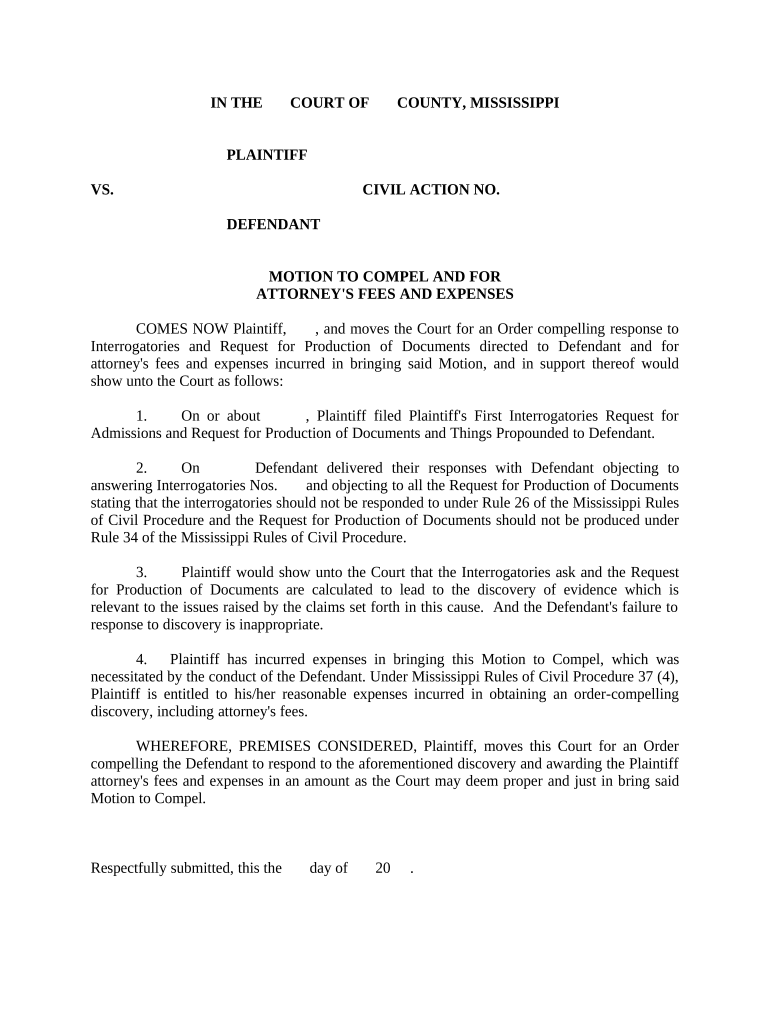
A Motion to Compel for Attorneys' Fees and Expenses is a court filing that asks a judge to order an opposing party to pay legal fees, costs, or other litigation expenses. It is typically grounded in statute, contract, or court rule that permits fee shifting when a party prevails or when the other side has acted unreasonably. The motion attaches supporting evidence (invoices, time records, declarations) and a proposed order. Courts evaluate entitlement, reasonableness, and proportionality before awarding fees and may reduce or deny amounts that are excessive or insufficiently documented.

Why This Motion Matters to Your Case

A properly prepared motion clarifies the legal basis for fee recovery, documents incurred expenses, and helps recover costs that would otherwise be borne by the prevailing party. It protects contractual fee-shifting rights and can deter meritless litigation by shifting financial risk.

Why This Motion Matters to Your Case

Who Typically Prepares and Files This Motion

The motion is most often used by litigators and parties seeking fee recovery after discovery disputes, summary judgment, or trial where a statutory or contractual basis exists.

  • Plaintiff's counsel seeking contract or statutory fees
  • Defense counsel pursuing sanctions or reciprocal fee awards
  • Self-represented litigants asserting entitlement under contract

Who Signs and Submits the Motion

Civil Plaintiff Attorney

A licensed attorney of record signs the motion, certifies billing and reasonableness, and files under local civil rules. Counsel attaches time entries and a supporting declaration to establish entitlement and amounts sought.

In-House Counsel

In-house counsel may prepare or approve a fee submission but typically partners with outside counsel to provide detailed billing records and a declaration attesting to hours and rates when required by the court.

Security and Compliance Considerations for Supporting Documents

Encryption Transit: TLS 1.2/1.3
Encryption Rest: AES-256
HIPAA Capability: BAA available
ESIGN / UETA: Compliant
SOC 2 Type II: Certified
Audit Trails: Detailed logs

Risks and Consequences of Errors

Denial of Fees: Insufficient documentation
Sanctions: Improper conduct
Reduction: Unreasonable rates or hours
Fee Shifting: Unfavorable cost allocation
Late Filing: Procedural bar
Service Defects: Invalid service may void motion

Common Pitfalls to Avoid When Preparing the Motion

  • Failing to tie each time entry to specific tasks or discrete litigation activities undermines reasonableness and can lead to large reductions by the court.
  • Submitting raw billing without a supporting declaration that explains rates, the experience of attorneys, and redactions for privilege often results in an award denial.
  • Over-claiming paralegal or administrative time as attorney time is frequently disallowed; segregate nonrecoverable clerical tasks from recoverable legal services.
  • Neglecting local rule formats, word limits, or required meet-and-confer certifications may result in rejection or sanctions under court procedural rules.

Step-by-Step: Preparing and Filing the Motion

Follow a clear sequence from entitlement analysis through filing, service, and hearing preparation to improve procedural compliance and evidentiary support.

  • 01
    Confirm Entitlement: Identify statutory or contractual fee-shifting basis.
  • 02
    Compile Records: Assemble time sheets, invoices, and receipts.
  • 03
    Draft Motion: Explain legal grounds, calculation, and reasonableness.
  • 04
    File & Serve: File under local e-filing rules and serve parties.

Where and How to Submit the Motion

Select the correct court division and follow local e-filing, service, and calendaring procedures to avoid procedural defects and ensure timely adjudication.

  • State Court Filing: Use county civil e-filing or clerk's office per local rules.
  • Federal Court Filing: E-file via CM/ECF and comply with local rules and form requirements.
  • Service of Process: Serve opposing counsel per rules, typically electronic service permitted.
  • Hearing Notices: Calendar via court system; include proof of service.

How to Configure an Online Workflow for the Motion

Set up a digital workflow that collects signatures, attaches exhibits, and records an auditable trail for each submission and signer.

Field Configuration
Document Template Use a reusable motion template with merge fields.
Signature Blocks Place attorney signature and date fields; enable signer authentication.
Exhibit Attachment Attach invoices and declarations as separate, bookmarked PDFs.
Audit Trail Enable timestamping, IP capture, and version history.

Digital Tools and Integration Needs

Choose a platform that supports secure document storage, audit trails, role-based signing, and common integrations for case management and e-filing.

  • Integrations: Salesforce, NetSuite, Microsoft 365 support
  • Formats: PDF, DOCX, and bookmarked exhibits
  • Authentication: Email, SMS, or advanced MFA options

Typical Timing and Scheduling Expectations

Deadlines vary by jurisdiction and the underlying rule that authorizes fee recovery; consult local rules and the case scheduling order early in the process.

Meet-and-Confer Period:

Often required 7–14 days before filing by some local rules.

Response Window:

Opposition often due 14–21 days after service, per local rules.

Hearing Scheduling:

Courts typically set hearings 21–90 days after filing.

Post-Order Payment:

Payment deadline varies; some orders set 14–30 days to pay.

Appeal Timing:

Appeal or motion for reconsideration deadlines follow local appellate rules.

Key Milestones from Preparation to Ruling

Track milestones from drafting through service, opposition, hearing, and final order to ensure compliance and readiness at each procedural stage.

01

Draft and Review

Complete motion, exhibits, and counsel declaration with billing detail.

02

Meet and Confer

Attempt resolution and certify efforts before filing if required.

03

File and Serve

E-file in the clerk's system and serve opposing counsel.

04

Hearing and Ruling

Attend the hearing; court issues order on entitlement and amount.

Core Components to Include in a Professional Motion

A complete motion presents entitlement, a detailed fee calculation, supporting exhibits, and a proposed order so the court can evaluate both the legal basis and the reasonableness of amounts sought.

Case Caption

Complete caption with court, parties, and docket number; establishes the motion's procedural context and ensures clerk acceptance.
Statement of Entitlement

Cite statute, contract clause, or rule authorizing fee recovery and briefly summarize why the movant qualifies as a prevailing party.

Detailed Billing

Provide time entries, attorney rates, and task descriptions, with privilege redactions clearly marked and explained in a cover declaration.

Declaration of Counsel

Include a sworn declaration attesting to accuracy of records, hourly rates, and efforts to meet and confer with opposing counsel before filing.

Fee Calculation

Show lodestar math or statutory calculation, itemize taxable costs, and explain any upward or downward adjustments.

Proposed Order

Attach a clean proposed order specifying award amounts, payment timing, and judgment language for the court to sign.

eSignature Vendor Comparison for Managing Fee Motions and Exhibits

Select an eSignature vendor that supports secure PDFs, audit trails, and integrations with case management tools; the table below compares common pricing and compliance features.

signNow DocuSign Adobe Sign PandaDoc HelloSign
Starting Price $8/user/mo $15/user/mo $14/user/mo $19/user/mo $15/user/mo
Free Trial Yes, 7-day free trial, no credit card Varies by vendor Varies by vendor Varies by vendor Varies by vendor
Bulk Send Yes (available on higher tiers) Varies by vendor Varies by vendor Varies by vendor Varies by vendor
Audit Trail Yes Yes Yes Yes Yes
HIPAA Compliant Yes Yes Yes No No

Frequently Asked Questions About This Motion

Answers to common practical and procedural questions to help you avoid defects, support entitlement, and use electronic tools correctly when preparing a motion for fees and expenses.


Need help? Contact support

be ready to get more
Join over 28 million airSlate SignNow users