Establishing secure connection…Loading editor…Preparing document…

Warning – Unauthorized Roommates

This template is fully customizable. Edit the text, fill out the fields, and send it for signature. Give it a try!
Warning – Unauthorized Roommates

What the Warning – Unauthorized Roommates Is

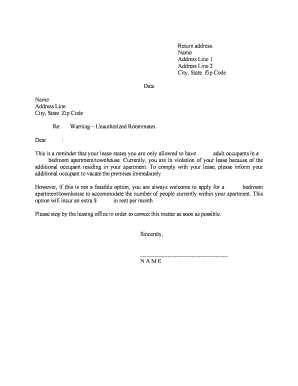
A Warning – Unauthorized Roommates is a written notice landlords or property managers use to inform a tenant that an additional occupant is residing in the rental unit without prior authorization under the lease or rental agreement. It documents the alleged violation, states the lease clause breached, requests corrective action or removal by a specified date, and preserves evidence for potential lease enforcement or eviction proceedings.

Why this notice matters for landlords and managers

Issuing a clear written warning creates a dated record, gives the tenant an opportunity to cure the violation, and preserves your position if further remedies are necessary. It also demonstrates consistent enforcement of lease terms and protects property rules and safety standards.

Why this notice matters for landlords and managers

Who typically issues a Warning – Unauthorized Roommates

The notice is also used by housing authorities and legal counsel preparing an enforcement path if the issue is not resolved.

  • Private landlords enforcing a written lease against unauthorized occupants and protecting occupancy limits.
  • Property managers handling multiple units who must document lease breaches consistently across properties.
  • Student housing administrators enforcing campus housing contracts and roommate eligibility rules.

Who can sign or issue the notice

Property Manager

A property manager or on-site representative authorized by the owner may prepare and sign the warning. Their signature should include printed name, title, and contact information; unauthorized or unsigned notices are weaker evidence in later proceedings.

Owner / Landlord

The landlord or property owner can issue the notice directly. When legal action follows, courts typically expect the notice to show it came from an authorized party and to include the landlord’s mailing address for service.

Essential security and record items to include

Date of Notice: MM/DD/YYYY
Tenant Name: Full legal name
Unit Address: Street, city, state, ZIP
Lease Clause: Specific clause cited
Corrective Deadline: MM/DD/YYYY
Issuer Contact: Name and phone

Common problems that weaken a warning letter

  • Vague or missing dates: failing to provide a clear date of discovery or cure deadline can undermine enforceability and make proof in court difficult.
  • Incomplete identification: omitting the tenant’s full legal name, unit number, or precise lease clause creates ambiguity about who is accused and what rule was violated.
  • Poor delivery proof: not documenting how the notice was delivered (mail, personal service, posting) reduces admissible evidence of proper notice in later proceedings.
  • Contradictory lease records: inconsistent lease versions or prior verbal waivers may permit the tenant to argue permission was granted, weakening the landlord’s case.

Consequences and legal risks of issuing or failing to issue a proper warning

Lease forfeiture: Possible termination
Eviction filing: Court process may follow
Damages claim: Rent or repair costs
Tenant defenses: Improper notice defenses
Administrative fines: Local code penalties
Legal fees: Potential litigation costs

Real-world examples of how the warning is used

The following scenarios show typical contexts where a Warning – Unauthorized Roommates protects lease rights and documents required steps.

Private Landlord Case

A landlord discovers a third adult living in a one-bedroom unit without approval.

  • The lease requires written consent for additional occupants.
  • The landlord issues a dated warning, gives a 14-day cure period, documents delivery, and preserves messages and photos for possible eviction court filing.

Student Housing Example

A resident advisor learns a non-authorized guest has been sleeping over regularly.

  • Campus housing policy prohibits unauthorized cohabitation.
  • Housing staff issue a written warning, notify the student of potential removal from housing, and record follow-up inspections and communications.

Step-by-step: preparing and sending the warning

Follow these steps to prepare a clear, legally defensible Warning – Unauthorized Roommates.

  • 01
    Document the facts: Record dates, times, photos, and witness names.
  • 02
    Identify the lease provision: Quote the exact clause being violated.
  • 03
    State required remedy: Specify removal or cure and exact deadline.
  • 04
    Deliver and retain proof: Send via tracked mail or personal service and keep receipts.

How the warning fits into the enforcement workflow

This sequence shows the typical routing and next steps after issuing the notice.

  • Notice issued: Landlord prepares and dates the warning.
  • Delivery method: Send via certified mail or in-person service.
  • Tenant response: Tenant cures, denies, or fails to respond.
  • Follow-up action: File eviction if cure is not completed.

Configuring an electronic workflow for warnings

Use an e-signature workflow to create, send, and archive notices consistently across properties.

Field Configuration
Document template Standardized warning letter template with merge fields
Signer roles Owner or manager as issuer; tenant as recipient
Delivery options Email with read receipt, certified mail, or personal service
Archive location Secure cloud folder with versioning

Technical considerations for electronic delivery

Retain signed copies and logs; ensure the platform you select can export reliable admissible records for court if matters escalate.

  • Authentication: Email link or SMS code options
  • Audit trail: IP, timestamp, and action log
  • Document formats: PDF, DOCX supported

Comparing eSignature providers for notices

A concise comparison focused on pricing and core capabilities relevant to sending and tracking Warning – Unauthorized Roommates notices.

signNow DocuSign Adobe Sign PandaDoc HelloSign
Starting Price $8/user/mo $15/user/mo $14/user/mo $19/user/mo $15/user/mo
Free Trial 7-day free trial Varies by vendor Varies by vendor Free limited plan Free limited plan
Bulk Send Yes Yes Yes Yes No
Audit Trail Yes Yes Yes Yes Yes
HIPAA Compliant Yes Yes Yes No No

Typical timelines and deadlines to include in the notice

Specify concrete dates and cure periods to avoid ambiguity and reduce tenant defenses.

Date Issued:

Include the exact MM/DD/YYYY the notice was delivered.

Date of Discovery:

Record when the unauthorized occupancy was first observed.

Cure Period:

Specify a deadline, commonly 3–14 days unless lease or local law requires otherwise.

Failure Deadline:

State the date after which enforcement steps may begin, such as eviction filing.

Record Retention:

Note how long you will keep records for legal purposes.

Key elements to include in a professional warning letter

A complete warning letter balances clear factual detail, legal citation, and practical resolution steps to preserve enforceability.

Clear identification

Identify the tenant and unit precisely, include lease start date and full legal names to avoid misidentification and conflicting records during enforcement.
Specific allegation

Describe the unauthorized occupancy factually — dates, observed behavior, evidence types (photos, witness statements) — avoiding speculation or inflammatory language.

Lease citation

Quote the exact lease clause that prohibits additional occupants or requires landlord consent, so the tenant understands the contractual basis for the warning.

Required remedy

State the exact action required (remove occupant, obtain written consent) and the precise deadline for compliance in MM/DD/YYYY format.

Delivery and proof

Record the method of delivery and retain proof (certified mail receipt, signed acknowledgment, or electronic audit trail) for court admissibility.

Consequences stated

Clearly describe follow-up steps for noncompliance, such as lease termination or eviction filing, including any applicable fee or damage claims.

Practical tips for drafting effective warnings

Use neutral language, document thoroughly, and follow lease and local rules to reduce dispute risk.

Use objective, factual wording
Avoid accusatory phrasing; state observable facts, dates, and evidence types. Neutral language reduces the chance of escalation and preserves credibility in court.
Confirm delivery procedures
Follow your lease’s notice requirements for service and keep proof. If electronically delivered, capture audit data showing recipient access and any signature events.
Keep consistent records
Maintain a chronological file with photos, inspection logs, tenant communications, and witness statements to support chronology and the landlord’s reasonable actions.
Coordinate with counsel when needed
For complex or contested situations consult an attorney before filing eviction to confirm statutory compliance and avoid procedural dismissals.

Key milestones after issuing the warning

Track milestones from issuance through potential enforcement to maintain a defendable timeline.

01

Issue Notice

Date the notice and send via documented delivery immediately after discovery.

02

Tenant Response Window

Allow the stated cure period for removal or written consent actions.

03

Verify Compliance

Inspect or obtain confirmation that the unauthorized occupant has been removed or authorized.

04

Proceed to Enforcement

If not cured, prepare documentation to start court filing or lease termination steps.

Frequently asked questions about issuing and enforcing warnings

Answers to common practical and legal questions about Warning – Unauthorized Roommates notices and electronic delivery.


Need help? Contact support

be ready to get more
Join over 28 million airSlate SignNow users