Establishing secure connection…Loading editor…Preparing document…

Motion to Enforce Settlement

This template is fully customizable. Edit the text, fill out the fields, and send it for signature. Give it a try!
Motion to Enforce Settlement

What a Motion to Enforce Settlement Is and When it’s Used

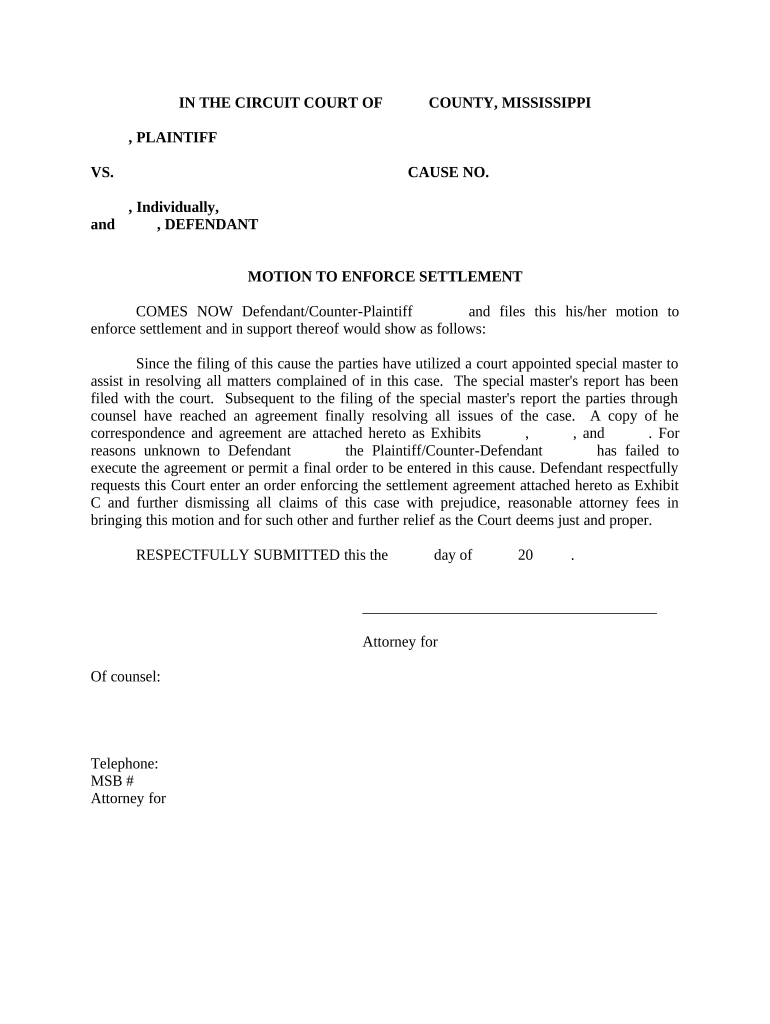
A Motion to Enforce Settlement is a court filing asking a judge to give effect to a previously reached settlement when one party refuses to comply, delays performance, or disputes the agreed terms. The motion relies on the settlement agreement, related correspondence, and any supporting exhibits to show the parties agreed on specific obligations and that court intervention is necessary to carry them out. Remedies the court may grant include entry of judgment, specific performance, or other relief consistent with the settlement terms. Motions to enforce are used in civil litigation across state and federal courts and depend on local rules and the agreement’s evidentiary record.

Why Filing a Motion to Enforce Settlement Matters

A properly drafted motion provides a focused path to compel performance or obtain a judgment without commencing a new full-blown lawsuit.

Why Filing a Motion to Enforce Settlement Matters

Who Typically Prepares or Signs a Motion to Enforce Settlement

The motion is usually drafted and filed by litigation counsel, though parties may prepare a pro se motion in some jurisdictions.

  • Litigators and law firms handling civil disputes, focusing on contract or tort settlements.
  • In-house counsel or corporate legal teams enforcing commercial settlement obligations.
  • Self-represented litigants in simple matters where formal counsel is not retained.

Who Signs and Why

Plaintiff/Movant

The party seeking enforcement; typically signs or authorizes the motion through counsel. The movant must attach the settlement, identify the breached provisions, and request specific relief from the court to enforce the agreement.

Attorney

The filing attorney signs and certifies the motion under local rules. Counsel prepares declarations or affidavits, ensures procedural compliance, and represents the movant at any enforcement hearing.

Required Document Elements and Security Considerations

Case Caption: Complete court and case identifiers
Settlement Attachment: Signed settlement agreement
Declaration: Fact witness or counsel affidavit
Service Proof: Certificate of service
E‑signature Evidence: Audit trail or signer attribution
Data Protection: Encrypted storage and access controls

Legal Risks and Potential Sanctions for Errors

Rule 11 Sanctions: Sanctions for frivolous or false filings (Fed. R. Civ. P. 11)
Contempt Risks: Court may hold a party in contempt for disobeying enforcement orders
Costs and Fees: Movant may seek fees; court may deny or shift costs
Evidence Exclusion: Improper proof can be excluded at hearing
Delay Consequences: Late filing can limit remedies or relief
Forged Signatures: Forgeries expose parties to criminal and civil liability

Common Pitfalls to Avoid When Preparing the Motion

  • Attaching an unsigned or redlined agreement that does not clearly show final consent; courts generally require the executed document.
  • Failing to include a declaration or affidavit that demonstrates the other party’s nonperformance and the movant’s attempts to resolve the issue.
  • Using vague or inconsistent drafting that omits the specific clause alleged to be breached, which weakens enforceability.
  • Neglecting local court rules for service, format, or required meet-and-confer certifications can result in denial or sanctions.

Key Parts of a Professional Motion to Enforce Settlement

A motion to enforce is strongest when it is concise, supported by authenticated exhibits, and tied to precise relief requests that the court can enter as an order or judgment.

Caption

Clear court, case number, and party names to ensure the document is docketed correctly and linked to the underlying litigation.
Statement of Facts

A chronological summary describing settlement negotiations, the executed agreement, and the specific breach or non‑compliance events.

Legal Argument

Concise legal grounds explaining why the court has authority to enforce the agreement, including citations to local rules and governing law.

Relief Requested

Specific remedies requested—entry of judgment, specific performance, enforcement of release, or monetary damages as shown by the record.

Exhibits

Executed settlement, correspondence, payment records, and any eSignature audit trails showing who signed and when.

Service & Certificate

Proof that opposing parties and relevant stakeholders were properly served under court rules.

Step-by-Step: Preparing and Filing the Motion

Follow the sequence below to prepare a coherent, court-ready motion supported by admissible evidence and compliant with local rules.

  • 01
    Gather Evidence: Collect the executed settlement, communications, and payment records.
  • 02
    Draft Motion: State facts, cite law, and specify requested relief clearly.
  • 03
    Attach Declarations: Include sworn statements confirming breach and attempts to resolve.
  • 04
    File and Serve: File with the clerk and serve opponents per local rules.

How Enforcement Proceeds Once the Motion Is Filed

Enforcement typically follows filing, service, possible opposition or reply briefing, then hearing or order entry based on the submitted record.

  • Filing: Case clerk dockets the motion.
  • Opposition: Opposing party may respond in writing.
  • Hearing: Court may schedule oral argument.
  • Order: Court issues judgment or directive to enforce.

Digital Workflow Settings for eSubmission and Service

Configure your eSigning and filing workflow so the motion, exhibits, and proof of service remain linked, time-stamped, and auditable.

Field Configuration
Authentication Method Use email plus SMS or ID verification where required
Document Formats Submit PDFs; include searchable text for exhibits
Audit Trail Capture Record timestamps, IP, and signer attribution
Export Settings Embed certificate of completion with each signed PDF

Technical Requirements for eSigning and eFiling

Use a platform that preserves audit trails, supports court-acceptable PDF output, and enables secure signer authentication.

  • PDF Output: ISO 32000-compatible signed PDFs
  • Authentication: Email link, SMS code, or ID verification
  • Integrations: Court eFiling or document management systems

eSignature Vendor Pricing Snapshot for Motion Evidence (signNow listed first)

This snapshot compares starting price and common capabilities relevant to preparing enforceable, auditable settlement evidence for court submission.

signNow DocuSign Adobe Sign PandaDoc HelloSign
Starting Price $8/user/mo $15/user/mo $14/user/mo $19/user/mo $15/user/mo
Free Trial 7-day free trial Varies by vendor Varies by vendor Varies by vendor Varies by vendor
Bulk Send Yes Yes Yes Yes No
Audit Trail Yes Yes Yes Yes Yes
HIPAA Compliant Yes Yes Yes No No

Timing and Deadline Considerations

Deadlines for motions to enforce depend on local civil rules, prior orders, and whether a new complaint or new docket entry is needed.

Prompt Filing:

File promptly after a material breach or refusal to perform

Local Rules:

Check court-specific deadlines for motion length, service, and response times

Hearing Scheduling:

Hearing dates are set per court calendar and rule-based notice periods

Service Timing:

Serve opponents according to rule timelines to avoid procedural defects

Post-Order Deadlines:

Comply with any deadlines the court sets for compliance or turnover

Key Milestones in the Enforcement Process

A typical enforcement timeline includes discrete stages from documentation to order entry and possible post-order collection steps.

01

Settlement Executed

Document the signed agreement and terms requiring performance

02

Noncompliance Identified

Record dates, communications, and missed obligations

03

Motion Filed

File motion with supporting exhibits and certificate of service

04

Order or Judgment

Court decides and enters enforcement order or judgment

How a Motion to Enforce Settlement Differs from a Consent Decree

Comparing enforcement tools clarifies expectations: a motion enforces an existing private settlement, while a consent decree converts settlement terms into a judicial order.

Criteria Motion to Enforce Consent Decree
Purpose enforce private agreement convert agreement to court order
Procedure motion practice negotiation plus court approval
Typical Outcome judgment or directive court-supervised order
Appealability appealable as order often immediately enforceable

Frequently Asked Questions About Motions to Enforce Settlement

Answers to frequent procedural and evidentiary questions help avoid common mistakes when seeking court enforcement of a settled dispute.


Need help? Contact support

be ready to get more
Join over 28 million airSlate SignNow users