Establishing secure connection…Loading editor…Preparing document…

Motion Venue Form

This template is fully customizable. Edit the text, fill out the fields, and send it for signature. Give it a try!
Motion Venue Form

What the Motion Venue Form is and when it’s used

A Motion Venue Form is a court filing that asks a judge to transfer or change the venue for a pending case. It sets out the factual and legal basis for moving venue, identifies the current and proposed forum, cites controlling statutes or rules, and requests relief such as dismissal, transfer, or change of venue for convenience or jurisdictional reasons. The form is typically accompanied by supporting affidavits, a proposed order, and proof of service so the court and opposing parties can review the grounds before a hearing.

Why a clear, compliant Motion Venue Form matters

A properly prepared Motion Venue Form focuses the court on jurisdictional facts and statutory grounds, reduces the risk of procedural dismissal, and preserves objections to venue. Clear presentation speeds judicial review and minimizes briefing disputes.

Why a clear, compliant Motion Venue Form matters

Who typically prepares and signs a Motion Venue Form

Attorneys and self-represented litigants complete this form when contesting or seeking a change of venue.

  • Civil litigators and defense counsel who need to relocate proceedings for convenience or proper jurisdiction.
  • Plaintiffs or defendants in commercial disputes where contract venue clauses or forum non conveniens are contested.
  • In-house counsel and compliance teams coordinating multi-jurisdiction litigation or enforcement actions.

Courts expect the form to be supported by fact declarations and a proposed order; service rules must be followed to avoid waiver.

Step-by-step: preparing and filing the Motion Venue Form

Follow these steps to prepare a motion that complies with court rules and preserves venue objections.

  • 01
    Draft the motion: State facts, statutory grounds, and requested relief concisely.
  • 02
    Attach affidavits: Include sworn declarations supporting key factual claims.
  • 03
    Prepare proposed order: Provide an order ready for the judge’s signature.
  • 04
    Serve parties: Serve per local rules and file proof of service with the court.

Typical routing and review process in court

A Motion Venue Form moves through defined procedural stages; knowing each step helps avoid delays.

  • Filing: File the motion with the clerk and obtain a filing stamp.
  • Service: Serve all counsel and file proof of service promptly.
  • Response: Opposing parties may file a written response per local timelines.
  • Hearing: Court schedules oral argument or decides on papers.

Digital workflow configuration for online completion

Set up an e-filing and signature workflow to streamline drafting, approvals, and court submission.

Field Configuration
Upload Format PDF or DOCX accepted by most e-filing systems
Signature Type Electronic signature with audit trail preferred
Authentication Email and SMS OTP or ID verification where required
Routing Sequential signer order and copy-to counsel options

Technical requirements for eSubmission and signing

Confirm file formats, signer authentication, and e-filing portal compatibility before finishing the form.

  • File Types: PDF and DOCX are widely supported
  • Authentication: Email or SMS codes; stronger KBA if court requires
  • Integrations: CRM and docketing integrations streamline filing

Test the full workflow end-to-end—upload, sign, and e-file—so the court receives a compliant submission without conversion errors.

Essential parts of a professional Motion Venue Form

A complete form balances factual clarity, legal citation, and procedural compliance to make the court’s review straightforward.

Case Caption

Shows the parties and docket number so the court can associate the motion with the correct case; essential for clerical indexing and service.
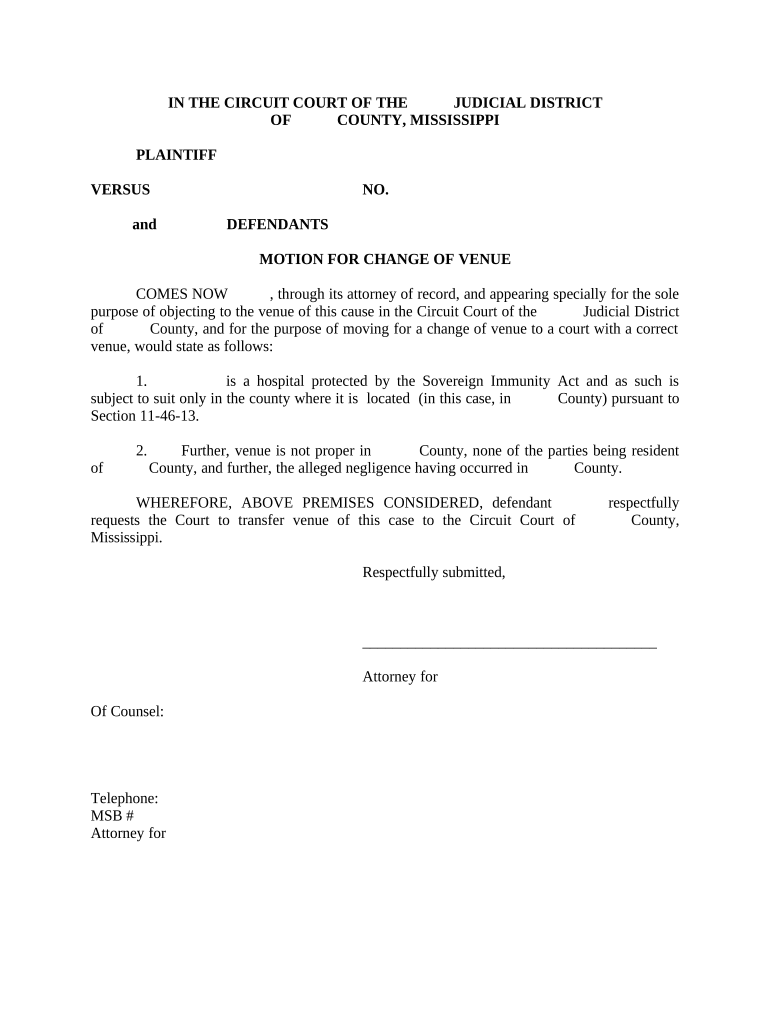
Jurisdictional Statement

Explains why the current court lacks proper venue or why transfer is appropriate under the applicable statute or rule.

Statement of Facts

Concise, sworn factual narrative establishing ties to the proposed forum, witness location, convenience, or forum-selection clause application.

Legal Grounds

Cite specific statutes, rules, or contractual clauses that authorize venue transfer or dismissal, and summarize controlling case law briefly.

Relief Requested

Specify the precise order sought—transfer, dismissal, or change—and any ancillary relief such as stay or protective conditions.

Certificate of Service

Document how and when all parties were served to demonstrate procedural fairness and avoid waiver of the venue objection.

Required document elements and data accuracy checklist

Party Names: Exact legal names
Docket Number: Court-issued identifier
Dates: MM/DD/YYYY format
Addresses: Street, city, state, ZIP
Signature: Typed or e-signed name
Service Details: Method and date

Consequences of errors or omissions

Waiver: Failure to timely object
Dismissal: Motion may be denied or case dismissed
Sanctions: Court may impose fees or penalties
Delay: Hearing or trial schedule disruption
Increased Costs: Additional briefing or travel expenses
Jurisdictional Bar: Loss of favorable forum options

Common drafting and filing mistakes to avoid

  • Leaving out a sworn affidavit for key factual claims, which can make the motion unreviewable on the papers and require an evidentiary hearing.
  • Using an incorrect case caption or docket number, which can cause clerks to misfile the motion and delay judicial consideration.
  • Failing to follow local court rules for format, page limits, or service, often resulting in rejection or the need to refile.
  • Requesting venue change without addressing contractual forum-selection clauses or statutory venue provisions that dictate the proper forum.

Timing considerations and court deadlines

Deadlines for filing a motion to change venue depend on local rules and the stage of litigation; early filing preserves procedural rights.

Pre-answer Motions:

Some defenses must be raised before an answer; check local rules to avoid waiver.

Local Rule Limits:

Court rules may set page and timing limits for motions and responses.

Service Deadlines:

Serve opposing parties within the timeframe required by the court to preserve response periods.

Hearing Scheduling:

Expect a scheduling order; provide availability to avoid delay.

Emergency Relief:

If urgent, seek expedited consideration per the court’s emergency procedures.

Key milestones from drafting to ruling

Track milestones to meet service, response, and hearing obligations and to avoid waiver.

01

Draft Complete

Prepare motion, exhibits, and proposed order.

02

File & Serve

File with clerk and serve opposing parties.

03

Opposition Filed

Receive and review any response or supporting affidavits.

04

Court Decision

Judge issues order after briefing or hearing.

eSignature vendor comparison for Motion Venue Form workflows

Comparing plan price and core capabilities helps choose an eSignature provider compatible with legal workflows and compliance needs.

signNow DocuSign Adobe Sign PandaDoc HelloSign
Starting Price $8/user/mo $15/user/mo $14/user/mo $19/user/mo $15/user/mo
Free Trial 7-day free trial Varies by vendor Varies by vendor Varies by vendor Varies by vendor
Bulk Send Yes Yes Yes Yes Varies
Audit Trail Yes Yes Yes Yes Yes
HIPAA Compliant Yes Yes Yes No No
Envelope Cap No cap 100 envelopes/user/year Varies Varies Varies

Frequently asked questions about the Motion Venue Form

Answers to common procedural and technical questions when preparing, signing, or filing a Motion Venue Form.


Need help? Contact support

be ready to get more
Join over 28 million airSlate SignNow users