Establishing secure connection…Loading editor…Preparing document…

Letter Regarding Motion for Summary Judgment

This template is fully customizable. Edit the text, fill out the fields, and send it for signature. Give it a try!
Letter Regarding Motion for Summary Judgment

What a Letter Regarding Motion for Summary Judgment Is

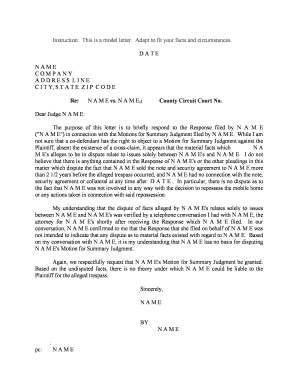
A Letter Regarding Motion for Summary Judgment is a formal cover letter submitted with a party's motion for summary judgment that identifies the case caption, motion title, supporting exhibits, and service details. It typically accompanies the memorandum of law, concise statement of material facts, and any supporting affidavits or declarations. The letter clarifies filing and service methods, requests specific relief, and notes expected hearing dates or available scheduling alternatives. Courts and opposing counsel use the letter to confirm receipt, summarize attachments, and record the filer’s contact information for follow-up.

Why a Clear Cover Letter Matters

A concise letter streamlines the court and counsel's review by listing attachments, citing key legal arguments, and confirming service. It reduces clerical ambiguity, establishes a clear point of contact, and can improve scheduling predictability for hearings and oppositions.

Why a Clear Cover Letter Matters

Who Prepares and Receives This Letter

Common users include litigation attorneys, paralegals, and pro se litigants preparing summary judgment motions for state or federal court.

  • Litigators and law firms handling dispositive motions and related filings.
  • Paralegals managing exhibits, certificates of service, and filing logistics daily.
  • Individual pro se litigants submitting concise attachments and contact info.

Representative Roles and Responsibilities

Litigation Attorney

Experienced counsel files the letter as part of the motion package, certifies service, and highlights key legal standards. They ensure exhibits are numbered, the concise statement of facts is attached, and an accurate Certificate of Service is completed per local rules.

Court Clerk

A court clerk reviews the cover letter to verify accompanying filings, docket the receipt, track scheduled hearing dates, and confirm service compliance. Clear formatting reduces clerical follow-up and helps ensure the motion meets court procedural and local rule requirements.

Core Elements to Include in the Letter

Essential elements ensure the letter clearly identifies the motion, exhibits, counsel, service, and requested hearing or schedule adjustments for judicial and opposing counsel review.

Case Caption

Include full caption exactly as on the complaint or docket, court name, index or case number, and judge designation. Mismatched captions can create filing confusion and clerical delay.
Motion Title

State 'Letter Regarding Motion for Summary Judgment' and reference the supporting memorandum and exhibits. Cite the rule authorizing the motion (e.g., Fed. R. Civ. P. 56) when applicable for clarity.

Attachments

List every exhibit, affidavit, and supporting document with exhibit letters or numbers. Note which documents are under seal and identify redactions or confidentiality designations per local rules.

Relief Requested

Summarize the specific relief sought by the motion (partial or full summary judgment), including the precise claim or issue and the requested disposition or next step from the court.

Certificate of Service

State how and when service was made on opposing counsel or parties, list recipients, and include electronic service details or certificates required by court local rules.

Contact Information

Provide the filer’s name, firm, mailing address, phone number, and email for follow-up and clerk communications. Include bar number and counsel designation where applicable.

Step-by-Step: Prepare, File, and Serve

Follow these steps to prepare, file, and serve the letter accompanying a motion for summary judgment.

  • 01
    Draft Letter: Summarize attachments, relief sought, and contact details.
  • 02
    Attach Documents: Include memorandum, exhibits, and affidavits with clear exhibit labels.
  • 03
    File with Court: E-file or file per local rules; confirm clerk receipt.
  • 04
    Serve Opposing: Provide certificates of service and serve all listed recipients.

Typical Routing and Confirmation Workflow

Typical routing for the letter includes assembly, filing, service, and confirmation of receipt to all parties and the court.

  • Assemble Package: Compile motion, exhibits, declarations, and the cover letter.
  • E-file: Submit via court e-filing system following local formatting rules.
  • Serve Parties: Serve counsel and parties using approved methods; retain proof.
  • Confirm Receipt: Record clerk confirmation and service timestamps for the case file.

Digital Workflow Settings to Match Court Requirements

Configure your digital workflow to match court requirements and maintain an audit trail for service and filing.

Field Configuration
Document Format PDF/A preferred; searchable PDF required
Authentication Email link or SMS code; KBA if required
Certificate of Service Auto-generate and attach with timestamps
Exhibit Index Embed an exhibit list and labels in front
Retention Settings Enable audit trail and store for statutory periods

Distribution and Platform Considerations

Digital sharing options should align with court e-filing, counsel service, and secure storage practices.

  • Accepted Formats: PDF, PDF/A, and DOCX
  • Integrations: Salesforce, Microsoft 365, NetSuite, Google Workspace
  • Authentication: Email, SMS, SSO, or KBA options

Common Timing Rules to Watch

Timelines for motions and related letters depend on local rules, service methods, and court scheduling practices.

Local Rule Deadline:

Follow court-specific filing deadlines; often 14–28 days before hearing.

Service Timing:

Serve opposing parties within the time required by rule; preserve proof.

Opposition Window:

Opposing brief deadlines typically 14–21 days after service.

Reply Deadline:

Reply briefs often due seven to fourteen days after opposition.

Hearing Notice:

Court issues hearing date; parties must confirm availability promptly.

Key Milestones from Draft to Hearing

Key milestones track drafting through disposition; meet each stage to avoid procedural default or delay.

01

Draft and Review

Prepare letter, exhibits, and certificate of service before filing.

02

File with Court

E-file or deliver to clerk and obtain confirmation receipt.

03

Serve Opponent

Serve all counsel and parties; retain proof and timestamps.

04

Monitor Response

Track opposition filings, schedule hearings, and prepare for oral argument.

Common Pitfalls to Avoid

  • Failing to include a complete exhibit list or mislabeling exhibits causes clerk confusion and may require refiling or court clarification, delaying proceedings.
  • Not certifying service correctly or omitting recipients can lead to defective service objections and may result in denied consideration of the motion.
  • Submitting documents in noncompliant formats, such as non-searchable scans or incorrect PDF types, can be rejected by e-filing systems or burden clerks.
  • Relying on simple image overlays for electronic signatures without an audit trail risks authentication issues if a party challenges signature attribution.

Potential Consequences of Errors

Missed Deadline: Motion may be denied.
Defective Service: Opposition may be excused.
Clerical Rejection: E-filing system can reject.
Sanctions Exposure: Possible court sanctions.
Confidentiality Breach: Sealed materials disclosed.
Authentication Dispute: Signature attribution challenged.

Security and Compliance Essentials

Transport Encryption: TLS 1.2/1.3 in transit
At-Rest Encryption: AES-256 encryption at rest
Certifications: SOC 2 Type II, ISO 27001
U.S. Electronic Law: ESIGN Act and UETA compliant
Healthcare Compliance: HIPAA support with BAA
Audit Trail: Complete timestamps and history

Basic eSignature Pricing and Feature Comparison

Pricing and basic feature comparison across common eSignature vendors for handling filing letters and related motion packets.

signNow DocuSign Adobe Sign PandaDoc HelloSign
Starting Price $8/user/mo $15/user/mo $14/user/mo $19/user/mo $15/user/mo
Free Trial 7-day free trial Varies by vendor Varies by vendor Varies by vendor Varies by vendor
Bulk Send Yes Yes Yes Yes No
Audit Trail Yes Yes Yes Yes Yes
HIPAA Compliant Yes Yes Yes No No
Envelope Cap No envelope cap 100 envelopes/user/year Varies by plan Varies by plan Varies by plan

Examples: How a Letter Affects Filing Outcomes

Real-world examples show how a cover letter affects filing clarity and clerk handling in civil motions.

County Court Filing

A small civil firm filed a summary judgment motion with a detailed cover letter listing exhibits and certifying service to all defendants.

  • Clerk accepted and docketed immediately without clerical questions.
  • Because the exhibit index and certificate of service were clear, opposing counsel responded within the prescribed deadlines and the court scheduled a timely hearing, reducing administrative follow-up and allowing counsel to focus on motion briefing and oral argument preparation.

Federal Court Example

A federal practitioner attached a concise cover letter that referenced Fed. R. Civ. P. 56 and listed key declarations and exhibits.

  • E-filing metadata reflected timestamps and service.
  • The clear presentation helped the clerk process the motion promptly, and the judge’s chambers received the materials in a format that supported efficient review and reduced requests for supplemental filings.

Frequently Asked Questions

Answers to frequent questions about preparing, signing, filing, and serving a Letter Regarding Motion for Summary Judgment in U.S. courts.


Need help? Contact support

be ready to get more
Join over 28 million airSlate SignNow users