Establishing secure connection…Loading editor…Preparing document…

New York Easement

This template is fully customizable. Edit the text, fill out the fields, and send it for signature. Give it a try!
New York Easement

What the New York Easement Is and When It’s Used

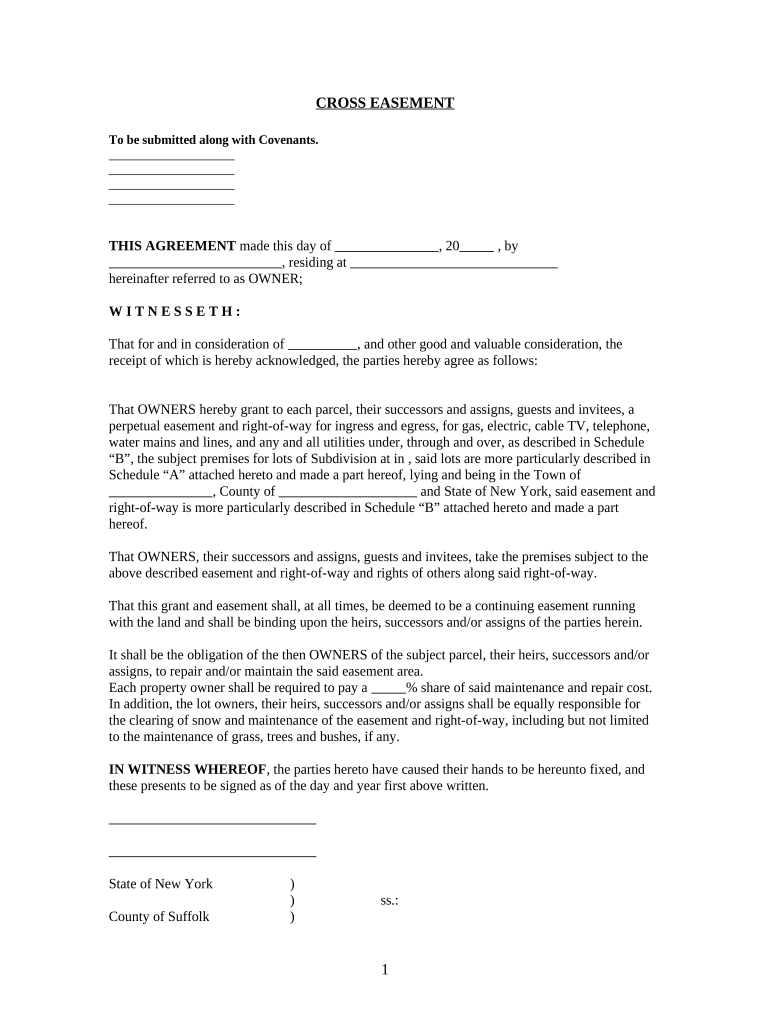
A New York Easement is a legal instrument that grants one party a specific right to use, access, or restrict use of another party’s real property for defined purposes such as utilities, access, drainage, or conservation. In New York the document is typically drafted with a clear legal description, identified grantor and grantee, defined scope and duration, recording instructions for the county clerk, and any conditions or maintenance obligations. Proper execution, notarization, and recording create public notice and help avoid title defects or disputes about property rights.

Why a Properly Drafted New York Easement Matters

A clear easement protects property interests, creates public record when recorded, and reduces litigation risk by setting use limits, maintenance duties, and dispute resolution rules under New York law.

Why a Properly Drafted New York Easement Matters

Who Typically Prepares and Signs an Easement

Each participant has different priorities—owners want clear limits, grantees need enforceable rights, and title professionals focus on recording and clouding issues.

  • Property owners and managers who grant or receive access rights for specific uses.
  • Utility and infrastructure providers needing rights for lines, pipes, or access.
  • Attorneys and title agents drafting language to protect grantor and grantee interests.

Core Components to Include in a Professional New York Easement

A complete easement should state the parties, precise property description, permitted uses, term, recording instructions, and any obligations or restrictions.

Parties

Identify grantor and grantee by full legal name and capacity (individual, company, trustee). Use entity formation details for corporate parties to avoid ambiguity.
Legal Description

Include the full metes-and-bounds description or recorded lot and section reference from the county deed to ensure accurate identification for recording and title searches.

Scope of Rights

Define permitted activities (e.g., access, utilities, maintenance) with clear geographic limits, hours, and equipment allowances to prevent later disputes.

Term and Termination

State whether the easement is perpetual, limited-term, or conditional and specify events that terminate or modify the easement rights.

Maintenance and Liability

Allocate responsibility for upkeep, repairs, indemnities, and insurance between parties to reduce future conflicts and clarify cost-sharing.

Recording and Notices

Provide instructions for where to record, who pays recording fees, and addresses for notices to ensure enforceability and public notice.

Step-by-Step: Completing a New York Easement

Follow a clear sequence to prepare, execute, notarize, and record the easement for legal effectiveness and public notice.

  • 01
    Drafting: Draft using precise legal descriptors and defined rights.
  • 02
    Review: Obtain title and attorney review to confirm exceptions and consent requirements.
  • 03
    Execution: Sign in the presence of a notary and required witnesses.
  • 04
    Recording: Record with the county clerk where the property is located and pay required fees.

How to Configure an Online Easement Workflow

Set up fields, authentication, and routing to mirror your physical signing process and preserve evidentiary chain of custody.

Field Configuration
Signature Field Require dated signature with signer name prefilled.
Notary Block Include notary acknowledgment area and attach recording metadata.
Attachments Allow upload of exhibits such as survey maps or prior deeds.
Routing Order Set sequential signing for grantor, grantee, and witness/notary.

Digital Signing Essentials and Technical Considerations

Ensure the chosen tool preserves metadata, creates a tamper-evident audit trail, and supports the notarization method required by the county or state authority.

  • File Types: PDF and DOCX supported for import and final export.
  • Authentication: Email, SMS, or stronger KBA options for signer verification.
  • Integrations: Connectors for title systems, CRMs, and cloud storage.

Where to Send and File a New York Easement

Recording and distribution follow a predictable path: prepare the document, obtain signatures and acknowledgments, then record and distribute copies to stakeholders.

  • County Clerk: Record easement in the county where the property is located.
  • Title Company: Provide recorded copy for title insurance and closing files.
  • Property Owner: Share executed recorded copy with grantor and grantee.
  • Municipal Records: Submit to local agencies when municipal consent or public works involvement exists.

Typical Timelines and Processing Expectations

Timelines vary by county and complexity; plan for drafting, review, notarization, and county recording delays.

Draft and Review Time:

1–14 days depending on title review and attorney involvement.

Notary and Witness Scheduling:

Same day to one week depending on availability.

County Recording Processing:

Same day to several weeks; check county clerk processing times.

Title Update:

Title company updates within 1–30 days after recording confirmation.

Dispute Window:

Statute of limitations and notice disputes follow applicable state law timelines.

Common Pitfalls When Preparing an Easement

  • Using an informal or incomplete legal description that fails county clerk indexing, causing a recording rejection or clouded title.
  • Omitting explicit scope or duration, enabling future disputes over permitted uses or access times.
  • Failing to obtain required consents from mortgagees or lienholders, which can create enforceability issues with lenders.
  • Not recording or delivering the recorded instrument promptly, leaving parties without public notice and increasing litigation risk.

Legal Risks and Consequences of an Incorrect Easement

Title Defect: Clouded title causing closing obstacles or insurance exceptions.
Enforceability: Unclear terms can render rights unenforceable in court.
Liability Exposure: Undefined maintenance roles increase liability for damages.
Recording Rejection: Clerical errors may lead to rejection and re-filing delays.
Lender Default Risk: Undisclosed easements can violate mortgage covenants.
Cost Overruns: Late corrections increase legal and recording costs.

Practical Examples of Remote Easement Execution

Real-world accounts illustrate how digital workflows reduce delays and preserve compliance when executing property instruments.

Martin Properties — Remote Execution

A property manager needed to complete recorded access agreements for multiple tenants without in-person meetings.

  • Remote signatures shortened turnaround and avoided rescheduling.
  • Tim Martin, Founder of Martin Properties, noted that executing documents online preserved compliance and sped delivery across mobile and offline workflows, helping the team maintain closings without physical presence or lost time.

Optica Ventures — Workflow Simplicity

A small investment firm required signatures from dispersed stakeholders on an easement amendment.

  • A streamlined interface reduced signer confusion.
  • Brian Fitzgibbons, COO of Optica Ventures LLC, remarked that the simple, easy-to-use interface helped internal teams and external signers complete necessary documents quickly while maintaining an auditable record of each action.

eSignature Platform Pricing and Feature Snapshot for Easement Workflows

Comparing core price and feature dimensions helps select a vendor that supports notarization, audit trails, and HIPAA or industry compliance where needed.

signNow DocuSign Adobe Sign PandaDoc HelloSign
Starting Price $8/user/mo $15/user/mo $14/user/mo $19/user/mo $15/user/mo
Free Trial 7-day free trial Limited trial Limited trial Limited trial Limited trial
Bulk Send Yes Yes Yes Yes No
Audit Trail Yes Yes Yes Yes Yes
HIPAA Compliant Yes Yes Yes No No

Frequently Asked Questions About New York Easements

Answers to common questions about drafting, signing, notarization, recording, and post-recording steps for easements in New York.


Need help? Contact support

be ready to get more
Join over 28 million airSlate SignNow users