Establishing secure connection…Loading editor…Preparing document…

New York Timber Sale Contract

This template is fully customizable. Edit the text, fill out the fields, and send it for signature. Give it a try!
New York Timber Sale Contract

What the New York Timber Sale Contract Is and When It Applies

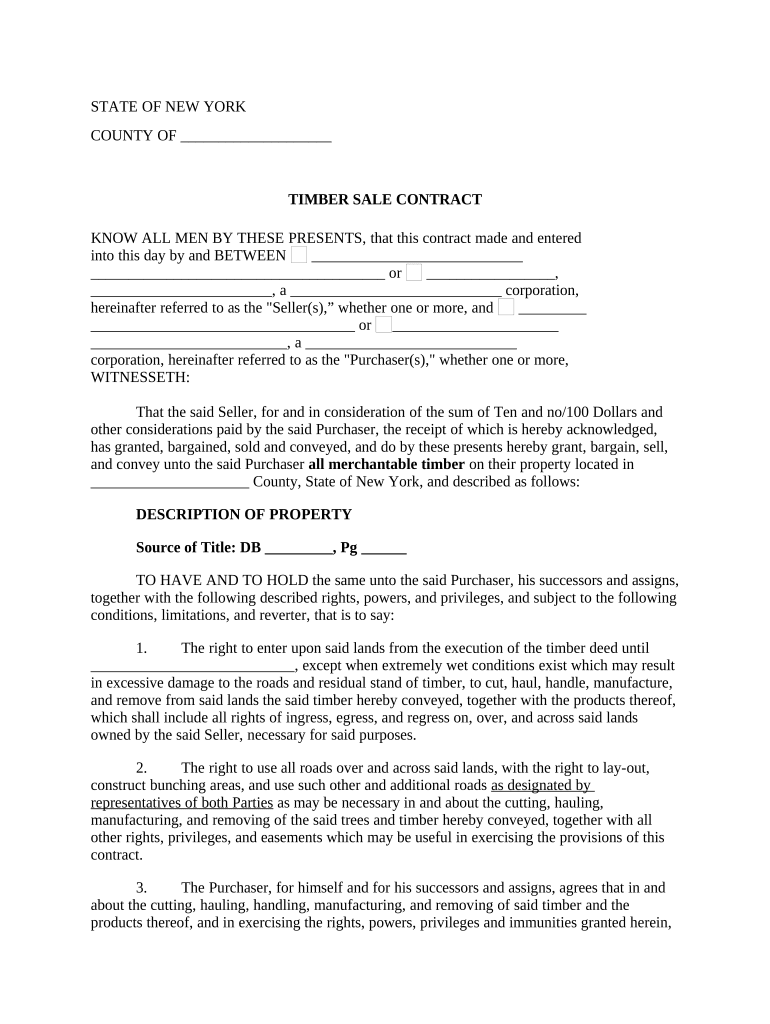
A New York Timber Sale Contract is a written agreement that transfers the right to cut, remove, or market timber from a defined parcel of land. The document defines parties, property description, sale method (lump-sum or stumpage/scale), harvest timing, access and road use, environmental protections, payment terms, and dispute resolution. For transactions in New York state, parties often add clauses addressing timber marking, residual stand protection, timber cruising methodology, and compliance with state forest practice standards to reduce ambiguity about volumes and permitted operations.

Why a Clear Timber Sale Contract Matters

A well-drafted timber sale contract reduces disputes by specifying price computation, harvest boundaries, and operational obligations. It clarifies liability allocation, payment schedule, and remediation responsibilities, which helps protect landowner value and buyer expectations during harvest and after completion.

Why a Clear Timber Sale Contract Matters

Who Typically Uses a Timber Sale Contract

Parties often involve forestry consultants, surveyors, or attorneys during negotiation to confirm boundaries, measurement procedures, and regulatory compliance.

  • Private landowners and family estates seeking to monetize timber while protecting residual forest value.
  • Timber buyers and sawmills contracting for stumpage or delivered logs under defined measurement methods.
  • Logging contractors agreeing to harvest, road access, and restoration obligations under supervision.

Core Sections to Include in a Professional Timber Sale Contract

A complete contract groups operational, financial, and legal terms so both parties can confirm obligations at every stage of the sale and harvest.

Parties

Full legal names and capacities of seller and buyer; specify if agent, trust, or corporate entity signs and include contact information and payment instructions.
Property

Precise legal description, parcel ID, and map reference or GPS coordinates; identify marked boundaries and reserved areas to avoid disputes during harvest.

Price Terms

State whether sale is lump-sum or stumpage per unit; include measurement method, scale location, deductions, taxes, and timing of payments or deposits.

Harvest Terms

Define harvest period, allowable cutting methods, road access, soil and water protections, slash management, and closure or reclamation requirements.

Liability and Insurance

Allocate responsibility for damage, require liability insurance limits and certificates, and state indemnity obligations for environmental or third-party claims.

Dispute Resolution

Specify governing law, mediation or arbitration steps, venue selection, and attorney fee allocation for enforcement or breach claims.

Essential Data Fields the Contract Must Contain

Seller Name: Full legal entity
Buyer Name: Full legal entity
Property Description: Legal description
Sale Price: Numeric amount
Harvest Dates: Start/end dates
Signatures: Signed and dated

Step-by-Step: Completing the Timber Sale Contract

Follow these steps to prepare, review, and finalize the contract while reducing ambiguity and legal exposure.

  • 01
    Gather records: Collect deed, parcel ID, maps, and forestry cruise data.
  • 02
    Define terms: Agree on pricing method, measurement, and harvest limits.
  • 03
    Allocate risks: Set insurance, indemnity, and restoration responsibilities.
  • 04
    Sign and retain: Execute signatures and keep original copies per retention rules.

How to Configure a Digital Workflow for This Contract

When moving the form online, map each contract element to a corresponding digital field and define signer roles and authentication methods.

Field Configuration
Seller Signature Require signature field, date stamp, and signer email
Buyer Signature Require signature field, date stamp, and signer email
Property Attachment Attach PDF map and make required for submission
Payment Terms Add conditional fields for deposits and final payment

Where to Send and How to Submit the Executed Contract

Execution and routing vary by party preference and downstream needs; identify recipients and recording targets before signing.

  • Seller Copy: Provide fully executed PDF to seller for records
  • Buyer Copy: Provide fully executed PDF to buyer and project manager
  • County Records: Record only if required by local rules or if deed transfer is involved
  • Advisor Distribution: Send copies to forester, attorney, and insurer

Digital Signing Considerations and Platform Needs

Ensure your platform can produce a tamper-evident signed PDF and a retrievable audit trail to support enforceability and record retention.

  • Authentication: Email link, SMS code, or stronger multi-factor authentication
  • File Formats: PDF and DOCX support for contracts and attached maps
  • Integrations: Connectors for cloud storage and accounting systems

Common Timing Elements and Scheduling Expectations

Timber sale timing includes execution, harvest window, payment milestones, and closeout steps — plan milestones so both parties meet obligations promptly.

Execution Date:

Date parties sign; governs when obligations begin

Deposit Due:

Typically within 10–30 days of execution

Harvest Window:

Defined start and end dates for cutting operations

Final Payment:

Due on completion or within agreed days after scaling

Closeout Inspection:

Final walk and restoration verification within specified days

Common Mistakes to Avoid When Preparing the Contract

  • Vague property descriptions that fail to match deed or parcel maps and cause boundary disputes.
  • Unspecified measurement methods for timber volume, producing later disagreement on quantity and payment.
  • Failing to require insurance certificates and naming the landowner as additional insured before harvest starts.
  • Ignoring local permits or silvicultural restrictions that can halt operations and increase liability.

Penalties, Risks, and Legal Consequences to Consider

Breach Damages: Monetary liability for failure to perform or pay
Trespass Liability: Costs for unauthorized cutting or boundary incursions
Environmental Fines: State or local penalties for erosion or waterway violations
Contract Termination: Loss of deposits and rights for defaulting party
Tax Reporting: Potential withholding or information reporting obligations
Insurance Gaps: Out-of-pocket exposure if coverage is inadequate

Sample Scenarios: How Contracts Are Used in Practice

These anonymized examples illustrate common contract structures and allocation of obligations between seller and buyer.

Case Study 1

A family landowner sold standing timber under a lump-sum agreement with defined boundaries and harvest timing.

  • Buyer agreed to repair roads after harvest.
  • The clear measurement method and deposit schedule prevented a payment dispute and ensured timely restoration.

Case Study 2

A regional mill contracted stumpage priced per MBF with onsite scaling at a bridgemounted scale.

  • Seller required insurance certificates naming seller as additional insured.
  • Detailed insurance and scaling language reduced exposure after a storm damaged access and delayed final payment.

Typical Signatory Roles and Authority

Landowner (Seller)

Owner or authorized representative who holds title; must sign with exact legal name and, if applicable, include title or trust information to bind the ownership entity.

Buyer / Logging Company

Company officer or authorized agent who can bind the purchaser; include printed name, title, and corporate authority documentation for larger entities.

Key Milestones from Agreement to Closeout

Plan the transaction around four primary milestones to manage cashflow, operations, and compliance across the harvest lifecycle.

01

Agreement Execution

Parties sign and deposit payment where applicable; obligations and deadlines commence

02

Pre-Harvest Clearance

Obtain permits, insurance, and site preparations before cutting begins

03

Active Harvest

Logging operations occur within the agreed window under specified protections

04

Final Scaling and Closeout

Final measurement, payment settlement, and restoration verification complete the sale

eSignature Vendor Comparison for Executing the Contract

Compare common eSignature pricing and feature criteria; signNow appears first as a representative option for secure, standards‑compliant eSigning.

signNow DocuSign Adobe Sign PandaDoc HelloSign
Starting Price $8/user/mo $15/user/mo $14/user/mo $19/user/mo $15/user/mo
Free Trial 7-day free trial Varies by plan Varies by plan Varies by plan Varies by plan
Bulk Send Yes Yes Yes Yes No
Audit Trail Yes Yes Yes Yes Yes
HIPAA Compliant Yes Yes Yes No No

Frequently Asked Questions About the New York Timber Sale Contract

Answers to common questions about execution, enforceability, and digital signing for timber sale agreements in New York.


Need help? Contact support

be ready to get more
Join over 28 million airSlate SignNow users