Establishing secure connection…Loading editor…Preparing document…

New Jersey Ejectment Forms

This template is fully customizable. Edit the text, fill out the fields, and send it for signature. Give it a try!
New Jersey Ejectment Forms

What New Jersey Ejectment Forms Are and when they apply

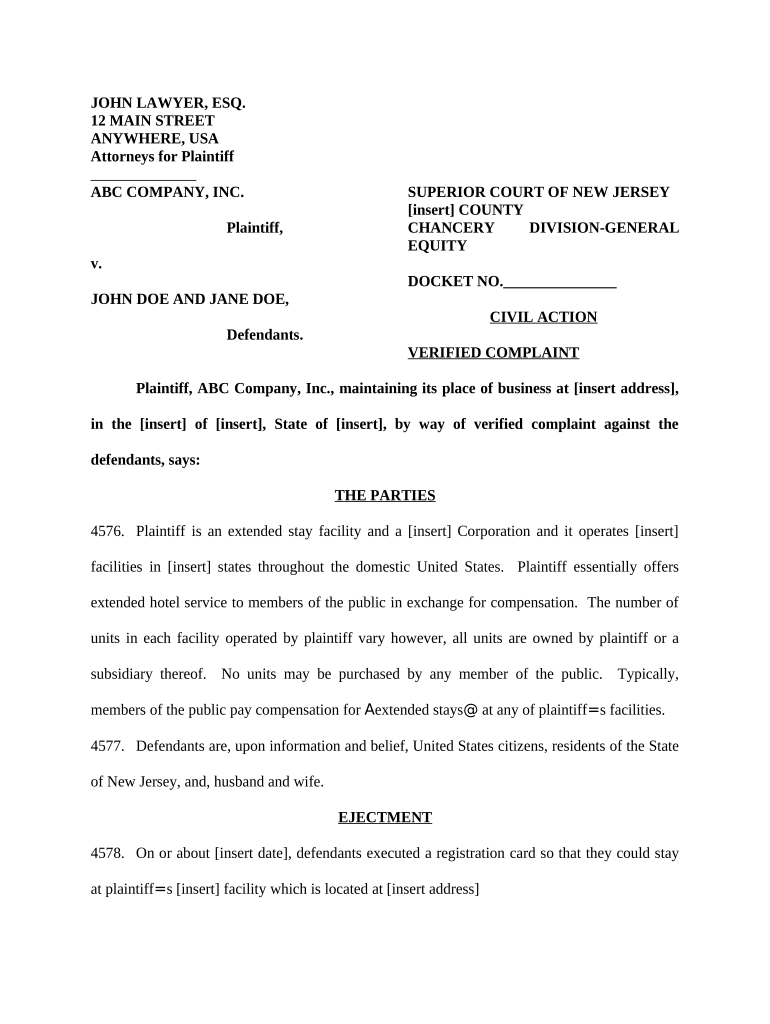
New Jersey ejectment forms are the standardized court documents used to start and process an ejectment (eviction) action in New Jersey courts. They include the complaint or summons, proof of service affidavit, any statutory notice attachments, and final judgment entry forms. These documents establish the parties, describe the property and grounds for removal, request specified relief (possession, back rent, damages), and create a court record that must conform to county clerk and local civil court rules.

Why these forms matter for landlords, tenants, and attorneys

Properly prepared ejectment forms focus the court on the legal basis for possession, reduce the risk of dismissal for procedural defects, and create the record needed for enforcement. Correct documentation clarifies timelines, preserves statutory notice requirements, and supports any ancillary remedies such as rent damages or writs of possession.

Why these forms matter for landlords, tenants, and attorneys

Who commonly completes New Jersey ejectment forms

Landlords, property managers, tenant attorneys, and court clerks are the most frequent users of these forms.

  • Independent landlords preparing a complaint for nonpayment of rent or holdover tenancy
  • Property management firms assembling packet filings and proof of service for county courts
  • Tenant or defense attorneys completing responsive filings, cross-claims, or motions to dismiss

Each user must follow local court rules and service requirements to avoid procedural defects that delay or dismiss cases.

Key signers and filing parties

Landlord Owner

The individual or entity that holds legal title or lease rights and is listed as plaintiff. The owner’s correct legal name and contact details are required to prove standing and to receive judgments and notices.

Attorney Filings

Licensed attorneys who file on behalf of landlords or tenants must provide bar identification and an address for service. Their signature binds the pleading and certifies procedural compliance under court rules.

Core components of a professional New Jersey ejectment filing

A complete ejectment packet reduces rejection risk and speeds processing. Include foundational elements that meet New Jersey court form expectations and local county rules.

Caption

Court name, docket number (if any), party names and addresses, and a clear case title identifying the ejectment action.
Statement of Grounds

Concise factual and legal basis for removal (nonpayment, holdover, breach). Cite lease provisions and relevant statute when applicable.

Relief Requested

Specify possession, monetary damages, costs, and any request for writ of possession or accelerated hearing date.

Proof of Service

Affidavit or certificate showing how and when the defendant was served; include server name, method, and date.

Notice Attachments

Copies of statutory notices (pay-or-quit, termination) with dates of delivery to demonstrate compliance with notice periods.

Signature Block

Signed and dated by plaintiff or counsel with printed name, address, telephone, and attorney bar number where required.

Step-by-step: preparing and filing an ejectment complaint in New Jersey

Follow a consistent sequence to prepare, serve, and file ejectment documents to comply with court and local rules.

  • 01
    Prepare Complaint: Draft complaint with parties, grounds, relief, and attachments.
  • 02
    Attach Notices: Include statutory termination or pay-or-quit notices with proof of delivery.
  • 03
    Serve Defendant: Serve per local rules (personal, certified mail, or other authorized method).
  • 04
    File with Court: Submit complaint, service affidavit, and filing fee to the county clerk or appropriate division.

Where ejectment forms go and how they progress

The filing is routed to the county civil court or landlord-tenant division and follows a defined path from intake to judgment and enforcement.

  • File at County: County clerk or civil division accepts complaint and assigns a docket number.
  • Serve and File Proof: After service, file affidavit of service to establish the court’s jurisdiction.
  • Hearing / Default: Case proceeds to hearing if contested; default judgment if defendant fails to respond.
  • Enforcement: Writs of possession or sheriff execution enforce a possession judgment.

Digital workflow settings for preparing New Jersey ejectment packets

Configure a repeatable e-filing and signing flow to ensure completeness and consistent service documentation.

Field Configuration
Complaint Template Pre-fill party names and property fields to avoid typos
Signature Block Require signer name, date, and role for all signature fields
Proof of Service Add conditional field to capture server method and date
Export Format Produce PDF/A with embedded audit trail for court retention

Technical and platform needs for eSigning and sharing ejectment forms

Choose a platform that supports court-acceptable PDF output, secure signer authentication, and audit trails for service and filing.

  • Document Formats: PDF, DOCX import and final PDF/A export
  • Authentication: Email or SMS code verification available
  • Integrations: Connectors for cloud storage and court e-file systems

Ensure the provider supports secure storage, audit logs, and any required BAA or regulatory compliance for your industry.

Typical time expectations during an ejectment action

Timelines vary by county and cause; the sequence below shows common milestones landlords and tenants should expect.

Notice Period:

Statutory or lease-based notice must be given before filing; timing depends on the cause.

Filing and Docketing:

Clerk assigns a docket number upon filing; timelines for initial scheduling vary.

Service Deadline:

Proof of service must be filed promptly to support court jurisdiction.

Answer Period:

Defendant typically has a short statutory period to answer or appear.

Hearing and Enforcement:

If judgment enters, execution or writ scheduling follows local sheriff timelines.

Key milestones from notice to enforcement

Track each stage to meet statutory windows and to preserve remedies such as possession and monetary claims.

01

Issue Notice

Give the required written notice to the tenant per lease or statute.

02

File Complaint

Submit the complaint and attachments to the appropriate county court.

03

Serve Defendant

Complete authorized service and file affidavit of service with the court.

04

Attend Hearing

Present evidence; obtain judgment or address defenses.

Common preparation mistakes that delay ejectment cases

  • Using inconsistent party names across complaint, lease, and proof of service causing identity or standing disputes and possible dismissal.
  • Failing to attach or date statutory termination notices, which can lead to rejection or court-ordered continuance.
  • Incorrect or incomplete proof of service affidavits that fail to show method, date, and server identity, undermining jurisdictional proof.
  • Not following county-specific filing formats and fee requirements, resulting in clerk refusal or administrative delay in docketing.

Consequences of defective or incorrect ejectment filings

Dismissal Risk: Case may be dismissed for procedural defects or improper service.
Delayed Relief: Remedies are postponed, prolonging possession or rent recovery.
Sanctions: Courts may impose costs or sanctions for bad-faith pleadings.
Enforcement Denied: Writs or executions may be delayed without proper judgment entry.
Financial Exposure: Misstated amounts can lead to reduced recovery or counterclaims.
Service Challenges: Improper service can void judgments and require re-service.

Essential verification and security elements for filings

Document Integrity: Tamper-evident PDF and embedded audit trail
Authentication: Email/SMS verification or stronger signer ID
Encryption: TLS 1.2/1.3 in transit; AES-256 at rest
Retention: Secure storage with version history
Access Controls: Role-based permissions for users
Compliance: Support for ESIGN, UETA, and audit requirements

Comparing eSignature vendors for New Jersey ejectment filings

Vendor selection affects cost, compliance, and volume handling; the table shows common plan criteria with signNow listed first as a baseline.

signNow DocuSign Adobe Sign PandaDoc HelloSign
Starting Price $8/user/mo $15/user/mo $14/user/mo $19/user/mo $15/user/mo
Free Trial 7-day free trial Varies Varies Varies Varies
Bulk Send Yes Yes Yes Yes No
Audit Trail Yes Yes Yes Yes Yes
HIPAA Compliant Yes Yes Yes No No

Practical examples of how ejectment forms are used

These short case outlines show common real-world scenarios and document needs when filing ejectment actions.

Private Landlord Case

A landlord files for nonpayment after a 3-day pay-or-quit notice was sent

  • Complaint includes rent ledger and lease section
  • The packet includes proof of notice delivery, an affidavit of service, and a clear monetary demand to avoid dismissal.

Property Management

A management firm files multiple holdover cases across units in one county

  • Uses template complaint and batch service affidavits
  • Standardized templates and an audit trail reduced prep time and improved consistency for follow-up enforcement steps.

Practical tips for accurate and efficient ejectment filings

Follow these practices to reduce procedural errors and to preserve remedies through judgment and execution phases.

Standardize templates
Create county-specific templates that pre-fill common fields and include required local attachments to avoid clerical rejections.
Verify party names
Match plaintiff and defendant names to lease, title, or government ID to avoid identity challenges and standing disputes.
Document service carefully
Use sworn affidavits describing method, date, and server identity; attach proof of mailing when applicable.
Keep audit trails
Retain signed PDFs with embedded audit logs and export timestamps for enforcement and appeals.

Frequently asked questions about New Jersey ejectment forms

Answers to common questions about form validity, service, notarization, and digital signing when using ejectment documents in New Jersey.


Need help? Contact support

be ready to get more
Join over 28 million airSlate SignNow users