Establishing secure connection…Loading editor…Preparing document…

New Jersey Interrogatories

This template is fully customizable. Edit the text, fill out the fields, and send it for signature. Give it a try!
New Jersey Interrogatories

Overview: What New Jersey Interrogatories Are

New Jersey interrogatories are written questions served by one party to another during civil discovery to obtain sworn, written answers. They form part of the discovery process under state or federal civil procedure and are used to narrow issues, preserve testimony, and collect facts before trial. Responses must be signed and verified by the responding party or their counsel, and responses, objections, or requests for protective orders should follow applicable local rules and timing requirements.

Why Use Interrogatories in Civil Cases

Interrogatories help parties define factual disputes, limit scope for depositions, and document admissions in writing. They create a record that can be used in motions, settlement negotiations, and at trial while reducing repeated oral questioning.

Why Use Interrogatories in Civil Cases

Who Prepares and Responds to Interrogatories

Typical users include attorneys, self-represented litigants, and in-house counsel preparing or answering written discovery in civil matters.

  • Civil plaintiffs and their counsel — draft targeted questions to establish elements of the claim.
  • Civil defendants and their counsel — answer, object, or seek protective orders as needed.
  • Pro se litigants and in-house counsel — prepare verified answers and certify authenticity.

Core Parts of a Professional Interrogatories Package

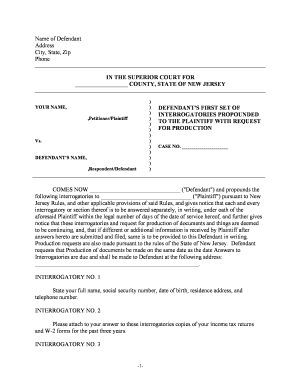
A complete set of interrogatories groups clear instructions, numbered questions, definitions, and a verification. Formatting and organization improve compliance and reduce motion practice over procedural defects.

Caption

Court name, docket number, case caption, and party designations placed at the top so responses are clearly tied to the pending matter and docket.
Instructions

Plain-language directions on how to answer, time for response, form of verification, and scope definitions to avoid misunderstandings about document requests.

Definitions

Concise definitions for terms, date ranges, and entities referenced in questions to limit ambiguity and improve the precision of answers.

Numbered Interrogatories

Sequentially numbered questions grouped by topic; each question should ask for one discrete fact or set of closely related facts to avoid objections.

Verification

Signature block for the responding party with a verification clause attesting to truthfulness under penalty of perjury where required by applicable rules.

Certificate of Service

Statement indicating how and when the interrogatories were served, listing recipients and method of service to show compliance with service rules.

Essential Fields and Information to Include

Case Caption: Court, docket number
Party Names: Plaintiff and defendant
Question Numbers: Sequential identifiers
Time Periods: Clear date ranges
Signature Block: Signed and dated
Service Details: Method and date

Step-by-Step: Completing New Jersey Interrogatories

Follow these sequential steps to prepare, serve, and respond to interrogatories while observing verification and service rules.

  • 01
    Draft: Write concise, numbered questions grouped by topic.
  • 02
    Review: Confirm definitions, date ranges, and scope to avoid ambiguity.
  • 03
    Serve: Serve opposing counsel and file service proof per local rules.
  • 04
    Verify: Sign verification and retain a copy for the file.

How to Configure an Online Interrogatories Workflow

Set up fields and routing for digital preparation, signature, and service to align with court and opposing counsel expectations.

Field Configuration
Caption Field Required, auto-fill from case metadata
Numbered Questions Repeatable blocks with rich-text answers
Verification Block Signature and date required
Service Record Track method and timestamp automatically

Where to Send and File Interrogatories

Interrogatories must be served on opposing counsel and a certificate of service filed per court rules; e-filing may also apply where available.

  • Opposing Counsel: Serve party counsel by agreed method or court rule.
  • Court Clerk: File certificate of service if required by local practice.
  • E-Filing Portals: Use court e-filing where accepted to record service.
  • Proof of Service: Retain stamped or electronic proof for the record.

Digital Submission and Platform Considerations

Choose a platform that supports PDF and DOCX formats, audit trails, and common integrations to streamline preparation and service.

  • File Formats: PDF, DOCX, and editable text supported
  • Integrations: Salesforce, Microsoft 365, NetSuite, Google Workspace
  • Audit Trail: Timestamps, IPs, and action history

Typical Deadlines and Timing to Expect

Deadlines vary by forum; federal practice often sets a 30-day response period, while state courts frequently mirror that timeline or set local variations.

Federal Rule:

30 days to respond (Fed. R. Civ. P. 33(b)(2))

New Jersey Practice:

Often 30 days; check local court rules

Requests for Extension:

Agreed extensions must be documented in writing

Motion to Compel:

File if responses are absent or evasive

Service Date:

Response clock starts on date of service

Common Mistakes to Avoid

  • Submitting vague or compound questions that invite objections and increase motion practice.
  • Failing to verify answers with a signed verification statement under penalty of perjury.
  • Overlooking local court rules on service method or e-filing requirements leading to procedural defects.
  • Providing evasive or incomplete responses instead of specific factual answers or timely objections.

Risks and Consequences of Improper Responses

Sanctions: Court-ordered fines or costs
Waiver: Failure to timely object may waive defenses
Adverse Inference: Missing answers can hurt credibility
Motion to Compel: Court may order production
Default Risk: Extreme noncompliance can lead to default
Perjury: False verified answers risk criminal exposure

eSignature Vendor Comparison for Interrogatories

Compare common provider attributes for preparing, signing, and storing interrogatories; signNow is listed first to align with platform details in the vendor data set.

signNow DocuSign Adobe Sign PandaDoc HelloSign
Starting Price $8/user/mo $15/user/mo $14/user/mo $19/user/mo $15/user/mo
Free Trial 7-day free trial Yes — trial available Yes — trial available Yes — trial available Yes — trial available
Bulk Send Yes Yes Yes Yes No
Audit Trail Yes Yes Yes Yes Yes
HIPAA Compliant Yes Yes Yes No No

Practical Examples of Interrogatory Use

These examples illustrate how interrogatories streamline fact gathering and reduce deposition time.

Law Firm Usage

A firm serves targeted interrogatories to identify key witnesses and documents

  • Saves deposition time by admitting facts in writing
  • Reduces hours preparing witness examinations and narrows factual disputes before trial.

In-House Counsel

An in-house team uses standardized templates to respond quickly to discovery requests

  • Centralizes answers to ensure consistency across matters
  • Improves auditability and reduces outside counsel billing for routine response drafting.

Practical Tips for Accurate and Efficient Responses

Adopt consistent formatting, clear definitions, and an auditable verification process to reduce disputes and motion practice.

Prefer Specificity
Ask and provide discrete, narrowly drawn facts rather than compound or ambiguous questions to minimize objections and clarify issues.
Keep a Document Log
Reference exhibits by number and maintain a production log to streamline follow-up and avoid disputes about what was produced.
Verify Carefully
Ensure the verification language matches local requirements and that the signatory understands the perjury risk of false statements.
Use Templates
Standardize interrogatory sets and response formats to reduce drafting time and improve consistency across matters.

Key Milestones in an Interrogatory Timeline

Track each milestone from drafting through any motion practice to maintain compliance with response and service deadlines.

01

Draft Interrogatories

Prepare and vet questions for clarity before service.

02

Serve Interrogatories

Effect service per local rules to start the response clock.

03

Receive Responses

Review answers and identify incompleteness or objections.

04

Motion Practice

File motions to compel if responses are deficient.

Frequently Asked Questions About New Jersey Interrogatories

Answers to common procedural, timing, and electronic-signature questions when preparing or responding to interrogatories in New Jersey.


Need help? Contact support

be ready to get more
Join over 28 million airSlate SignNow users