Establishing secure connection…Loading editor…Preparing document…

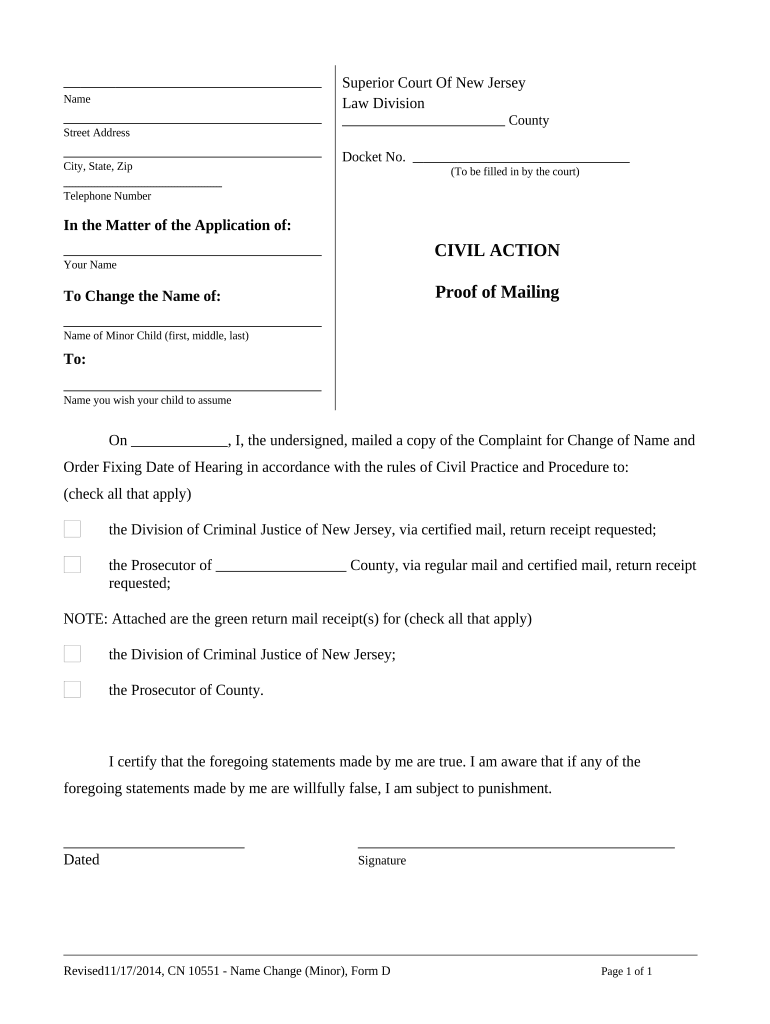
New Jersey Application for Change of Name of Minor Child

This template is fully customizable. Edit the text, fill out the fields, and send it for signature. Give it a try!
New Jersey Application for Change of Name of Minor Child

What the New Jersey Application for Change of Name of Minor Child is

The New Jersey Application for Change of Name of Minor Child is a court filing used to request that a county Superior Court change a child's legal name. It typically includes the child's current and proposed names, birth details, reasons for the change, parental consents or objections, and any required affidavits. The form begins the judicial process: filing with the appropriate county clerk or court, serving interested parties when required, and attending a hearing if the court schedules one. The resulting order modifies official records once entered and certified.

Why this application matters for legal identity and records

Filing the application updates a minor's legal identity for all official purposes: school records, Social Security, passports, medical records, and insurance. A properly completed application reduces delays when updating government documents and minimizes later disputes about parental consent, custody implications, or benefits eligibility.

Why this application matters for legal identity and records

Who typically completes the form and who receives it

Parents, legal guardians, or attorneys usually prepare and file the application with the county Surrogate or Superior Court handling name changes.

  • Parent or guardian filing to formalize a child’s name change after marriage, adoption, or personal reasons.
  • Court-appointed guardian or social services filing for child welfare or protection reasons.
  • Attorney preparing, signing, and representing parental interests during the court process.

Filings often involve other parties (other parent, GAL, or child welfare agencies) who will be notified according to local court rules.

Step-by-step: completing and filing the New Jersey application

Use this sequence to prepare, submit, and follow up on a minor name-change application in New Jersey.

  • 01
    Prepare: Gather birth certificate, IDs, and custody documents.
  • 02
    Complete: Fill the application with accurate names and dates.
  • 03
    File: Submit to county Superior Court clerk and pay filing fee.
  • 04
    Serve: Provide notice to the other parent or interested parties as required.

How to configure an online workflow for the application

An online workflow reduces errors and standardizes signatory order for multi-party filings.

Field Configuration
Name Fields Required; set validation for letters and spaces only
Date Fields MM/DD/YYYY format enforced
Consent Checkbox Conditional visibility for non-filing parent info
Signature Field Require signer authentication before completion

Where to file, serve, and obtain the final court order

Understand destination points: clerk's office for filing, other parties for service, and the court for final order issuance.

  • Filing Office: County Superior Court clerk receives the application.
  • Service: Serve non-filing parents or interested parties per local rules.
  • Hearing: Attend if the court schedules review or objections are filed.
  • Certified Order: Obtain certified copy from clerk after judge signs order.

Digital signing and submission considerations

Electronic completion and eSignature can streamline multi-party consent, but must meet legal and court acceptance criteria.

  • Authentication: Use email link, SMS code, or higher-assurance methods for signer identity
  • Audit Trail: Capture timestamp, IP, and action history for evidentiary support
  • File Formats: Submit PDF/A or court-accepted format when filing electronically

Confirm with the local court whether electronic filings and e-signed affidavits are accepted and whether notarization or RON is required for signatures.

Common timing and processing expectations

Processing times and mandatory notices vary; plan for court scheduling, required publication, and service timelines.

Court Processing:

Local docketing can take several weeks to months

Service Deadlines:

Service to other parties often required before hearing

Publication:

Some counties require published notice; rules vary

Hearing Scheduling:

Judge may set a hearing if objections or child welfare concerns exist

Final Order Issuance:

Certified copies available after judge signs the order

Consequences of incorrect or incomplete applications

Dismissal: Application may be rejected if incomplete
Delays: Missing items prolong court processing
Service Failure: Improper service can void the proceeding
Consent Issues: Absent consent may trigger hearings or objections
Fraud Allegations: False statements can lead to sanctions
Privacy Risk: Sensitive data exposure if not secured

Common mistakes to avoid when preparing the application

  • Submitting inconsistent names or dates between the application and the birth certificate, which often results in rejection or the need to amend filings.
  • Failing to include or properly document parental consent when it is required by the court, triggering additional notice or a contested hearing.
  • Omitting required attachments such as custody orders, adoption paperwork, or proof of identity, causing processing delays or denial.
  • Assuming electronic signature acceptance; some counties require original notarized signatures or specific RON procedures before accepting filings.

Practical tips for accurate and efficient completion

Follow these practical tips to reduce errors, speed court review, and simplify downstream updates to identity records.

Verify identity documents upfront
Compare the child's birth certificate, parents' IDs, and any prior court orders before completing the application to ensure consistent information and avoid amendments.
Document parental consent clearly
If both parents agree, include signed, dated consent forms; if not, state objections with supporting facts and be prepared for a hearing.
Confirm local filing rules
Check county court rules for required forms, publication obligations, notarization, and fee amounts to prevent procedural rejections.
Use a secure, auditable signing method
When permitted, choose an eSignature solution that preserves an audit trail and supports the authentication level the court accepts.

Key components to include in a professional application packet

A complete packet anticipates court requirements and provides clear supporting evidence to justify the requested name change for a minor.

Cover Letter

Summarize the request, list enclosures, and identify the filer and case type to help the clerk process the submission.
Completed Application

Accurately completed form with child’s current and proposed names, birth details, and reason for the change.

Proof of Identity

Certified birth certificate and government-issued IDs for parents or guardians to establish identity and relationship.

Parental Consents

Signed consent forms or declarations from non-filing parent or explanation and evidence if consent is withheld.

Custody Documents

Court orders or custody agreements that clarify legal authority to request the name change when relevant.

Proposed Order

Draft order for the judge to sign, clearly stating the new legal name and effective date to streamline entry of judgment.

Security and compliance considerations for electronic documents

Encryption: AES-256 at rest
Transport: TLS 1.2/1.3 in transit
Certifications: SOC 2 Type II
Privacy: HIPAA-compliant with BAA
Legal Framework: ESIGN and UETA compliant
Audit Trail: Detailed signer activity logs

Real-world examples of how organizations handle name-change workflows

These short case arcs illustrate typical operational approaches and outcomes when digitizing name-change filings.

Optica Ventures

A small firm standardized intake and signatures to reduce clerical errors.

  • Implemented template-based forms for consistency.
  • The result reduced repeat submissions and improved client experience by ensuring all supporting documents were attached and signatures authenticated prior to filing.

Fertility Centers of Illinois

A healthcare provider centralized consent and identity updates for minors.

  • Adopted auditable e-sign workflows for parental consents.
  • This approach maintained HIPAA protections while streamlining updates to medical and insurance records after the court issued name-change orders.

Typical eSignature vendor pricing and capability snapshot for form completion

Comparing common eSignature vendors on starting price and key capabilities relevant to name-change workflows; signNow is listed first per vendor comparison convention.

signNow DocuSign Adobe Sign PandaDoc HelloSign
Starting Price $8/user/mo $15/user/mo $14/user/mo $19/user/mo $15/user/mo
Free Trial 7-day trial Varies Varies Varies Varies
Bulk Send Yes Yes Yes Yes No
Audit Trail Yes Yes Yes Yes Yes
HIPAA Compliant Yes Yes Yes No No

Frequently asked questions about the New Jersey Application for Change of Name of Minor Child

Answers to commonly raised procedural and technical questions when preparing, signing, and filing the application.


Need help? Contact support

be ready to get more
Join over 28 million airSlate SignNow users