Prepared by U.S. Legal Forms, Inc.
Copyright 2016 - U.S. Legal Forms, Inc.
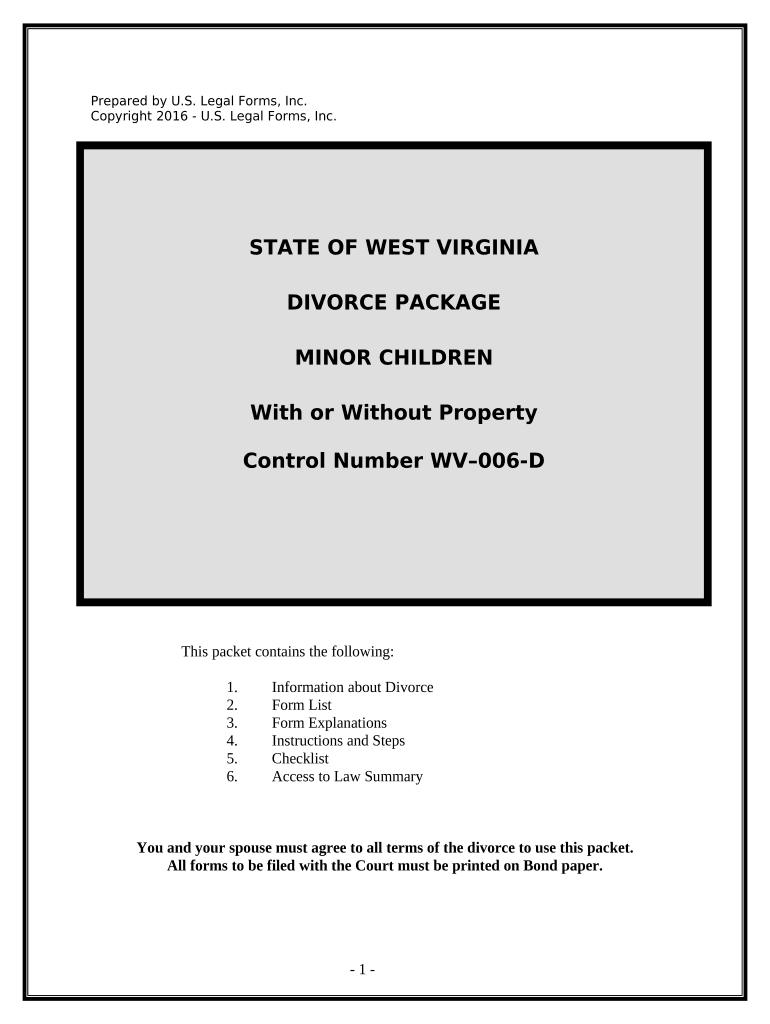
STATE OF WEST VIRGINIA
DIVORCE PACKAGE
MINOR CHILDREN
With or Without Property
Control Number WV–006-D
This packet contains the following:
1. Information about Divorce
2. Form List
3. Form Explanations
4. Instructions and Steps
5. Checklist
6. Access to Law Summary
You and your spouse must agree to all terms of the divorce to use this packet.
All forms to be filed with the Court must be printed on Bond paper.
- 1 -
INFORMATION ABOUT DIVORCE
1. WHO CAN USE THESE FORMS: This packet is designed for the sole purpose of
obtaining an uncontested divorce. This packet is only of use to you if you and your
spouse are willing to agree to all the terms and conditions of your divorce. You
must communicate with your spouse and keep him or she advised as to each step in
the process. If you cannot agree, you will become involved in a contested divorce,
which is beyond the scope of this packet. To use this divorce package to file for
divorce in West Virginia, all of the following must be true:
(a) You and your spouse are seeking a divorce based upon
irreconcilable differences;
(b) There are minor children of said marriage, and the wife is not
now pregnant;
(c) You and your spouse agree on all the terms of the divorce .
2. THE BASICS: In a typical divorce, there are two basic requirements that must be met
before you can file for a divorce. Those requirements are below:
(a) You must satisfy the residency requirements
(b) You must satisfy the no-fault procedures.
3. RESIDENCY REQUIREMENTS: At least one of the parties to the action for divorce
must have been an actual resident of the State of West Virginia for at least one year prior
to the filing of the action for divorce, unless the marriage was contracted in the State of
West Virginia and one of the parties was a resident of the State at the time of contracting,
in which case there is no durational residency requirement.
4. WHERE TO FILE: If the defendant is a resident of the State of West Virginia, an
action for divorce shall be filed in the county where the parties last cohabitated or in the
county where the defendant resides, at the plaintiff's option. If the defendant is not a
resident of the State of West Virginia, the action shall be brought in either the county
where the plaintiff resides, or in the county where the parties last cohabitated.
5. GROUNDS FOR DIVORCE: A divorce may be granted in the State of West Virginia
upon the following grounds:
a. Adultery;
b. Commission of a felony;
- 2 -
c. Willful abandonment or desertion of a party for six months;
d. Cruel or inhuman treatment;
e. Habitual drunkenness or drug addiction;
f. Living separate and apart in separate places of abode without
cohabitation or interruption for one year;
g. Permanent and incurable insanity;
h. Abuse or neglect of a child of the parties or of one of the parties;
i. Irreconcilable differences.
This package is designed to be used by parties seeking a divorce based upon the ground
of irreconcilable differences. The court may order a divorce if the Petition alleges that
irreconcilable differences exist between the parties and an answer is filed admitting that
allegation. A divorce on this ground does not require corroboration of the irreconcilable
differences or of the issues of jurisdiction or venue.
6. LEGAL SEPARATION : A judgement of legal separation is properly referred to as
Judgement of Separate Maintenance. A judgement of separate maintenance may be
awarded:
(a) On any ground for which a decree of divorce may be awarded; or,
(b) If the party from whom separate maintenance is sought, without good and
sufficient cause:
i. Has failed to provide suitable support for the other spouse; or
ii. Has abandoned or deserted the other spouse.
This package does not contain forms for a legal separation.
7. WAITING PERIOD : A final hearing for divorce may not be held until at least twenty
(20) days have elapsed from the date of service of the Petition upon the Respondent
8. ALIMONY/SUPPORT : Since this is an agreed upon divorce, you and your spouse will
decide issues of alimony. The forms assume that no alimony will be paid and is waived
but you may add provisions for alimony if you desire. In a contested case, the courts may
award temporary or permanent alimony to either spouse in either periodic or lump sum
form. In addition to an award of temporary or permanent alimony, the court may make
additional orders regarding medical insurance for a party, use and enjoyment of the
family home, and use or ownership of vehicles owned by the parties. In determining
whether to award alimony and in what amount, the court will consider the following
factors:
(a) The length of the marriage and the period of time that the parties actually
lived together during the marriage;
- 3 -
(b) The present employment income and other earnings income of each party;
(c) The income-earning abilities of each party, and each party's financial
needs;
(d) The terms of the marital property distribution;
(e) The age, physical, mental and emotional health of the parties;
(f) The educational qualifications of each party;
(g) Whether either party has foregone or postponed economic, education or
employment opportunities during the course of the marriage;
(h) The standard of living established during the marriage;
(i) The likelihood of the party seeking alimony increasing his or her income-
earning abilities within a reasonable time through additional education or
training, and the costs of obtaining same;
(j) Financial or other contributions by either party to the education, training
or earning capacity of the other;
(k) The costs of education for any children of the marriage;
(l) The tax consequences to each party;
(m) The extent to which it would be inappropriate for the custodian of minor
children to seek outside employment;
(n) The legal obligations of each party to support himself or herself in
addition to any other person;
(o) Costs associated with a minor or adult child's physical or mental
disabilities;
(p) Any other factor the court deems necessary or appropriate.
9. DISTRIBUTION OF PROPERTY: Since this is an agreed upon divorce, the parties
will agree to all terms of the property distribution. West Virginia is an equitable
distribution state. In a contested case, this means that the court will court shall presume
that all marital property is to be divided equally between the parties, but may alter this
distribution, without regard to fault of either party, after a consideration of the following:
(a) The extent to which each party has contributed to the acquisition, preservation
and maintenance, or increase in value of marital property by monetary
contributions, including, but not limited to:
i. Employment income and other earnings; and
ii. Funds which are separate property.
(b) The extent to which each party has contributed to the acquisition, preservation
and maintenance or increase in value of marital property by nonmonetary
contributions, including, but not limited to:
i. Homemaker services;
ii. Child care services;
iii. Labor performed without compensation, or for less than
adequate compensation, in a family business or other
- 4 -
business entity in which one or both of the parties has an
interest;
iv. Labor performed in the actual maintenance or improvement of
tangible marital property; and
v. Labor performed in the management or investment of assets
which are marital property.
(c) The extent to which each party expended his or her efforts during the marriage
in a manner which limited or decreased such party’s income-earning
ability or increased the income-earning ability of the other party,
including, but not limited to:
i. Direct or indirect contributions by either party to the education
or training of the other party which has increased the
income-earning ability of such other party; and
ii. Foregoing by either party of employment or other income-
earning activity through an understanding of the parties or
at the insistence of the other party.
(d) The extent to which each party, during the marriage, may have
conducted himself or herself so as to dissipate or depreciate the value
of the marital property of the parties: provided, that except for a
consideration of the economic consequences of conduct, fault or
marital misconduct shall not be considered by the court in determining
the proper distribution of marital property.
In cases where the parties have executed a separation agreement, then the court shall
divide the marital property in accordance with the terms of the agreement, unless the
court finds:
(a) That the agreement was obtained by fraud, duress or other unconscionable
conduct by one of the parties; or
(b) That the parties, in the separation agreement, have not expressed themselves
in terms which, if incorporated into a judicial order, would be enforceable
by a court in future proceedings; or,
(c) That the agreement, viewed in the context of the actual contributions of the
respective parties to the net value of the marital property of the parties, is
inequitable, and such agreement was inequitable at the time the same was
executed.
10. NAME CHANGE: When decreeing a divorce, the court may restore a party to the
use of a maiden or former name.
11. CHILD CUSTODY/VISITATION: In determining custody, the court shall give
primary consideration to the best interests of the child. The court shall assure minor
children of frequent and continuing contact with both parents, when appropriate, and
- 5 -
encourage parents to share in the responsibilities of rearing their children. As between the
parents, there shall be no presumption or inference of law in favor of either. The court
shall give due regard to the primacy of the parent-child relationship but may upon a
showing by clear and convincing evidence that the best interest of the child would be
served thereby award custody or visitation to any other person with a legitimate interest.
The court may award joint custody or sole custody.
In determining best interests of a child for purposes of determining custody or visitation
arrangements, the court shall consider the following:
a) In cases where the parties to an action commenced under the provisions of this article
have not executed a separation agreement, or have executed an agreement which is incomplete
or insufficient to resolve the outstanding issues between the parties, or where the court finds the
separation agreement of the parties not to be fair and reasonable or clear and unambiguous, the
court shall proceed to resolve the issues outstanding between the parties.
(b) The court shall consider the following factors in determining the amount of spousal support,
child support or separate maintenance, if any, to be ordered under the provisions of parts 5 and
6, article five of this chapter, as a supplement to or in lieu of the separation agreement:
(1) The length of time the parties were married;
(2) The period of time during the marriage when the parties actually lived together as husband
and wife;
(3) The present employment income and other recurring earnings of each party from any source;
(4) The income-earning abilities of each of the parties, based upon such factors as educational
background, training, employment skills, work experience, length of absence from the job market
and custodial responsibilities for children;
(5) The distribution of marital property to be made under the terms of a separation agreement or
by the court under the provisions of article seven of this chapter, insofar as the distribution affects
or will affect the earnings of the parties and their ability to pay or their need to receive spousal
support, child support or separate maintenance: Provided , That for the purposes of determining a
spouse's ability to pay spousal support, the court may not consider the income generated by
property allocated to the payor spouse in connection with the division of marital property unless
the court makes specific findings that a failure to consider income from the allocated property
would result in substantial inequity;
(6) The ages and the physical, mental and emotional condition of each party;
(7) The educational qualifications of each party;
(8) Whether either party has foregone or postponed economic, education or employment
opportunities during the course of the marriage;
(9) The standard of living established during the marriage;
(10) The likelihood that the party seeking spousal support, child support or separate maintenance
can substantially increase his or her income-earning abilities within a reasonable time by
acquiring additional education or training;
(11) Any financial or other contribution made by either party to the education, training, vocational
skills, career or earning capacity of the other party;
(12) The anticipated expense of obtaining the education and training described in subdivision (10)
above;
(13) The costs of educating minor children;
(14) The costs of providing health care for each of the parties and their minor children;
(15) The tax consequences to each party;
(16) The extent to which it would be inappropriate for a party, because said party will be the
custodian of a minor child or children, to seek employment outside the home;
(17) The financial need of each party;
(18) The legal obligations of each party to support himself or herself and to support any other
person;
(19) Costs and care associated with a minor or adult child's physical or mental disabilities; and
- 6 -
(20) Such other factors as the court deems necessary or appropriate to consider in order to arrive
at a fair and equitable grant of spousal support, child support or separate maintenance.
12. REQUIRED DISCLOSURES OF ASSETS: In all divorce actions and in any
other action involving child support, all parties shall fully disclose their assets and
liabilities within forty days after the service of summons or at such earlier time as
ordered by the court. The information contained on these forms shall be updated on
the record to the date of the hearing.
The disclosure required by this part may be made by each party individually or by the
parties jointly. Assets required to be disclosed shall include, but are not limited to,
real property, savings accounts, stocks and bonds, mortgages and notes, life
insurance, health insurance coverage, interest in a partnership or corporation, tangible
personal property, income from employment, future interests whether vested or non
vested and any other financial interest or source.
The supreme court of appeals shall prepare and make available a standard form for
the disclosure of assets and liabilities required by this part.
For more information, see the West Virginia Divorce Law Summary.
- 7 -
FORMS LIST
The forms included in this package are:
1. Civil Case Information Statement (WV-SCA-FC-103)
2. Petition for Divorce (WV-SCA-FC-101)
3. Vital Statistics Form (WV-SCA-FC-104)
4. Summons (Sample) (WV-804D)
5. Acceptance of Service (WV-SCA-FC-105)
6. Answer (WV-SCA-FC-108)
7. Financial Disclosure Statement (WV-SCA-FC-106)
8. Separation and Property Settlement (WV-808D)
9. Notice of Hearing (WV-SCA-FC-107)
10. Instructions for Completing Forms–Petitioner (WV-SCA-FC-
100)
11. Instructions for Completing Forms-Respondent (WV-SCA-FC-
100A)
12. Parenting Plan Instructions (WV-SCA-FC-120)
13. Proposed Parenting Plan (WV-SCA-FC-121)
14. Parenting Plan Worksheet (WV-SCA-Fc-128)
15. Motion to Adopt Parenting Plan (WV-SCA-FC-129)
16. Bureau for Child Support Enforcement Application and
Income Withholding Form (WV-SCA-FC-113)
- 8 -
FORM EXPLANATIONS
All forms included in this package are identified below.
1. Civil Case Information Statement (WV-SCA-FC-103) – This form is
used to provide the Court with information regarding the type of case before it and the
parties involved.
2. Petition for Divorce (WV-SCA-FC-101) - The Petition for Divorce is
the document is the document is which you are asking the court to grant your divorce
along with any other relief requested.
3. Vital Statistics Form (WV-SCA-FC-104) – This form is used by the
State of West Virginia to update its vital statistics records upon granting the divorce.
4. Summons (WV-804D) – This document is used to provide the
Respondent with notice that a Petition for Divorce has been filed against him or her. The
Summons further informs the Respondent that failure to file an answer may result in a
judgment being taken against him or her for the relief demanded in the Petition. A
sample copy of a Summons has been provided to you in this package for use as a guide.
You must obtain an official Summons issued by the Clerk of Court.
5. Acceptance of Service (WV-SCA-FC-105) – This document is used by
the Respondent to acknowledge receipt of the Petition and Summons.
6. Answer (WV-SCA-FC-108) – This form is used by the Respondent to
respond to the allegations contained in the Petition and to acknowledge that irreconcilable
differences exist between the parties.
7. Financial Disclosure Statement (WV-SCA-FC-106) – This document
is used to identify the assets and debts and income and expenses of the parties. Each
party must complete this document and provide his or her spouse with a completed copy.
The original must be filed with the Court.
8. Separation and Property Settlement Agreement (WV-808D) – This
document provides for the final distribution of any assets and debts of the parties,
- 9 -
provides for support of any children of the marriage and any other agreements reached
between the parties, such as:
(a) Whether spousal support shall be awarded;
(b) Whether an award of spousal support, other than an
award of rehabilitative spousal support or spousal support in gross, may be
reduced or terminated because a de facto marriage exists between the
spousal support payee and another person;
(c) Whether a court shall have continuing jurisdiction over
the amount of a spousal support award so as to increase or decrease the
amount of spousal support to be paid;
(d) Whether spousal support shall be awarded as a lump
sum settlement in lieu of periodic payments;
(e) Whether spousal support shall continue beyond the
death of the payor party or the remarriage of the payee party; or,
(f) Whether the spousal support award shall be enforceable
by contempt proceedings or other judicial remedies aside from contractual
remedies.
9. Notice of Hearing (WV-SCA-FC-107) – This form is used to provide the Respondent
with notice as to the time and place of the Final Hearing. This notice must be sent to the
Respondent at least ten (10) days prior to the date of the Final Hearing.
10. Instructions for Completing Forms–Petitioner (WV-SCA-FC-100) – These are the
instructions for the petitioner to use when filling out the forms. The document also
contains information regarding filing fees, hearings, and definitions of important legal
terms.
11. Instructions for Completing Forms–Respondent (WV-SCA-FC-100A) – These are the
instructions for the respondent to use when filling out the forms. The document also
contains information regarding deadlines, filing of the answer, hearings, and
definitions of important legal terms.
12. Parenting Plan Instructions (WV-SCA-FC-120 – These are the instructions for
completing the parenting plan. The parenting plan is required in all cases involving
minor children.
13. Proposed Parenting Plan (WV-SCA-FC-121) – The court requires a parenting plan
for all cases that involve minor children. If the parents can agree on a plan, they
can submit a Joint Proposed Parenting Plan to the court. If the parents cannot agree
on a joint plan, either parent can submit an Individual Proposed Parenting Plan.
(Please see the “Parenting Plan Instructions” for a thorough explanation of your rights
and responsibilities regarding the Proposed Parenting Plan).
- 10 -
14. Parenting Plan Worksheet (WV-SCA-FC-128) – This worksheet must be filled out
and submitted with the Proposed Parenting Plan. (Please see the “Parenting Plan
Instructions for a thorough explanation of your rights and responsibilities).
15. Motion to Adopt Parenting Plan (WV-SCA-FC-129) – This document must be filed with
the Proposed Parenting Plan and the Parenting Plan Worksheet. These documents must
also be served on your spouse. (Please see the “Parenting Plan Instructions” for an
explanation of methods of service).
16. Bureau for Child Support Enforcement Application and Income Withholding Form
(WV-SCA-FC-113) – This form is necessary if minor children are involved, or spousal
Support is being requested by either party. If either of these conditions apply to the
Divorce, both parties must complete the form. (Please see the “Instructions for
Completing Forms” for a complete explanation).
- 11 -
INSTRUCTIONS AND STEPS
Note: If a form con tains a space for the signature of a Notary Public, it must be signed by you
(and if necessary by your spouse) in front of a Notary Public, who must notarize the document.
Prepare an original and several copies of each of your completed documents. Your spouse
should have a copy of everything you file, stamped “filed” by the clerk. You should keep copies
and the court must have originals.
STEP 1: The filing party should completely fill out the Petition (WV-SCA-FC-101). This
document tells the Court that you are seeking a divorce and informs the Court as
to why you want one. The Verification form attached to the Petition tells the
Court that everything stated in the Petition (WV-SCA-FC-101) is true. This must
be signed under oath in front of a Notary Public.
STEP 2: The Civil Case information Sheet (WV-SCA-FC-103) must next be completed.
This form is used by the Court to track cases on its docket. Three (3) copies of
this form must be filed with the Clerk.
STEP 3: The Vital Statistics (WV-SCA-FC-104) form must also be completed. This form
is used by the Clerk to update the State Office of Vital Statistics regarding your
divorce. If minor children are involved, or spousal support is being requested by
either party, a Bureau for Child Support Enforcement Application and Income
Withholding Form (Wv-SCA-FC-113) must be completed.
STEP 4: The Petition (WV-SCA-FC-101), Civil Case Information Statement (WV-SCA-
FC-103) , Vital Statistics Sheet (WV-SCA-FC-104), and the Bureau for Child
Support Enforcement Application and Income Withholding Form (WV-SCA-FC-
113) must be filed with the Clerk of Court in the county of filing. A filing fee
must be paid at this time.
STEP 5: The Respondent must next be provided with notice of the divorce action by
serving him or her with the Summons (WV-804D) and copies of the previously
filed documents. The Summons (WV-804D) must be obtained from the Clerk of
Court in the county of filing. A copy has been provided to assist you when
completing this document. When giving a copy of the previously filed documents
to your spouse, also provide your spouse with the Acceptance of Service (WV-
SCA-FC-105) form included in this packet. Your spouse should complete and
return this form to you. Once the Acceptance of Service (WV-SCA-FC-105) is
returned to you, file the form with the Clerk of Court in the county of filing to
inform the Court of the Respondent’s receipt of the Petition (WV-SCA-FC-101)
and Summons (WV-804D) .
- 12 -
STEP 5: Once the other spouse is served or accepts service, he/she has 20 days in which to
file an Answer (WV-SCA-FC-108) to the Petition (WV-SCA-FC-101). By
completing the Answer (WV-SCA-FC-108) , the other spouse is agreeing to the
ground of irreconcilable differences. TO OBTAIN A NO-FAULT DIVORCE,
your spouse MUST FILE AN ANSWER (WV-SCA-FC-108) agreeing to the
ground of irreconcilable differences. A copy of the Respondent’s Answer must
be served on the Petitioner. The Respondent must also complete a Bureau for
Child Support Enforcement Application and Income Withholding Form (WV-
SCA-FC-113) if minor children are involved or either party is seeking spousal
support. This form must be filed with the Respondent’s Answer. The Respondent
must serve the Petitioner with a copy of the Answer and other documents that
have been filed with the Answer. If minor children are involved, the parties must
also complete a Proposed Parenting Plan (WV-SCA-FC-121) and an
accompanying Parenting Plan Worksheet (WV-SCA-FC-128). These forms must
be filed with the court prior to the first hearing . (Please refer to the Parenting
Plan Instructions (WV-SCA-FC-120) before completing the forms).
STEP 6: Each party to the divorce must complete a copy of the Financial Disclosure
Statement (WV-SCA-FC-106) . This document informs the Court of both parties’
financial status. Each party must complete this form and provide the other spouse
with a completed copy. The original must be filed with the Court no less than
five (5) days before the hearing.
STEP 7: Both parties should next complete the Separation and Property Settlement
Agreement (WV-808D) , making certain to agree to all of the terms contained
therein. After completion, this document must be filed with the Clerk of Court.
STEP 8: A final hearing must now be scheduled. The final hearing may not be scheduled
until at least twenty days have elapsed from the date of service of the Petition
(WV-SCA-FC-101) upon the Respondent. Contact the Clerk for the procedure
used to schedule the hearing and follow those procedures. The other spouse must
be given 10 days notice of the hearing. The original Notice of Hearing (WV-
SCA-FC-107) form must be filed with the Clerk and a copy must be mailed to
your spouse.
STEP 9: Be prepared to answer any questions the Court may ask regarding your divorce at
the final hearing. The Court may pose questions to either party regarding the
financial information submitted to the Court, the Proposed Parenting Plan (WV-
SCA-FC-121), and whether both parties understand and agree to all of the terms
contained in the Separation and Property Settlement Agreement (WV-808D) .
STEP 10: After your hearing, the Court will prepare all orders and findings of fact. A copy
of these findings and orders will be sent to you and your spouse. Be certain to
- 13 -
review them carefully. If you and your spouse agree with all of the terms in the
recommended order, you must simply wait for the Judge in your case to sign the
Final Order. A copy will be set to you by the Clerk’s office. If you do not agree
with the recommended order, you must file written objections with the Clerk
within five (5) days after you receive the Order. If no objections are received, the
court shall enter the order and findings no later than three (3) days following the
conclusion of the objection period.
STEP 10: Your divorce is final when the Final Order is entered by the Court.
Notes: When presenting Pleadings to the Clerk make sure you have at least 4 copies for
the Clerk. The Clerk will return the copies to you that the Court does not need.
If a Certificate of Mailing is on any form, a copy of the form should be mailed to
the person indicated.
- 14 -
CHECKLIST
Petition (WV-SCA-FC-101), Civil Case Information Sheet (WV-SCA-FC-103),
Bureau for Child Support Enforcement Application and Income Withholding
Form (Wv-SCA-FC-113) and Vital Statistics (WV-SCA-FC-104) forms
completed and filed with the Clerk of Court in the county of filing. Filing fee
paid.
Respondent served with Summons and copies of Petition (WV-SCA-FC-101),
Civil Case Information Sheet (WV-SCA-FC-103), Bureau for Child Support
Enforcement Application and Income Withholding Form (Wv-SCA-FC-113), and
Vital Statistics (WV-SCA-FC-104) forms. Respondent also provided with
Acceptance of Service (WV-SCA-FC-105) form and Answer (WV-SCA-FC-108).
Acceptance of Service (WV-SCA-FC-105) form is completed by Respondent and
then returned to the Petitioner for filing.
Respondent completes and files Answer (WV-SCA-FC-108) and the Bureau for
Child Support Enforcement Application and Income Withholding Form (Wv-
SCA-FC-113) within allotted time period of twenty days from service of Petition
(WV-SCA-FC-101). Answer (WV-SCA-FC-108) and the Bureau for Child
Support Enforcement Application and Income Withholding Form (Wv-SCA-FC-
113) served on Petitioner. If minor children are involved, the parties must also
complete a Proposed Parenting Plan (WV-SCA-FC-121) and an accompanying
Parenting Plan Worksheet (WV-SCA-FC-128). These forms must be filed with
the court prior to the first hearing . (Please refer to the Parenting Plan Instructions
(WV-SCA-FC-120) before completing the forms).
Both parties complete and exchange with each other copies of the Financial
Disclosure Statement (WV-SCA-FC-106). Originals of the Financial Disclosure
Statements (WV-SCA-FC-106) filed with the Court not less than five (5) days
before the final hearing.
Separation and Property Settlement Agreement (WV-808D) completed by the
parties and filed with the Court.
Final hearing scheduled. Notice of Hearing (WV-SCA-FC-107) form filed with
Court and copy provided to Respondent giving him or her at least ten (10) days
notice of final hearing.
Final hearing held. Both parties answer any questions posed to them by the
Court.
- 15 -
Court prepares proposed final orders and findings of fact. Copies of proposed
final orders and findings of fact provided to both parties. Parties have five (5)
days to object in writing to proposed final orders and findings of fact. If no
objections received, Court will enter Final Order within three (3) days of
conclusion of objection period.
Divorce is final when entered by the Court.
- 16 -
NOTE ABOUT COMPLETING THE FORMS
The forms in this packet contain “form fields” created using Microsoft Word. “Form fields”
facilitate completion of the forms using your computer. They do not limit you ability to print the
form “in blank” and complete with a typewriter or by hand.
If you do not see the gray shaded form fields, go the View menu, click on Toolbars, and then
select Forms. This will open the forms toolbar. Look for the button on the forms toolbar that
resembles a shaded letter “a”. Click in this button and the form fields will be visible.
The forms are locked which means that the content of the forms cannot be changed. You can
only fill in the information in the fields.
If you need to make any changes in the body of the form, it is necessary for you “unlock” or
“unprotect” the form. IF YOU INTEND TO MAKE CHANGES TO THE CONTENT, DO
SO BEFORE YOU BEGIN TO FILL IN THE FIELDS. IF YOU UNLOCK THE
DOCUMENT AFTER YOU HAVE BEGUN TO COMPLETE THE FIELDS, WHEN
YOU RELOCK, ALL INFORMATION YOU ENTERED WILL BE LOST. To unlock,
click on “Tools” in the Menu bar and then selecting “unprotect document”. You may then be
prompted to enter a password. If so, the password is “uslf”. That is uslf in lower case letters
without the quotation marks . After you make the changes relock the document before you
begin to complete the fields.
After any required changes and re-protecting the document, click on the first form field and enter
the required information. You will be able to navigate through the document from form field to
form field using your tab key. Tab to a form field and insert your data. If you experience
problems, please let us know.
- 17 -
LAW SUMMARY
You may access the law summary for your State by using the link below:
http://secure.uslegalforms.com/lawsummary/WV/WV-004-D.htm
- 18 -
DISCLAIMER
These materials were developed by U.S. Legal Forms, Inc. based upon statutes and forms for the
State of West Virginia. All Information and Forms are subject to this Disclaimer: All forms in
this package are provided without any warranty, express or implied, as to their legal effect and
completeness. Please use at your own risk. If you have a serious legal problem we suggest that
you consult an attorney. U.S. Legal Forms, Inc. does not provide legal advice. The products
offered by U.S. Legal Forms (USLF) are not a substitute for the advice of an attorney.
THESE MATERIALS ARE PROVIDED "AS IS" WITHOUT ANY EXPRESS OR IMPLIED
WARRANTY OF ANY KIND INCLUDING WARRANTIES OF MERCHANTABILITY,
NONINFRINGEMENT OF INTELLECTUAL PROPERTY, OR FITNESS FOR ANY
PARTICULAR PURPOSE. IN NO EVENT SHALL U. S. LEGAL FORMS, INC. OR ITS
AGENTS OR OFFICERS BE LIABLE FOR ANY DAMAGES WHATSOEVER
(INCLUDING, WITHOUT LIMITATION DAMAGES FOR LOSS OF PROFITS, BUSINESS
INTERRUPTION, LOSS OF INFORMATION) ARISING OUT OF THE USE OF OR
INABILITY TO USE THE MATERIALS, EVEN IF U.S. LEGAL FORMS, INC. HAS BEEN
ADVISED OF THE POSSIBILITY OF SUCH DAMAGES.
THESE FORMS WERE PREPARED FOR STATEWIDE USE. HOWEVER, SOME
COUNTIES OR JUDGES MAY REQUIRE CERTAIN MODIFICATIONS TO THE FORMS
FOR USE IN YOUR PARTICULAR COUNTY AND MAY REQUIRE SPECIAL FORMS
NOT INCLUDED. CHANGES REQUIRED BY PARTICULAR JUDGES ARE NOT
UNCOMMON EVEN IF THE FORMS HAD BEEN PREPARED BY YOUR ATTORNEY.
REGARDLESS, YOU SHOULD BE ABLE TO USE THESE FORMS AND INSTRUCTIONS,
WITH ANY REQUIRED MODIFICATIONS, TO MAKE IT THROUGH THE PROCESS. IF
YOU NEED TO MAKE CHANGES, OR IF SPECIAL FORMS ARE REQUIRED IN YOUR
COUNTY, YOU CAN MAKE THE CHANGES AND REFILE, OR OBTAIN THE SPECIAL
FORMS EITHER FROM THE CLERK OR A CLOSED DIVORCE FILE WHICH YOU CAN
USE AS AN EXAMPLE.
- 19 -