Establishing secure connection…Loading editor…Preparing document…

North Carolina Bankruptcy

This template is fully customizable. Edit the text, fill out the fields, and send it for signature. Give it a try!
North Carolina Bankruptcy

Overview of North Carolina bankruptcy filings

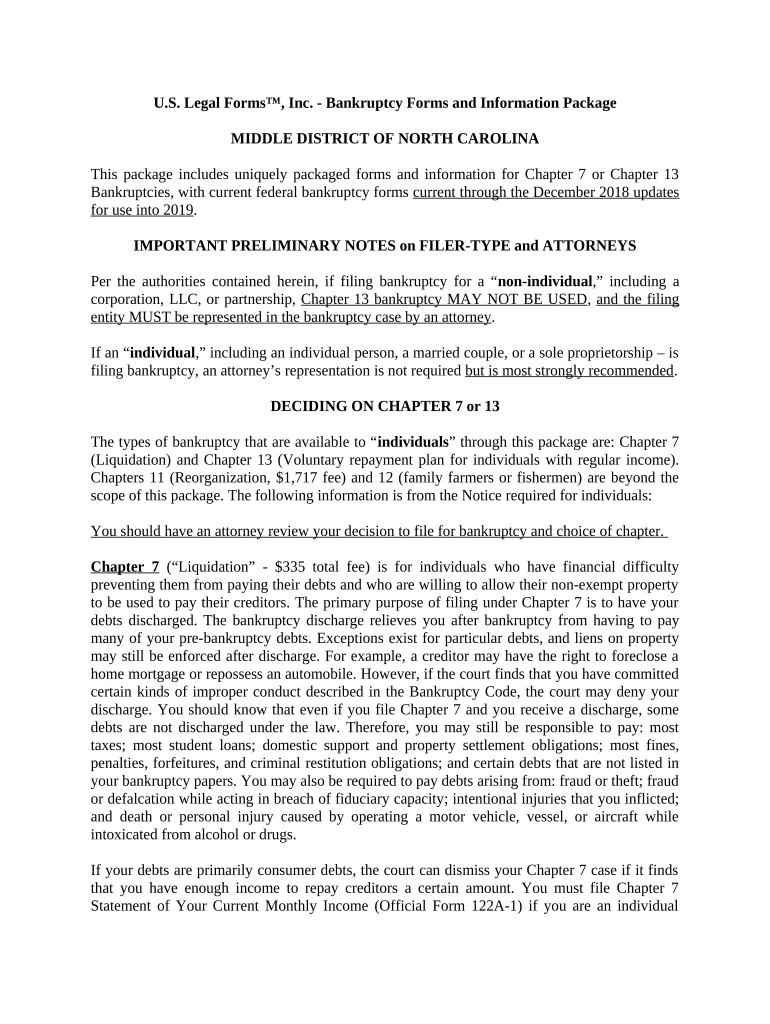
A North Carolina bankruptcy refers to a consumer or business insolvency filing processed through the federal bankruptcy courts that serve North Carolina. Common case types include Chapter 7 liquidations and Chapter 13 repayment plans, and filings initiate an automatic stay that pauses most collection actions. Local practice varies by district; petitions, schedules, and supporting exhibits are submitted to the appropriate U.S. Bankruptcy Court and follow federal bankruptcy rules plus state-specific exemption choices.

Why understanding the North Carolina bankruptcy process matters

Filing bankruptcy in North Carolina can provide legal relief from unsecured debt and structured repayment options while imposing procedural requirements and deadlines that affect discharge eligibility.

Why understanding the North Carolina bankruptcy process matters

Who prepares and relies on North Carolina bankruptcy documents

Individuals, small-business owners, bankruptcy attorneys, trustees, and court clerks typically prepare or receive bankruptcy petitions and schedules.

  • Individuals seeking debt relief who need to inventory assets, income, and creditors for a federal bankruptcy petition.
  • Bankruptcy attorneys who draft petitions, advise on exemptions and means test calculations, and represent debtors in hearings and adversary proceedings.
  • Trustees and court staff who review filings, administer assets, and schedule creditor meetings and confirmations.

Accurate preparation supports timely hearings, protects discharge rights, and reduces the risk of dismissal or objections.

Key people involved

Bankruptcy Attorney

A licensed attorney who advises the debtor on chapter eligibility, prepares petition schedules and statements, represents the client at the meeting of creditors, and files required court pleadings. Attorneys also advise on exemption elections and negotiate with trustees or creditors when appropriate.

Trustee

An appointed or panel trustee administers the estate: reviews schedules, conducts the meeting of creditors, evaluates nonexempt assets for liquidation in Chapter 7, or monitors Chapter 13 plan payments and trustee distributions to creditors.

Document security and legal frameworks to consider

Encryption: TLS 1.2/1.3 in transit; AES-256 at rest
Audit Trail: Timestamps, IP addresses, detailed action log
Electronic Signature Law: ESIGN and UETA recognize e-signatures
HIPAA: BAA required when PHI is present
Records Controls: Retention and access controls required
Compliance Reports: SOC 2 Type II and ISO 27001 available

Risks and legal consequences of errors

Case Dismissal: Incomplete filings can result in dismissal
Loss of Discharge: Undisclosed debts may remain nondischargeable
Creditor Sanctions: False statements can trigger sanctions
Preference Claims: Trustee may pursue recoveries
Perjury Risk: Signatures attest to truth under penalty
Late Objections: Missed deadlines limit remedies

Common preparation mistakes to avoid

  • Failing to list all creditors and recent transfers, which can result in trustee inquiries or adversary actions and jeopardize discharge eligibility.
  • Incorrect exemption selection or arithmetic errors on Schedules A–J that produce objections or require amended filings.
  • Not completing the means test accurately, causing an eligibility determination or conversion to a different chapter.
  • Omitting required supporting documentation such as tax returns, pay stubs, or proof of secured debt that delays the 341 meeting.

Filing steps for a North Carolina bankruptcy petition

Use this sequential checklist to prepare and submit a typical consumer bankruptcy petition in North Carolina.

  • 01
    Gather information: Collect income, assets, creditor names, and recent transactions.
  • 02
    Complete schedules: Fill Schedules A–J, Statement of Financial Affairs, and means test.
  • 03
    File petition: Submit documents to the appropriate U.S. Bankruptcy Court clerk.
  • 04
    Attend 341 meeting: Appear for the creditor meeting and answer trustee questions.

Where petitions are routed and processed

Court filing and service follow structured channels; choose the correct district, serve required parties, and preserve proof of filing and service.

  • District Clerk: File with the U.S. Bankruptcy Court serving your county.
  • Electronic Filing: Use CM/ECF for attorney e-filing; pro se filers follow local rules.
  • Serve Creditors: Provide notice and proof of service to scheduled creditors.
  • Trustee Office: Send required documents to the assigned trustee as directed.

Core documents included in a North Carolina bankruptcy case

A complete filing bundles specific petitions, schedules, statements, and any chapter-specific plans; accuracy and supporting evidence are essential for court review and trustee administration.

Voluntary Petition

The initial filing that opens the case and lists parties, case chapter, and basic debtor information; it triggers the automatic stay and sets deadlines for subsequent filings.
Schedules A–J

Comprehensive asset, liability, income, and expense schedules that disclose property, secured debt, unsecured debt, and monthly budget items for trustee and creditor review.

Statement of Affairs

Narrative and transaction history disclosures used by trustees and creditors to evaluate transfers, secured interests, and potential avoidance actions.

Means Test

Income and expense calculations determining chapter eligibility and whether a Chapter 7 filing is presumed abusive under federal rules.

Chapter 13 Plan

For Chapter 13 debtors, a proposed repayment plan outlining monthly payments, distribution to unsecured creditors, and treatment of secured claims.

Proofs of Claim

Creditor-submitted claims that document amounts owed; trustees use proofs of claim to calculate distributions when required by the plan or liquidation process.

Downloading, supporting documents, and export options

Maintain editable and secure copies of filings and supports; export formats affect redaction, signatures, and court submissions.

PDF Export

Export finalized petitions and schedules as PDF/A for stable, court-ready archives that preserve pagination and embedded metadata.

Word Drafts

Keep editable DOCX drafts during preparation for collaborator edits, then finalize to PDF before filing to avoid inadvertent post-filing changes.

Supporting Exhibits

Attach tax returns, pay stubs, and account statements as numbered exhibits with a table of contents for the trustee and court.

Certificate of Service

Generate and retain signed certificates documenting service method, recipients, and dates; courts require this proof for many filings.

Practical tips for accurate and efficient filings

Follow these practices to reduce errors, accelerate review, and protect your discharge rights.

Double-check creditor names and addresses
Use account statements or credit reports rather than memory; accurate creditor identification prevents missed notices and reduces the likelihood of creditors being omitted from schedules.
Document sources of income thoroughly
Attach current pay stubs and tax return summaries; inconsistent income reporting can trigger additional trustee inquiries and means test recalculation.
Organize supporting evidence into exhibits
Label and paginate supporting documents, and provide a short index; well-organized exhibits simplify trustee review and reduce continuances.
Keep an audit-ready filing record
Retain signed petition copies, proof of service, and timestamps; these records are essential if a creditor challenges a filing or the court requests proof.

Key deadlines to monitor in a bankruptcy case

Deadlines vary by chapter and local rule; track federal time limits and any dates set in scheduling orders.

Meeting of Creditors (341):

Typically scheduled within weeks after filing; exact timing set by the court.

Objections to Discharge:

Often due within 60 days after the first date set for the meeting of creditors.

Claim Filing Deadline:

Bar dates are set by the court; unsecured creditors must file by the stated deadline.

Plan Confirmation Hearing:

For Chapter 13, scheduled after plan filing and notice to creditors.

Amendment Windows:

Corrective amendments should be filed promptly upon discovery of errors.

Milestones in a typical consumer bankruptcy case

A sequential view of major case milestones and what each stage requires from the debtor and counsel.

01

Preparation

Assemble financial records, run the means test, and draft schedules.

02

Petition Filed

Clerk opens the case and issues notices to creditors and trustee.

03

341 Meeting

Debtor appears before the trustee to answer questions under oath.

04

Resolution

Trustee administers estate, plan confirmed, or discharge entered.

Comparing Chapter 7 and Chapter 13 in practical terms

A concise side-by-side of common differences to guide chapter selection conversations with counsel.

Criteria Chapter 7 Chapter 13
Eligibility means test pass regular income required
Typical duration immediate liquidation three to five years
Repayment plan no plan confirmed court plan required
Discharge scope many unsecured debts debts subject to plan

SignNow and competitor pricing snapshot for e-signing court documents

Overview of starting prices and core capabilities for common e-signature vendors used to collect and manage signed bankruptcy documents—signNow is listed first per vendor-comparison convention.

signNow DocuSign Adobe Sign PandaDoc HelloSign
Starting Price $8/user/mo $15/user/mo $14/user/mo $19/user/mo $15/user/mo
Free Trial 7-day free trial Varies Varies Varies Varies
Bulk Send Yes Yes Yes Yes No
Audit Trail Yes Yes Yes Yes Yes
HIPAA Compliant Yes Yes Yes No No
Envelope Cap No cap 100 envelopes/user/year Varies Varies Varies

Frequently asked questions about North Carolina bankruptcy filings

Answers to common questions about filing, signatures, deadlines, and corrections to help prevent routine errors and set expectations.


Need help? Contact support

be ready to get more
Join over 28 million airSlate SignNow users