Establishing secure connection…Loading editor…Preparing document…

Final Notice of Default for Contract for Deed

This template is fully customizable. Edit the text, fill out the fields, and send it for signature. Give it a try!
Final Notice of Default for Contract for Deed

What the Final Notice of Default for Contract for Deed Is

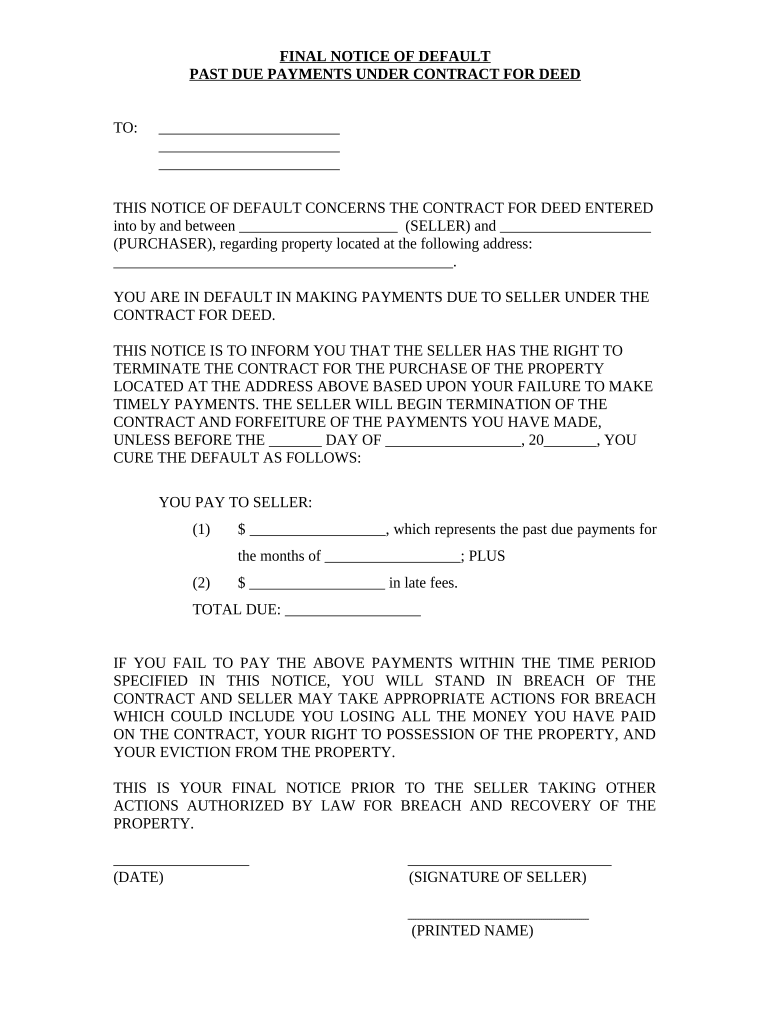
A Final Notice of Default for Contract for Deed is a formal written notice sent by the seller (vendor) to a buyer who has failed to meet payment or performance obligations under a contract for deed. The notice summarizes the breach, states the amount owed or remedy required, specifies any contractual cure period, and informs the buyer of the seller’s intent to accelerate, repossess, or pursue other remedies if the default is not cured. It preserves enforcement rights and begins statutorily required notice timelines for many jurisdictions.

Why a Clear Final Notice of Default Matters

A professionally prepared final notice documents the default, creates a clear paper trail for enforcement or litigation, and satisfies procedural notice requirements that many states impose before acceleration or repossession.

Why a Clear Final Notice of Default Matters

Core Elements to Include in the Notice

A compliant notice should be concise but complete, identifying the parties, the contract, the specific breaches, the cure terms, and the consequences of noncompliance. Draft each element to match contract language and state law requirements.

Parties

Identify seller and buyer by full legal names and roles; include contact information and mailing addresses exactly as in the contract.
Contract Details

Reference the original contract date, parcel or property description, and any recorded instrument numbers to uniquely identify the agreement.

Default Description

State the exact covenant breached (missed payment, insurance lapse, tax default), include dates and amounts, and reference the contract section.

Amount Due

Itemize unpaid principal, interest, late charges, escrow advances, and total demand with a calculation period and supporting dates.

Cure Period

Specify the number of days to cure, the required payment method, and where cure payments must be delivered under the contract.

Consequences

Explain contractual remedies (acceleration, forfeiture, repossession, foreclosure) and any intent to record or file enforcement documents.

Who Prepares and Receives This Notice

The Final Notice of Default is typically prepared by the seller, property manager, or their attorney to begin enforcement under a contract for deed.

  • Seller or vendor: issues the notice when a buyer materially defaults under contract terms.
  • Buyer (obligor): receives the notice and has the opportunity to cure within the stated period.
  • Attorneys and agents: often prepare, review, and serve notices to ensure legal compliance.

Step-by-Step: Preparing and Serving the Notice

Follow a standard sequence to reduce procedural errors and create a dependable record for enforcement.

  • 01
    Review Contract: Confirm default definitions, cure terms, and required notice language from the contract.
  • 02
    Calculate Demand: Compute the exact amount owed and supporting dates before populating the notice.
  • 03
    Draft Notice: Use clear, plain language that tracks contractual terms and states consequences precisely.
  • 04
    Serve and File: Serve per contract/state method and retain proof; record or file with county if required.

Configuring an Online Workflow for Notices

Set up templates and signer authentication to standardize notices and track completions across the organization.

Field Configuration
Template Create a reusable template with locked legal clauses and editable demand fields.
Authentication Use email plus SMS or KBA where required to verify recipient identity.
Audit Trail Enable full logging of IP, timestamps, and document history for evidentiary purposes.
Storage Archive executed notices in encrypted cloud storage with versioning enabled.

Digital Signing and Submission Considerations

When you e-sign and e-submit a final notice of default, ensure the platform supports legal retention, strong authentication, and a tamper-evident audit trail.

  • PDF Support: PDF and PDF/A output
  • Authentication: Email, SMS, or KBA
  • RON Ready: Audio-video and journal options

Where to File or Send the Final Notice

Determine destination(s) based on contract language and applicable state law; commonly send to the buyer and record or file with county or court when required.

  • Buyer Delivery: Serve personally, by certified mail, or per contract-specified method.
  • County Recording: Record only if statute or enforcement requires filing to create public notice.
  • Service Providers: Send copies to escrow, property manager, or attorney as applicable.
  • Court Filing: File if immediate judicial relief or foreclosure is pursued.

eSignature Vendor Comparison for Serving Notices

A quick comparison of core pricing and compliance features for common eSignature vendors; signNow is listed first per platform comparison conventions.

signNow DocuSign Adobe Sign PandaDoc HelloSign
Starting Price $8/user/mo $15/user/mo $14/user/mo $19/user/mo $15/user/mo
Free Trial 7-day free trial Varies by plan Varies by plan Varies by plan Varies by plan
Bulk Send Yes Varies by plan Varies by plan Varies by plan Varies by plan
Audit Trail Yes Yes Yes Yes Yes
HIPAA Compliant Yes Yes Yes No No
Envelope Cap No cap 100 envelopes/user/year Varies by plan Varies by plan Varies by plan

Common Preparation Mistakes to Avoid

  • Using informal property descriptions that create ambiguity at recording or in court proceedings.
  • Listing incorrect names or addresses that prevent effective service or lead to jurisdiction challenges.
  • Failing to compute interest, late fees, or escrow advances accurately, producing disagreements about amounts due.
  • Neglecting proof of service or failing to follow contract-ordered notice procedures.

Consequences of an Incorrect Notice

Void Notice: Court may find notice invalid
Lost Remedies: Seller could lose acceleration or forfeiture rights
Monetary Liability: Potential damages for wrongful repossession
Regulatory Penalties: State fines for noncompliance
Delay: Enforcement postponed, increasing costs
Reputational Harm: Business relationships and credit impact

Practical Tips for Accurate, Efficient Notices

Follow standardized templates, verify calculations, and document service carefully to reduce legal risk and speed enforcement.

Use a Master Template
Maintain a single vetted template that maps to your contract language and state requirements; route all notices through legal review for non-routine cases to ensure consistency and defensibility.
Document Service Carefully
Always obtain proof of service—certified mail receipts, process server affidavits, or RON logs—and archive evidence in a secure, auditable system to support enforcement actions.
Confirm Signer Authority
Ensure the signer is authorized by corporate resolution or contract delegation; attach evidence of authority when signing on behalf of an entity to prevent challenges.
Validate Calculations
Reconcile ledger entries to demand amounts before sending; include a clear arrears schedule to avoid disputes and reduce the likelihood of litigation over math errors.

Frequently Asked Questions

Answers to common legal and procedural questions about issuing and serving a Final Notice of Default for Contract for Deed.


Need help? Contact support

be ready to get more
Join over 28 million airSlate SignNow users