Establishing secure connection…Loading editor…Preparing document…

California Notice of Cessation

This template is fully customizable. Edit the text, fill out the fields, and send it for signature. Give it a try!
California Notice of Cessation

What the California Notice of Cessation Is and when it applies

The California Notice of Cessation is a recording used in California construction law to indicate that work on a private construction project has stopped. Recording the notice can affect the time periods for filing mechanic's liens and stop notices by shortening the lien claim window for some subcontractors and suppliers. It typically contains parties, property description, the last date of work, and recording details. Use of the form varies by county and project type; confirm local recorder requirements and service rules before relying on the recorded notice.

Why filing a Notice of Cessation matters for project closeout

Recording a Notice of Cessation clarifies when on-site work stopped and can shorten lien-filing windows, reducing open exposure and clarifying final accounting and release obligations for owners, general contractors, and suppliers.

Why filing a Notice of Cessation matters for project closeout

Which parties commonly prepare or rely on this notice

The Notice of Cessation is primarily used by property owners and prime contractors to document project cessation and to limit ongoing exposure.

  • Property owners and managers who want to fix the official stop date for a project and reduce extended lien exposure.
  • General contractors and construction managers who need to close accounting and confirm contract finality for downstream parties.
  • Subcontractors, suppliers, and title insurers monitoring recorded filings to calculate mechanics lien or bond claim deadlines.

Essential elements to include in a professional Notice of Cessation

A compliant notice is concise, accurate, and clearly identifies parties, property, project dates, and recording information to make the cessation effective against potential lien claimants.

Notice Title

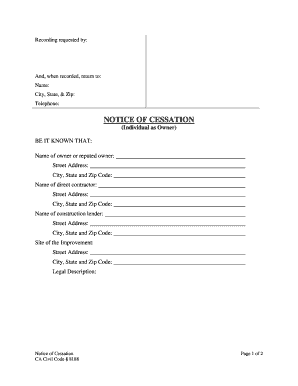
A clear heading such as 'Notice of Cessation' so recorders and searchers immediately recognize the filing type.
Property

Full legal property description and street address so the recorder and claimants can identify the project without ambiguity.

Owner Details

Owner name and mailing address for service and to tie the notice to the correct legal entity or individual.

Contractor Details

Name and address of the prime contractor or entity responsible for the work at the project site.

Last Work Date

Exact last date of labor, services, or materials on site; this date defines the cessation triggering lien timelines.

Recording Info

Signature, date, and space for county recorder stamps; include notary block if locally required by the recorder.

Step-by-step: completing and recording the Notice of Cessation

Follow this ordered checklist to prepare, verify, record, and distribute the Notice of Cessation so it has the intended legal effect.

  • 01
    Prepare the draft: Populate all required fields accurately.
  • 02
    Verify parties: Confirm legal names and parcel identifiers.
  • 03
    Record with county: Submit to the county recorder with required fee.
  • 04
    Provide copies: Serve stakeholders and retain certified copy.

How to configure an online workflow for this notice

Setting up a repeatable online workflow reduces manual errors and ensures each notice is recorded and distributed consistently.

Field Configuration
Document template Create a reusable Notice of Cessation template with locked fields.
Signer roles Assign owner or contractor as signer with email authentication.
Recorder export Export final PDF sized for county recorder acceptance.
Distribution list Auto-send certified copy to title, GC, and suppliers.

Digital signing and platform considerations

Verify the eSignature platform supports the document format, signer authentication, and audit trail retention you need.

  • File formats: PDF and DOCX accepted
  • Authentication: Email, SMS code, or stronger
  • Audit trail: IP, timestamp, and consent

Choose a platform that produces a tamper-evident signed PDF, stores a complete audit trail, supports any notarization steps required by local recorders, and lets you export signed copies for distribution and long-term storage.

Filing and distribution flow at a glance

This sequence shows common routing from preparation to public recording and stakeholder notices.

  • Draft Notice: Populate template with project and party data.
  • Sign and certify: Authorized party signs; notarize if required.
  • Record: Submit to county recorder with fee.
  • Serve copies: Send recorded copy to interested parties.

Timing considerations and practical filing windows

File and distribute promptly: recording and service timing affects the lien and notice windows available to subcontractors and suppliers.

Record Promptly:

Record as soon as practical after actual work stops.

Serve Interested Parties:

Provide recorded copy to contractors and claimants quickly.

Check County Rules:

Some counties require specific submission formats or fees.

Coordinate with Contracts:

Align filing with contract closeout and final pay requests.

Preserve Evidence:

Keep proof of service and certified recorded copy for disputes.

Consequences and legal risks of an incorrect or late notice

Invalid Notice: May not shorten lien deadlines
Recording Rejection: County may reject for improper formatting
Service Failure: Stakeholders may not be bound or notified
Title Issues: Recorded errors can cloud title searches
Litigation Exposure: Incorrect filings can trigger disputes
Extra Costs: Re-recording and legal fees may result

Common mistakes to avoid when preparing this notice

  • Using an incomplete legal description that fails to match the county parcel or assessor parcel number, causing recorder rejection or misindexing.
  • Entering inconsistent party names between contracts, title records, and the notice, which can create confusion and weaken the notice's intended effect.
  • Failing to retain proof of service or a certified recorded copy, leaving the filer unable to prove distribution or the effective record date.
  • Relying on informal email circulation instead of formal recorded filing and required statutory service methods recognized by courts and title companies.

Required information checklist for the Notice of Cessation

Project Name: Exact project identifier
Property Description: Street address and APN
Owner Name: Legal owner or entity
Contractor Name: Prime contractor or agent
Last Work Date: MM/DD/YYYY format
Recorder Block: Space for county stamps

Real-world examples of how parties use a Notice of Cessation

Two brief scenarios illustrate typical uses and outcomes when the notice is recorded and shared correctly.

Owner Records to Limit Claims

A property owner recorded a Notice of Cessation when final site work ended

  • This clarified the last-date-of-work for all subcontractors
  • As a result, title clearance proceeded and the owner reduced exposure to late lien claims while retaining proof of the cessation date for future disputes.

Contractor Uses for Final Accounting

A general contractor recorded the notice to start final accounting and close purchase orders

  • Suppliers used the recorded date to file final invoices timely
  • The contractor completed lien releases faster and closed the job with complete documentation for the owner and title insurer.

eSignature platform pricing and feature snapshot relevant to recording and serving notices

Compare starting prices and select platform features that matter for multi-signer, bulk, and HIPAA-sensitive workflows; signNow appears first for parity in feature comparison.

signNow DocuSign Adobe Sign PandaDoc HelloSign
Starting Price $8/user/mo $15/user/mo $14/user/mo $19/user/mo $15/user/mo
Free Trial 7-day free trial Varies by vendor Varies by vendor Varies by vendor Varies by vendor
Bulk Send Yes Yes Yes Yes Varies
Audit Trail Yes Yes Yes Yes Yes
Envelope Cap No envelope cap 100 envelopes/user/year Varies Varies Varies

Frequently asked questions about the California Notice of Cessation

Answers to common practical and legal questions when preparing, recording, and serving a Notice of Cessation.


Need help? Contact support

be ready to get more
Join over 28 million airSlate SignNow users