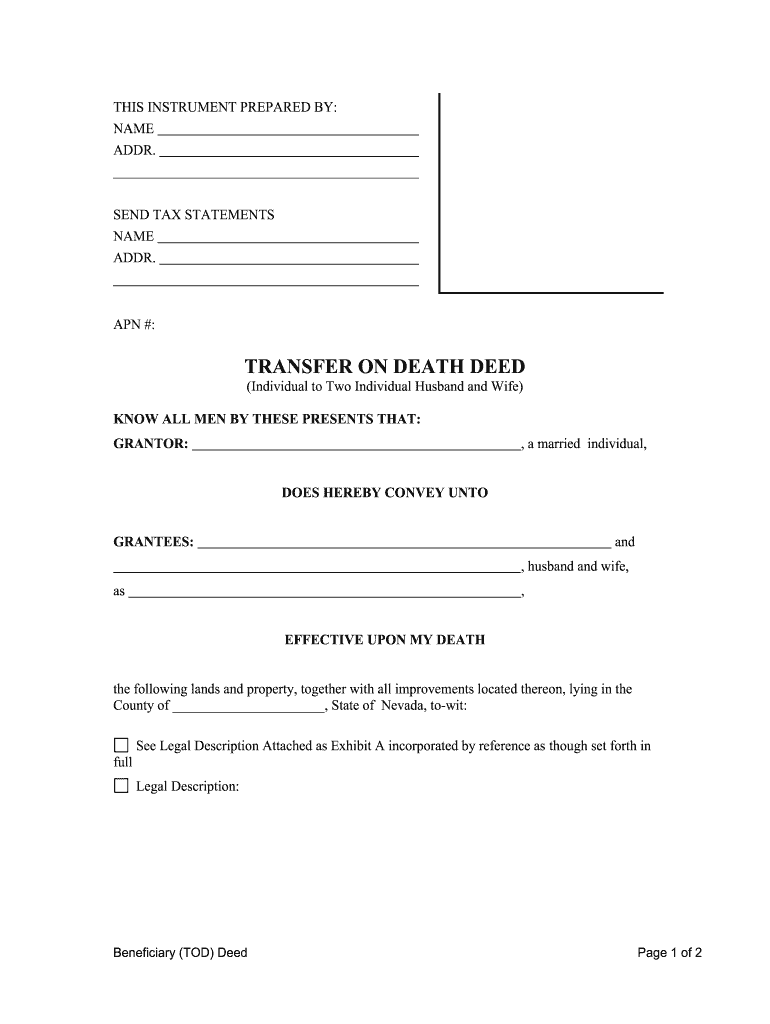
Nevada Beneficiary Deed
What a Nevada Beneficiary Deed Is and How It Works
Why People Use a Nevada Beneficiary Deed
A beneficiary deed simplifies transfer of real property at death, can avoid probate for that parcel, preserves the owner’s control during life, and reduces time and expense for heirs when properly drafted and recorded.
Who Typically Prepares or Signs This Deed
Common users include individual homeowners, estate planners, fiduciaries, and attorneys advising clients on nonprobate property transfer strategies.
- Individual homeowners seeking to avoid probate and streamline title transfer for a single family residence or unimproved parcel, while retaining revocation rights during life.
- Estate planning attorneys preparing straightforward transfer-on-death instruments for clients with clear title and uncomplicated beneficiary relationships.
- Real estate professionals and title officers assisting owners who want beneficiary designations without changing present ownership or occupancy until death.
Professional review is recommended when mortgages, community property, tax issues, or contingent beneficiary planning could affect transfer outcomes.
Step-by-step: Prepare, Execute, and Record the Deed
-
01Draft: Prepare deed with full legal description and beneficiary details.
-
02Sign: Owner signs in presence of a notary as required.
-
03Notarize: Notary acknowledges signature; retain notarial evidence or RON record if used.
-
04Record: File the deed in the county recorder’s office for the property's location.
How to Set Up an Online Workflow for This Deed
| Field | Configuration |
|---|---|
| Upload document | Accept PDF or DOCX formats for source documents |
| Add beneficiary field | Use required text fields for each beneficiary |
| Signer authentication | Email plus SMS code or ID verification |
| Notary / RON | Attach notarization image or RON session record |
Execution and Recording: A High-level Flow
-
Prepare: Assemble legal description and beneficiary names
-
Authenticate: Verify signer identity for the owner and notary
-
Sign: Owner signs; notary acknowledges per state rules
-
Record: Submit deed to county recorder where property is located
What Digital Platforms Should Support
Digital execution requires platforms that support fillable fields, secure signer authentication, notarization evidence capture, and a tamper-evident audit trail.
- File formats: PDF, DOCX accepted
- Authentication: Email, SMS, or ID verification
- Integrations: County e-recording and cloud storage
Key Risks and Consequences of Errors
Common Preparation and Execution Mistakes
- Using a street address instead of the full recorded legal description leads to misindexing and may render the beneficiary designation ineffective for title searches.
- Failing to name contingent beneficiaries can cause the interest to pass through intestacy or require probate if the primary beneficiary predeceases the owner.
- Not recording the deed promptly leaves the property subject to liens, transfers, or creditor claims that may take priority over an unrecorded beneficiary deed.
- Omitting a proper notary acknowledgement or using an uncertified remote notarization method can cause counties to reject recording or create later disputes.
Timing Considerations and Practical Deadlines
Execution Date:
Date owner signs; demonstrates intent to transfer
Recording:
Record during lifetime to ensure priority against third parties
Tax Reporting:
Beneficiaries report sales later; retain records for IRS review
Probate Avoidance:
Valid recorded deed typically avoids probate for that parcel
Statute Limits:
State challenge periods vary; consult counsel for deadlines
Milestones from Draft to Transfer
Drafting
Assemble legal description, beneficiary names, and revocation clause
Execution & Notary
Owner signs before notary and identification is recorded
Recording
File with the county recorder in the property's jurisdiction
Transfer at Death
Title vests in beneficiary upon owner’s death per recorded deed
Practical Tips to Reduce Risk and Speed Processing
Illustrative Examples of Typical Uses
Simple Transfer
An elderly homeowner recorded a transfer-on-death deed naming a single child as beneficiary to avoid probate and simplify estate settlement.
- Beneficiary inherited clear title after recording and death.
- Because the deed was recorded during life, the child avoided a probate administration for that parcel and retained a clear, recorded chain of title for future sale.
Contingent Designation
A property owner named a primary beneficiary and two contingent beneficiaries on a beneficiary deed to address the possibility the primary predeceases the owner.
- Contingents preserve transfer continuity.
- When the primary beneficiary predeceased the owner, the recorded deed’s contingent provisions conveyed title to the named alternates without a separate probate proceeding, subject to mortgages and creditor claims.
eSignature Pricing and Feature Comparison for Deed Execution
| signNow | DocuSign | Adobe Sign | PandaDoc | HelloSign | |
|---|---|---|---|---|---|
| Starting Price | $8/user/mo | $15/user/mo | $14/user/mo | $19/user/mo | $15/user/mo |
| Free Trial | 7-day free trial | Varies by plan | Varies by plan | Varies by plan | Varies by plan |
| Bulk Send | Yes | Yes | Yes | Yes | No |
| Audit Trail | Yes | Yes | Yes | Yes | Yes |
| HIPAA Compliant | Yes | Yes | Yes | No | No |
| Envelope Cap | No envelope cap | 100 envelopes/user/year | Varies by plan | Varies by plan | Varies by plan |
Frequently Asked Questions About Nevada Beneficiary Deeds
-
Is a beneficiary deed revocable by the owner?
Yes. A beneficiary deed is typically revocable during the owner’s lifetime. The owner may execute a notarized revocation or a new deed superseding the earlier instrument. To prevent confusion, record any revocation or replacement deed promptly in the county recorder’s office.
-
Does a recorded beneficiary deed avoid probate?
When properly executed and recorded during the owner’s lifetime, a beneficiary deed generally transfers the designated property outside probate. Recording gives public notice and helps prevent competing claims, but title issues, liens, or challenges can still trigger ancillary proceedings.
-
Can the deed be signed electronically?
Electronic signing is broadly permitted under the ESIGN Act (15 U.S.C. §7001) and UETA in most states, provided intent, consent, attribution, and retention are satisfied. Certain jurisdictions or recording offices may require wet-ink or specific notarization methods; confirm local recording and notary rules.
-
Is notarization required for recording?
Most county recorders require a notary acknowledgement for deed recording to confirm the signer’s identity. Remote online notarization (RON) may be allowed where state law and county practice permit; verify Nevada and county notary rules before using RON.
-
What if a beneficiary dies before the owner?
If the primary beneficiary predeceases the owner, the deed’s contingent beneficiary provisions govern transfer. Absent contingents, the interest may pass under the owner’s will or by intestacy. Name alternates to avoid probate in this scenario.
-
How does an owner revoke or amend the deed?
An owner can revoke or replace the beneficiary deed by executing and recording a notarized revocation or a later deed that explicitly revokes prior instruments. Prompt recording of the revocation or replacement is critical to avoid conflicting claims.