Establishing secure connection…Loading editor…Preparing document…

New York Affidavit of Proposed Guardian

This template is fully customizable. Edit the text, fill out the fields, and send it for signature. Give it a try!
New York Affidavit of Proposed Guardian

What the New York Affidavit of Proposed Guardian Is and When It’s Used

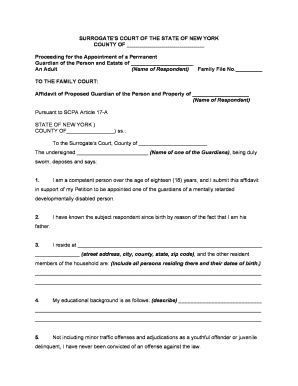
The New York Affidavit of Proposed Guardian is a sworn written statement submitted by an individual seeking appointment as guardian for a person alleged to lack capacity. The affidavit describes the proposed guardian’s relationship to the person, relevant background information, the nature of the incapacity, the scope of requested powers, and any proposed care or financial plans. Courts use it to evaluate fitness and necessity before scheduling hearings. Accurate, complete affidavits streamline court review and support service to interested parties and statutory notice requirements.

Why a Clear, Complete Affidavit Matters for Guardianship Proceedings

A well-prepared affidavit provides the factual basis the court needs to assess the proposed guardian’s suitability, clarifies requested powers, and reduces contested issues that lengthen proceedings.

Why a Clear, Complete Affidavit Matters for Guardianship Proceedings

Who Typically Prepares or Reviews This Affidavit

The affidavit is most often prepared by the proposed guardian or that person's attorney before filing with the court.

  • Proposed guardian — Completes facts, disclosures, and proposed care plan prior to filing.
  • Attorneys and paralegals — Review legal sufficiency, add statutory language, and prepare supporting exhibits.
  • Court staff and investigators — Use the affidavit as a primary source when setting hearings and requesting evaluations.

Having the right parties involved early — proposed guardian, counsel, and necessary professionals — reduces delays and increases the filing’s completeness.

Core Sections Found in a Professional Affidavit of Proposed Guardian

A complete affidavit groups facts into distinct sections so the court can evaluate capacity, relationships, finances, and the guardian’s plan.

Caption and Parties

Case caption, county, names of proposed guardian and proposed ward, and docket or index identifying the matter for court processing.
Statement of Capacity

Clear factual description of the ward’s alleged incapacity, including recent incidents, functional limitations, and who provided the assessment.

Guardian Background

Proposed guardian’s full legal name, address, relationship to the ward, employment, criminal history disclosures, and relevant experience.

Financial and Asset Summary

Concise listing of major assets, account custodians, and whether the guardian seeks authority over finances or health decisions.

Proposed Care Plan

Intended living arrangements, medical decision approach, visitation proposals, and any third-party service providers the guardian intends to engage.

Oath, Notary, Exhibits

Signature block for the affiant, notary acknowledgement, and attached supporting documents such as medical evaluations or financial statements.

Essential Data Elements to Include

Names: Full legal names of guardian and ward.
Dates: Birthdates and effective dates in MM/DD/YYYY.
Addresses: Current street address, city, state, ZIP.
Relationship: Nature and duration of relationship.
Capacity Summary: Brief factual description of limitations.
Signature Date: Date signed before notary.

Step-by-Step: Completing and Submitting the Affidavit

Follow this sequential checklist to prepare a filing-ready affidavit and avoid procedural omissions when approaching New York courts.

  • 01
    Obtain the correct form: Get the county or court-approved affidavit template before completing.
  • 02
    Complete all fields: Enter factual answers, dates, and contact information accurately.
  • 03
    Attach supporting items: Include medical evaluations, financial documents, and prior orders as exhibits.
  • 04
    Sign, notarize, file: Sign before a notary and file with the clerk according to local rules.

Typical Document Flow From Preparation to Court Review

This simplified flow shows the actions most jurisdictions require from affidavit drafting through court consideration.

  • Prepare affidavit: Draft facts and assemble exhibits in one document package.
  • Sign and notarize: Execute the affidavit before a notary public or RON if permitted.
  • File with court: Submit the original affidavit and required copies to the clerk.
  • Serve interested parties: Provide copies to the ward, counsel, and other parties per local rules.

Configuring an Online Workflow for the Affidavit

When using an eSignature platform, configure fields, authentication, and notifications to meet court and evidentiary needs.

Field Configuration
Authentication Email plus SMS code or stronger 2FA for signer identity.
Signature Type Allow electronic signatures but plan for notarized wet or RON originals if court requires.
Template Save a completed template to reuse county-specific language.
Audit Trail Capture IP, timestamps, and action logs for evidentiary records.

Technical Considerations for eSigning and eFiling

Ensure the platform you use supports required file formats, signer authentication, and an auditable trail accepted by the court.

  • File Formats: PDF and Word DOCX are commonly accepted.
  • Signer Authentication: Email plus SMS or knowledge-based checks recommended.
  • Audit Trail: Platform must record IP, timestamp, and signer events.

Confirm local court rules about electronic filings and whether an original notarized affidavit must be delivered after e-signature; maintain secure copies for the record.

Common Timeline Expectations After Filing the Affidavit

Exact timing varies by county and court calendar; the following are typical stages applicants should anticipate after filing.

Initial Filing:

Clerk accepts the affidavit and assigns a docket or index number.

Service and Notice:

Interested parties must be served according to local rules prior to a hearing.

Court Scheduling:

Hearing typically scheduled within weeks to a few months depending on caseload.

Hearing and Evidence:

Medical evidence and witness testimony presented at the hearing.

Post-Appointment Filings:

If appointed, the guardian files inventories or accountings as required by the court.

Notarization and Witness Authentication Steps

Completing authentication steps correctly prevents clerical rejection and preserves evidentiary value during hearings.

01

Sign in Presence

Affiant signs the affidavit in front of the notary or under approved remote notarization.

02

Provide ID

Present government-issued photo ID for identity proofing to the notary.

03

Notary Acknowledgement

Notary completes the official stamp and acknowledgement block on the affidavit.

04

Record Journal

Notary may record the session in a journal, especially for RON.

05

Witness Attestation

Where required, witnesses sign and attest to witnessing the affiant’s signature.

06

Audio/Video RON

If RON used, ensure audio-video record retention meets state rules.

07

Original Delivery

File the original signed and notarized affidavit with the clerk if required.

08

Maintain Copies

Keep certified copies and digital backups for parties and counsel.

Common Preparation Errors to Avoid

  • Incomplete identity details: omitting full legal names or birthdates leads to verification delays and potential court queries.
  • Mismatched names across documents: inconsistent spellings between affidavit, medical records, and IDs can require corrective filings.
  • Missing supporting exhibits: absent medical evaluations or financial statements often produce adjournments or requests for supplementation.
  • Improper notarization or witness errors: wrong notary wording or missing witness signatures frequently result in the clerk returning the filing.

Consequences of Deficient or Incorrect Affidavits

Case Delay: Filing defects can postpone hearings.
Hearing Postponement: Judge may adjourn to allow corrections or additional evidence.
Court Rejection: Clerk may refuse to accept noncompliant originals.
Financial Exposure: Missing account disclosures may trigger court accounting orders.
Alternate Guardian: Court could appoint a different guardian if concerns arise.
Legal Fees: Additional attorney time for corrections increases costs.

Supporting Documents Frequently Submitted with the Affidavit

Courts expect corroborating materials; attaching them at the time of filing reduces requests for supplementation and helps judges evaluate the petition efficiently.

Medical Reports

Recent physician or specialist evaluations describing diagnosis, functional limitations, and recommended support or treatment.

Capacity Evaluations

Formal cognitive or psychological assessments when capacity is in dispute or the nature of impairment requires expert opinion.

Financial Statements

Bank statements, account summaries, and bills showing assets and expenditures relevant to requested fiduciary powers.

Proof of Relationship

Birth certificates, marriage records, or other documents establishing familial ties or legal status with the proposed ward.

Pricing and Feature Comparison for eSignature Solutions

Compare starting prices, basic capabilities, and compliance posture across commonly used eSignature vendors to match platform features to filing needs.

signNow DocuSign Adobe Sign PandaDoc HelloSign
Starting Price $8/user/mo $15/user/mo $14/user/mo $19/user/mo $15/user/mo
Free Trial 7-day free trial Yes Yes Yes Yes
Bulk Send Yes Yes Yes Yes No
Audit Trail Yes Yes Yes Yes Yes
HIPAA Compliant Yes Yes Yes No No
Envelope Cap No cap 100 envelopes/user/year No cap No cap No cap

Frequently Asked Questions About the New York Affidavit of Proposed Guardian

Answers to common questions about validity, notarization, signatures, corrections, and court filing practices for New York affidavits.


Need help? Contact support

be ready to get more
Join over 28 million airSlate SignNow users