Establishing secure connection…Loading editor…Preparing document…

Oklahoma Quitclaim Mineral Deed

This template is fully customizable. Edit the text, fill out the fields, and send it for signature. Give it a try!
Oklahoma Quitclaim Mineral Deed

What an Oklahoma Quitclaim Mineral Deed Is and when it applies

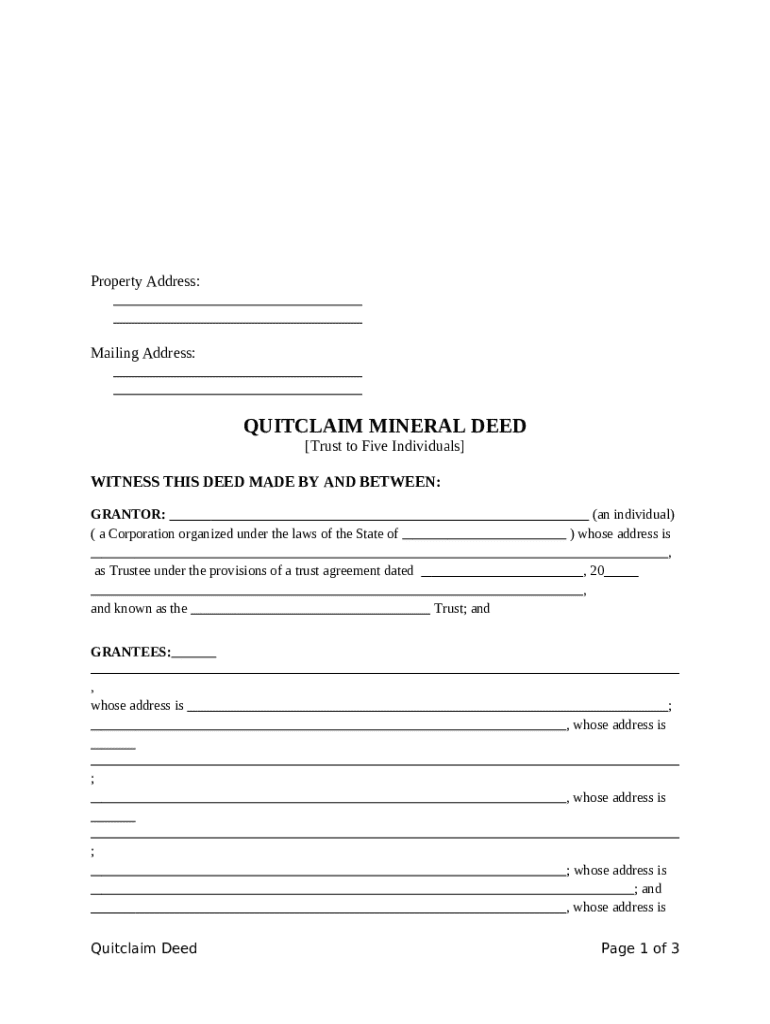
An Oklahoma Quitclaim Mineral Deed is a written instrument used to transfer whatever mineral rights the grantor holds in a parcel of land to a grantee, without warranties as to title or ownership. It conveys only the grantor's current interest, if any, and is commonly used to clear title issues, transfer fractional interests, or formalize negotiated mineral assignments. In Oklahoma the deed is typically executed before a notary and recorded in the county where the land is located to provide public notice of the change in mineral ownership.

Why the Oklahoma Quitclaim Mineral Deed matters for property and mineral interests

Use this deed to transfer mineral rights quickly without title covenants; it is suited to simple assignments, intra-family transfers, or clearing a cloud on title. Because it makes no guarantees, buyers should perform due diligence; sellers transfer only what they legally possess.

Why the Oklahoma Quitclaim Mineral Deed matters for property and mineral interests

Who commonly completes an Oklahoma Quitclaim Mineral Deed

Typical parties include landowners, royalty owners, mineral buyers, and attorneys facilitating transfers or title cleanups.

  • Individual Grantors transferring or releasing mineral interests to relatives or buyers, often to simplify ownership.
  • Energy companies or mineral buyers consolidating small interests for leasing or development purposes in Oklahoma counties.
  • Title or real estate attorneys preparing assignments and ensuring proper legal description and recording steps.

Parties should confirm ownership via title work and attach supporting documentation to avoid disputes after recording.

Who signs and why

Grantor

The person or entity that currently claims the mineral interest. The grantor must sign in presence of a notary or follow RON procedures where allowed; accurate legal name and capacity (individual, trustee, corporation) are essential.

Grantee

The recipient of the mineral interest. The grantee’s full legal name and address should be listed for recording and future communications; recording creates public notice and helps prevent later disputes.

Essential information required in the deed

Grantor name: Full legal name
Grantee name: Full legal name
Legal description: Lot, section, township
County: County of record
Consideration: Monetary amount or nominal
Signature block: Grantor signature & date

Risks and legal consequences of errors

Unclear transfer: Disputes over ownership
Wrong legal desc: Invalid or rejected recording
Mismatched names: Clouded title, delayed marketability
Missing notary: Refused county recording
Failure to record: Loss of priority versus later purchasers
Tax consequences: Possible transfer or gift tax issues

Common mistakes to avoid when preparing the deed

  • Using informal property references instead of the complete legal description, which can lead to recording rejection or ambiguity.
  • Failing to verify the grantor’s actual mineral ownership through title search or division order, risking a transfer of no interest.
  • Omitting the county recording block or incorrect recording information, delaying or preventing constructive notice to third parties.
  • Relying on unsigned or improperly witnessed signatures; missing notarization will often cause the clerk to refuse filing.

What a professional Oklahoma Quitclaim Mineral Deed includes

A complete deed balances legal precision with clear parties, a correct legal description, and proper execution formalities to ensure recordability and to minimize future disputes.

Grant clause

A succinct clause stating the grantor transfers their mineral interest to the grantee without warranties, specifying minerals conveyed and any exceptions or reservations.
Legal description

Detailed metes-and-bounds or governmental survey description (section, township, range) sufficient for county clerks and title examiners to identify the tract.

Consideration statement

Clear statement of consideration (dollar amount, love and affection, or nominal sum) that supports the transfer and may affect recording tax.

Notarial acknowledgement

A proper notary block per Oklahoma requirements showing the grantor’s sworn signature and date; or compliant RON acknowledgement where permitted.

Recording block

Space reserved for county clerk recording details (instrument number, book and page, recording date) to be completed by the recorder.

Exhibits and attachments

Attach deed plots, corporate resolutions, or trustee documentation when entities or complex ownership interests are involved.

Step-by-step: completing the deed for recording

Follow these sequential steps to prepare, execute, and record a valid Oklahoma Quitclaim Mineral Deed.

  • 01
    Research title: Order title search or review county records.
  • 02
    Draft deed: Include full legal description and grant language.
  • 03
    Execute: Grantor signs before a notary or via RON.
  • 04
    Record: Submit to county clerk where property is located.

Where to file and how the recording process works

Recording creates public notice; file in the county clerk/recorder’s office where the property is located and follow county formatting and fee rules.

  • County recorder: Primary filing location for instrument and public record creation.
  • Clerk acceptance: Clerk reviews notary acknowledgement and legal description for sufficiency.
  • Indexing: Deed is indexed under grantor and grantee names for public search.
  • Certified copy: Obtain recorded copy showing instrument number for title files.

Configuring an online workflow for this deed

Set up a digital workflow to collect signatures, notarization, and recording-ready outputs while preserving the audit trail.

Field Configuration
Document upload PDF or DOCX; use final formatted deed
Signature fields Place grantor signature and date fields
Notary block Include acknowledgement block for Notary or RON
Delivery Email signed copy to parties and title company

Digital signing and e-notarization considerations

Use e-signature and RON tools that produce tamper-evident PDFs and maintain an audit trail suitable for title evidence.

  • File formats: PDF/A or PDF with embedded signatures
  • Authentication: Email, SMS, or stronger KBA where required
  • Audit trail: IP, timestamp, and signing history retained

Ensure the chosen platform supports notarization workflows accepted by the Oklahoma county clerk and produces a recordable, tamper-evident document.

Timing and processing expectations for recording

Recording timelines vary by county; prepare for clerk processing times and plan for priority by timely recording.

Effective date:

Use the execution date; recording provides constructive notice

Recording window:

Same-day to several business days depending on county workload

Priority:

Recording date and instrument number establish priority

Title updates:

Title reports update after recording—expect 3–10 business days

Tax reporting:

Check county transfer tax or documentary fee obligations

Key milestones from signing to clear public record

Track these stages to ensure the deed becomes effective and visible in public records.

01

Draft and review

Prepare deed with legal description and review title exceptions.

02

Execution and notarization

Grantor signs and notary acknowledges signature.

03

Submission to recorder

File with county clerk and pay recording fees.

04

Recording confirmation

Receive instrument number and recorded copy for files.

Real-world scenarios where this deed is commonly used

Two concise examples illustrate typical uses of an Oklahoma Quitclaim Mineral Deed.

Family Transfer

An oil-royalty owner conveys an undivided mineral interest to a sibling to consolidate family holdings.

  • The deed transfers only the grantor’s current interest.
  • Parties recorded the deed in the county clerk’s office and attached supporting title documents to prevent later disputes over royalty payments and indexing.

Title Cleanup

A landowner uses a quitclaim mineral deed to clear a cloud created by an unnamed prior assignment.

  • The deed conveys whatever interest the grantor holds without warranty.
  • After recording the deed and updating the title report, the owner achieved clearer marketability for future leases and sale negotiations.

Frequently asked questions about the Oklahoma Quitclaim Mineral Deed

Answers to common questions about validity, notarization, e-signing, recording, and correcting errors with this type of deed.


Need help? Contact support

eSignature vendor pricing comparison relevant to document workflows

Compare common vendor starting prices and core capabilities for executing and managing deeds; signNow appears first per table requirements.

signNow DocuSign Adobe Sign PandaDoc HelloSign
Starting Price $8/user/mo $15/user/mo $14/user/mo $19/user/mo $15/user/mo
Free Trial 7-day free trial Varies by vendor Varies by vendor Varies by vendor Varies by vendor
Bulk Send Yes (Business Premium) Available by plan Available by plan Available by plan Available by plan
Audit Trail Yes Yes Yes Yes Yes
HIPAA Compliant Yes Yes Yes No No
be ready to get more
Join over 28 million airSlate SignNow users