Parties
List the judgment creditor, debtor (defendant) with full legal names, and addresses; include counsel names and contact information to enable lawful service and future communications without ambiguity.
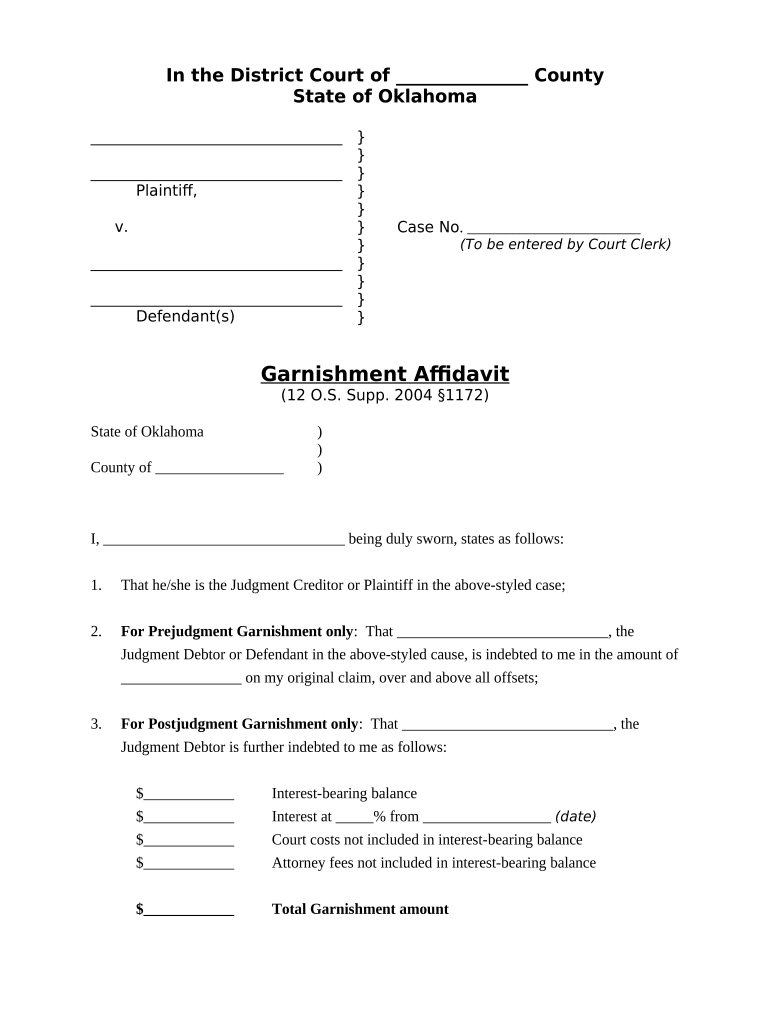
Use the Oklahoma Garnishment Form to enforce a money judgment, secure creditor recovery, and obtain court-ordered wage or asset withholding. Completing the form correctly reduces delays, ensures statutory notices are issued to the debtor, and provides clear instructions for the garnishee to remit payments.

Typical users include judgment creditors, collection attorneys, and court clerks responsible for initiating or processing garnishment actions in Oklahoma.
Typically a person or business holding a court judgment seeking collection; they or their counsel file the garnishment, provide judgment details, and monitor compliance. Accurate debtor identifiers and judgment amounts reduce the risk of dismissal or wrongful garnishment claims.
An employer, bank, or other third party served with the writ; responsible for freezing or withholding specified funds and remitting them to the court or creditor. Garnishees must follow statutory procedures, claim exemptions if applicable, and document all payments.
List the judgment creditor, debtor (defendant) with full legal names, and addresses; include counsel names and contact information to enable lawful service and future communications without ambiguity.
Record the original judgment date, court name, docket number, principal amount, accrued interest, costs, and any post-judgment adjustments that affect the total collectible sum accurately.
Provide explicit withholding instructions including percentage or flat amount, pay periods covered, start date, calculation method, remittance address, and reporting requirements to the clerk or creditor.
Include the method and date of service, the party who served process, and attach proof of service; courts require accurate service records to enforce garnishments.
List statutory exemptions claimed by the debtor and provide forms or notices required under Oklahoma law; clerks will review exemptions before disbursement of withheld funds.
Include signature, printed name, title, firm, and date for the filer; notarization or clerk verification fields, where required, should appear clearly on the form section.
A local contractor obtained a $12,000 judgment after unpaid invoices and filed a garnishment to collect wages from the debtor's employer.
A judgment creditor obtained a writ to garnish a debtor's bank account; the bank froze available funds following verified service and court order.
| Field | Configuration |
|---|---|
| Form Template | Use a court-compliant PDF with editable fields |
| Magic Fields | Enable auto-fill for names, dates, and amounts |
| Authentication | Select email, SMS, or knowledge-based auth |
| Proof of Service | Upload affidavit or certificate after service |
Choose delivery channels and integrations that preserve audit trails and comply with Oklahoma court submission standards when e-filing or serving garnishees.
File with county court as soon as judgment is recorded.
File affidavit or certificate to demonstrate garnishee was served.
Begin withholding per writ on first pay period after service.
Remit withheld funds per court schedule, often monthly.
Debtor typically has time to file claim of exemption or objection.
| signNow | DocuSign | Adobe Sign | PandaDoc | HelloSign | |
|---|---|---|---|---|---|
| Starting Price | $8/user/mo | $15/user/mo | $14/user/mo | $19/user/mo | $15/user/mo |
| Free Trial | 7-day trial | Varies | Varies | Varies | Varies |
| Bulk Send | Yes | Yes | Yes | Yes | No |
| Audit Trail | Yes | Yes | Yes | Yes | Yes |
| HIPAA Compliant | Yes | Yes | Yes | No | No |
| Envelope Cap | No cap | 100 envelopes/user/year | Varies | Varies | Varies |
Secure final judgment before initiating garnishment.
Complete form and file with the county court.
Proper service triggers withholding obligations.
Remit funds, resolve exemptions, and close case.