Establishing secure connection…Loading editor…Preparing document…

Oklahoma Notice of Hearing Form

This template is fully customizable. Edit the text, fill out the fields, and send it for signature. Give it a try!
Oklahoma Notice of Hearing Form

What the Oklahoma Notice of Hearing Form Is and When It’s Used

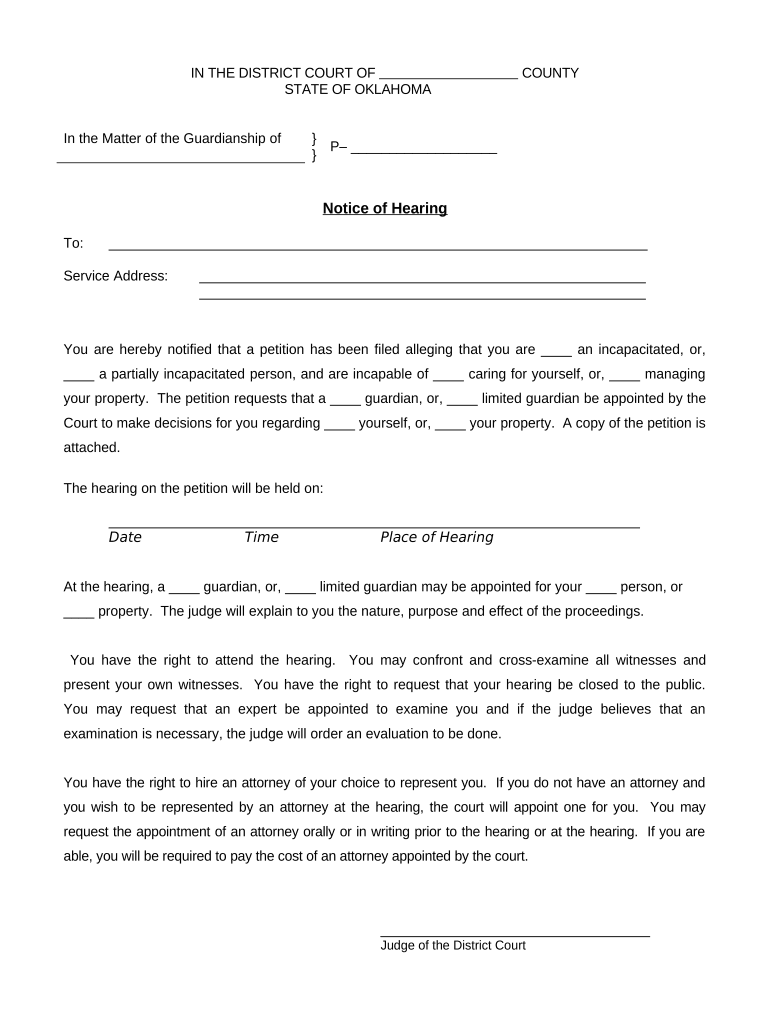
The Oklahoma Notice of Hearing Form is a court document used to notify parties and the court of a scheduled hearing date, time, location, and subject matter. It typically identifies the case caption, case number, parties, hearing type (pretrial, motion, custody, administrative), and the judge or courtroom. Courts use the form to calendar matters and confirm that notice was provided to all required recipients before the hearing. Proper completion and timely service are essential to preserve hearing rights and avoid delays, default orders, or rescheduling.

Why a Correct Notice of Hearing Matters

A complete, properly served Notice of Hearing protects due process: it ensures parties can prepare, appear, and contest matters. Courts rely on accurate notice to schedule proceedings and to enforce orders.

Why a Correct Notice of Hearing Matters

Who Typically Prepares and Receives This Notice

Each recipient has different responsibilities: filers prepare and file the notice, while recipients must review, respond, and appear as required.

  • Attorneys and law firms filing motions and scheduling court events on behalf of clients.
  • Self-represented litigants preparing their own hearing notices for small-claims or family court matters.
  • Court clerks and administrative staff who calendar hearings and confirm service compliance.

Representative Users

Self-Represented Litigant

A person without counsel filing a motion or requesting a hearing. They must follow local rules for filing, deliver notice to opposing parties per court procedures, and retain proof of service to avoid dismissal or default.

Court Clerk

Clerks receive and docket notices, assign hearing dates, and advise filers on local service rules. They ensure the notice meets caption and scheduling requirements and that service proofs are retained in the case file.

Essential Parts of a Professional Oklahoma Notice of Hearing Form

A clear, complete form reduces disputes and calendar errors; include the following elements to make the notice effective and enforceable.

Case Caption

Full court name and party captions identify the proceeding and link the notice to the correct docket and case file.
Case Number

Exact docket or case number used by the court to prevent misfiling and ensure the notice appears on the correct calendar.

Hearing Type

Specify the motion or matter to be heard (e.g., motion to compel, temporary custody hearing) to inform parties what to prepare.

Date and Time

Provide the scheduled date and start time in MM/DD/YYYY and local time to avoid ambiguity across time zones or courtrooms.

Location

Include courtroom number, building name, and full street address or instructions for virtual/telephonic appearances.

Service Information

Indicate how and when the notice was served and include proof of service or instructions for filing proof with the clerk.

Step-by-Step: Filling Out and Filing the Notice

Follow these sequential steps to complete, file, and serve a Notice of Hearing correctly.

  • 01
    Gather Case Details: Verify caption, case number, and party names from the docket.
  • 02
    Complete the Form: Enter hearing type, date, time, and location clearly.
  • 03
    File with Clerk: Submit per local filing rules (in person, e-file, or mail).
  • 04
    Serve Parties: Serve required parties and retain proof of service.

How the Notice of Hearing Moves Through Court Processes

A typical workflow covers filing, calendar assignment, service, and final hearing confirmation.

  • File Submission: Court accepts and dockets the notice.
  • Clerk Scheduling: Clerk assigns date and issues calendar entry.
  • Service to Parties: Parties receive notice by allowed service methods.
  • Hearing Proceeding: Court holds the scheduled hearing as noticed.

Typical Filing and Service Configurations

Select filing and service methods that comply with local rules; below are common configurations for court notices.

Field Configuration
Filing Method In-person filing | E-file if court supports it
Service Method Personal service | Certified mail or e-service
Proof Required Affidavit or certificate | File with clerk
Calendar Entry Assigned by clerk | Appears on court docket

Digital Formats and Integration Considerations

Verify the court’s e-filing system requirements and confirm whether electronic service is accepted before relying on digital submission.

  • File Formats: PDF or PDF/A preferred
  • Integrations: Common: Microsoft 365, Google Workspace
  • Signing Options: Email link or secure eSignature

Common Timeframes and Court Deadlines to Watch

Deadlines for filing and serving notices depend on the hearing type and local rules; plan ahead to meet minimum notice periods.

Filing Before Hearing:

File the notice per court rules as soon as the hearing is scheduled.

Minimum Service Periods:

Many courts require service 7–21 days before a hearing; check court-specific rules.

Proof of Service Timing:

File proof of service promptly; some courts require filing before the hearing.

Contested Matter Deadlines:

Motions may require additional response periods set by local rule.

Calendar Changes:

If rescheduling, re-serve notice and file amended notice promptly.

Key Milestones From Draft to Hearing

Track these milestones to ensure the notice is effective and that parties receive timely information.

01

Draft Notice

Prepare form with complete caption and hearing details.

02

File with Clerk

Submit to the appropriate court office per local practice.

03

Serve Opposing Parties

Use approved service methods and secure proof of service.

04

Attend Hearing

Appear at scheduled time or notify court per rules.

Common Preparation Errors to Avoid

  • Using an incorrect case number that causes misdocketing and delays in calendaring the hearing.
  • Failing to include full hearing location or virtual access details, producing confusion on the hearing day.
  • Relying on informal service without filing proof, which can result in the court continuing the matter.
  • Scheduling a hearing without verifying the court’s availability or required minimum notice period.

Risks and Consequences of Improper Notice

Default Orders: Court may grant relief to the opposing party if notice is inadequate.
Dismissal: Improper service can lead to dismissal of scheduled matters.
Rescheduling: Court may continue or reset the hearing, increasing costs and delays.
Sanctions: Repeated failures can produce attorney or party sanctions.
Appeal Risk: Procedural defects in notice may form grounds for appeal.
Contempt: Failure to obey service or appearance orders can result in contempt findings.

Security and Compliance Options for Electronic Notices

Transport Encryption: TLS 1.2/1.3 protects documents in transit.
At-Rest Encryption: AES-256 secures stored copies and backups.
Audit Trail: Record timestamps, IP addresses, and actions for attribution.
ESIGN / UETA: E-signatures comply with ESIGN and UETA standards in the U.S.
HIPAA Compliance: Business associate agreement required for protected health information.
Certifications: SOC 2 Type II and ISO 27001 support enterprise security needs.

Practical Examples of Notice Use

These scenarios illustrate typical use and outcomes when notices are handled correctly.

County Civil Motion

A plaintiff files a motion and serves a notice

  • Clerk assigns a motion calendar date
  • Proper service and proof filed prevented continuance and allowed timely ruling on discovery disputes.

Family Law Hearing

A parent self-files an emergency custody petition

  • Court schedules an expedited hearing
  • Accurate notice, prompt service, and attached supporting affidavit ensured the hearing proceeded without delay.

eSignature Vendor Pricing and Feature Comparison Relevant to Notice Serving

For electronic completion and secure signatures, compare common plan starting prices and key features; signNow is listed first per comparison conventions.

signNow DocuSign Adobe Sign PandaDoc HelloSign
Starting Price $8/user/mo $15/user/mo $14/user/mo $19/user/mo $15/user/mo
Free Trial 7-day free trial No No No Yes, limited
Bulk Send Yes Yes Yes Yes No
Audit Trail Yes Yes Yes Yes Yes
HIPAA Compliant Yes Yes Yes No No

Frequently Asked Questions and Troubleshooting

Answers to common questions about completing, filing, serving, and fixing issues with an Oklahoma Notice of Hearing Form.


Need help? Contact support

be ready to get more
Join over 28 million airSlate SignNow users