Establishing secure connection…Loading editor…Preparing document…

Oklahoma Notice of Judgment

This template is fully customizable. Edit the text, fill out the fields, and send it for signature. Give it a try!
Oklahoma Notice of Judgment

What the Oklahoma Notice of Judgment Is and Why It Matters

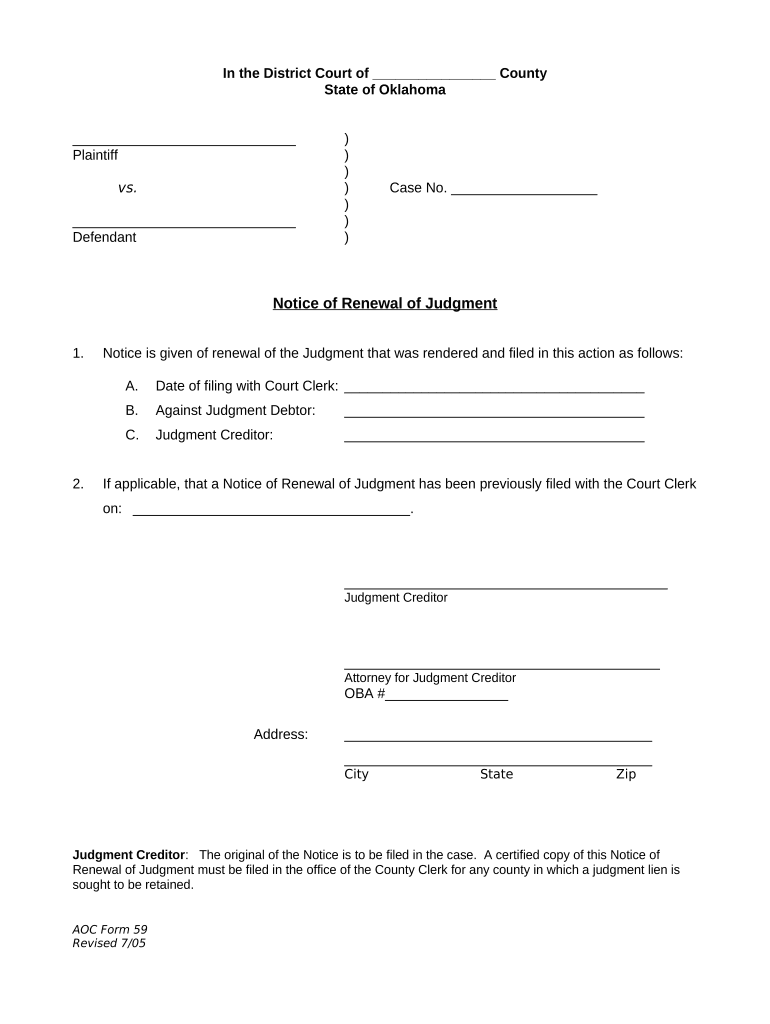
The Oklahoma Notice of Judgment is a court filing that formally records and notifies interested parties of a civil judgment entered in state court. Filing the notice creates a public record tied to the judgment and supports subsequent collection or lien enforcement steps when permitted under state law. The notice typically identifies the judgment creditor and debtor, case number, judgment amount, and the county of filing. Proper completion and timely recording help preserve priority and make the judgment discoverable by title searches and lien searches.

Why filing a Notice of Judgment is important

A properly prepared Oklahoma Notice of Judgment creates constructive notice that preserves a judgment creditor’s lien priority, helps locate debtor assets, supports enforcement remedies, and reduces the risk of disputes that can delay collection.

Why filing a Notice of Judgment is important

Common users and when they file a notice

Lenders, judgment creditors, collection attorneys, and title companies use the Oklahoma Notice of Judgment to protect lien priority and notify third parties.

  • Judgment creditors — record to create lien priority and enable collection remedies statewide.
  • Attorneys — file on behalf of clients after judgment becomes final to secure enforceability.
  • Title companies — search notices to confirm encumbrances before real estate closings.

Step-by-step: Preparing and filing an Oklahoma Notice of Judgment

Follow these ordered steps to prepare, file, and preserve an Oklahoma Notice of Judgment for reliable lien priority and enforceability.

  • 01
    Prepare Document: Include case number, parties, judgment amount, and county of record.
  • 02
    Verify Judgment: Ensure judgment is final and not stayed or on appeal.
  • 03
    File with Clerk: Submit signed notice to county clerk where debtor property is located.
  • 04
    Serve Interested Parties: Provide required notices to debtor and other entitled parties per local rules.

Frequently asked questions about Notices of Judgment

Answers to frequent questions about preparing, filing, and enforcing an Oklahoma Notice of Judgment, with practical guidance on common issues and next steps.


Need help? Contact support

Security and compliance considerations for digital notices

Encryption: TLS 1.2/1.3 in transit, AES-256 at rest.
Certifications: SOC 2 Type II and ISO 27001 certified.
HIPAA: Compliant with BAA available.
ESIGN / UETA: Compliant with ESIGN and UETA requirements.
Audit Trail: Detailed timestamps, IP, action log.
Accessibility: WCAG 2.0 Level AA support.

Risks of incorrect or incomplete filings

Lien Invalidity: Improper form can void lien.
Title Clouding: Recording errors encumber property sales.
Missed Deadlines: Loss of enforcement priority.
Sanctions: Court may impose costs.
Privacy Risk: Public disclosure of sensitive data.
Extra Costs: Additional attorney or re-filing fees.

Common preparation mistakes to avoid

  • Incomplete case information leading to returned filings or incorrect indexing by the county clerk, which can delay lien attachment and cause extra costs for re-filing.
  • Using inconsistent party names between the judgment and the notice — for example, abbreviations or DBAs — that prevent matching and may invalidate priority claims.
  • Failing to verify local clerk rules for notarization, fees, or electronic submission; counties can reject filings that do not meet specific procedural requirements.
  • Neglecting to serve the debtor or record in the correct county results in weak enforcement and potential legal challenges to lien validity.

Where to file and how the filing flows

Typical routing for an Oklahoma Notice of Judgment from preparation to public recording and distribution to affected parties.

  • Preparation: Draft notice using judgment details and case metadata.
  • Filing: Submit to county clerk where property is located.
  • Recording: Clerk indexes and makes the notice public record.
  • Distribution: Serve debtor and notify lien-search services as required.

Recommended digital workflow settings for repeat filings

Set up a repeatable workflow to draft, sign, file, and record Notices of Judgment with clear responsibilities and verification checks.

Workflow Field and Configuration Setting Configuration
Document Template and Fields Setup Pre-fill judgment data and lock critical fields.
Signer Authentication and Access Controls Require email or SMS codes; enable audit trail.
County Clerk Filing Method Selection Choose in-person, RON, or clerk upload per county.
Post-Filing Notifications and Distribution Setup Auto-send copies to creditor, debtor, and title services.

Key components of a professional Oklahoma Notice of Judgment

A professional Oklahoma Notice of Judgment clearly identifies parties, case details, judgment amount, and filing data while meeting clerk formatting and filing requirements.

Caption

Include the court name, case caption, judge name where appropriate, and full case number. A complete caption ensures the clerk files the notice under the correct docket and aids title searches and indexing.
Parties

List the judgment creditor and debtor with complete legal names and contact addresses. For businesses, use the exact registered entity name and include trade names only if they appear in the judgment instrument itself.

Amount

Specify principal, accrued post-judgment interest, and awarded costs or attorney fees numerically and in words where required. Precise calculation avoids disputes during levy, garnishment, or property sale enforcement actions.

Filing County

Clearly state the county and clerk office where the notice is lodged. Jurisdiction choice affects which properties are encumbered and where subsequent enforcement motions or executions must be filed.

Service

Document the method and date of service to the judgment debtor and any statutory notice recipients. Proof of service supports enforcement and is often required before levy or garnishment proceedings commence.

Notary

If required by local rules, include a notary acknowledgment or jurat with the notary's printed name, commission number, and commission expiration date to satisfy county recording standards.

Practical tips for accurate, defensible filings

Follow these best practices to reduce filing errors, support enforcement, and maintain clear public records for judgment liens.

Confirm judgment finality and appeal deadline
Verify the judgment is final and any appeal period has ended or been resolved. Filing prematurely may be rejected or ineffective; stamp dates and clerk receipts create an audit trail proving timely filing if disputed.
Use consistent legal names and identifiers
Match names, entity identifiers, and case numbers exactly to court documents. Inconsistencies increase risk of misindexing, reduce lien priority, and may require corrective filings or affidavits to resolve.
Keep proof of service and filing in multiple formats
Retain stamped copies, digital receipts, and proof of service records in both physical and electronic formats. These records are essential for contested collections, title searches, or when proving lien priority in court.
Consult local clerk or legal counsel before filing
Because county procedures and recording fees vary widely, ask the county clerk or consult local counsel before filing. Early verification minimizes rejections and ensures the notice meets local formatting and procedural rules.

Real-world examples of digital notice workflows

Real-world examples show how filing and distributing Notices of Judgment digitally supports collections and title clarity for property professionals.

Martin Properties — Tim Martin

Martin Properties used digital notice workflows to record and distribute judgment notices for property collections efficiently.

  • Saved time on recording and title checks.
  • I can process and execute all of these documents online with 100% compliance and built-in security. Whether on mobile or working offline, I can get forms back to their necessary parties efficiently.

Optica Ventures — Brian Fitzgibbons

Optica Ventures streamlined judgment filing to improve collections and reduce manual delivery of notices across multiple counties.

  • Improved customer communication and tracking.
  • The interface is simple and easy-to-use for our team; more importantly, it is just as easy for our customers. Their team reported smoother processing and fewer manual steps when filing and distributing judgment notices.

Comparing eSignature providers for Notice of Judgment workflows

Compare signNow and common eSignature providers on price and compliance dimensions relevant to submitting an Oklahoma Notice of Judgment.

signNow DocuSign Adobe Sign PandaDoc HelloSign
Starting Price $8/user/mo $15/user/mo $14/user/mo $19/user/mo $15/user/mo
Free Trial 7-day free trial Varies by vendor Varies by vendor Varies by vendor Varies by vendor
Bulk Send Yes Yes Yes Yes No
Audit Trail Yes Yes Yes Yes Yes
HIPAA Compliant Yes Yes Yes No No
be ready to get more
Join over 28 million airSlate SignNow users