Establishing secure connection…Loading editor…Preparing document…

Oklahoma Petition

This template is fully customizable. Edit the text, fill out the fields, and send it for signature. Give it a try!
Oklahoma Petition

What an Oklahoma Petition Is and When It Begins a Case

An Oklahoma Petition is a formal written pleading submitted to a state court or administrative agency asking the tribunal to exercise jurisdiction and grant specified relief under Oklahoma law. Petitions initiate proceedings in many areas — civil disputes, family law, probate, name changes, and administrative appeals — and must frame facts, identify parties, cite legal grounds, and state the relief requested. Timely filing, proper venue, and accurate service are essential because they establish timelines for responses, hearings, and enforcement of rights.

Why Preparing a Correct Petition Matters

A properly drafted Oklahoma Petition gives courts the information needed to accept jurisdiction, starts statutory and procedural timelines, and reduces the risk of dismissal or delay, preserving your substantive and procedural rights under Oklahoma rules.

Why Preparing a Correct Petition Matters

Who Commonly Files Oklahoma Petitions

Primary users include individuals, attorneys, and organizations filing claims or requests in Oklahoma state courts or agencies.

  • Private individuals pursuing civil relief, family law actions, probate matters, or name changes.
  • Attorneys representing clients in district, county, or municipal courts across Oklahoma.
  • Government agencies or utilities filing appeals, administrative petitions, or enforcement actions.

Stepwise Process: From Draft to Hearing

Follow these sequential steps to prepare, file, serve, and track an Oklahoma Petition from drafting through initial hearing.

  • 01
    Draft: Assemble facts, legal grounds, and exhibits; number paragraphs.
  • 02
    Review: Confirm jurisdiction, venue, deadlines, and necessary attachments.
  • 03
    File: Submit to clerk with required copies and filing fee; obtain stamped copy.
  • 04
    Serve: Serve respondents per Oklahoma rules and file proof of service promptly.

Where to File and How the Filing Flow Works

Typical filing flow for an Oklahoma Petition: prepare documents, file with the proper court, serve parties, and monitor case events.

  • Determine Venue: Choose county and court with subject-matter jurisdiction.
  • Clerk Filing: File physical or electronic copies as allowed by court rules.
  • Proof of Service: Complete and file affidavit stating how and when service occurred.
  • Case Tracking: Monitor docket entries and scheduled hearings through court portal.

Electronic Submission and eSignature Considerations

Oklahoma courts increasingly accept electronically filed petitions where authorized; local rules determine allowed formats and submission methods.

  • File Format: PDF is preferred for filings.
  • eSignature: ESIGN-compliant electronic signatures are acceptable.
  • Authenticity: Follow court rules for notarization or RON.

Core Elements Every Oklahoma Petition Should Include

A professional Oklahoma Petition is concise, follows court formatting, cites legal authority, attaches supporting exhibits, and clearly states the relief requested to guide the court and opposing parties.

Caption

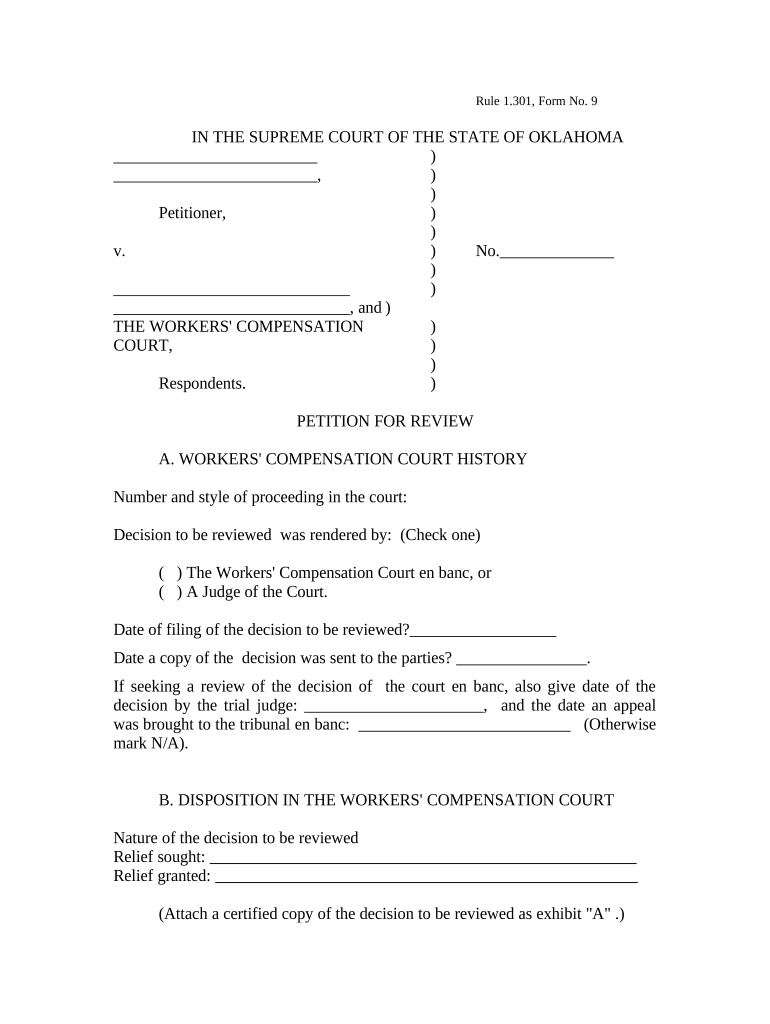
Include the court name, county, case caption with party designations, and a clear title such as 'Petition' or 'Complaint.' Proper captioning ensures clerk indexing and correct case assignment.
Jurisdiction

State the statutory or constitutional basis for the court's jurisdiction, including subject-matter jurisdiction, monetary thresholds, and any venue statutes supporting filing in the chosen county.

Parties

Identify petitioner(s) and respondent(s) with full legal names, addresses, and capacity (individual, corporation, guardian). Include business DBAs and registered agent details for service.

Statement of Facts

Present facts chronologically, with dates and specific acts. Attach exhibits referenced by exhibit letters or numbers and cite them in the fact paragraphs for clarity.

Causes of Action

List each legal claim as a separate count, state elements required by law, and explain briefly how the facts satisfy those elements for each cause of action.

Requested Relief

Conclude with a specific prayer for relief specifying orders, injunctions, damages, costs, and any alternative remedies sought; request a hearing date if appropriate and identify preferred dates.

Essential Information Required in the Petition

Petitioner Name: Full legal name required.
Respondent Name: Include aliases and DBAs.
Case Caption: Court name and county.
Filing Date: Use MM/DD/YYYY date format.
Relief Requested: Be specific and itemized.
Signature Block: Sign and date; include address.

Common Preparation Pitfalls to Avoid

  • Failing to verify venue or subject-matter jurisdiction can result in dismissal or transfer, causing delay and additional filing costs for refiling in the correct court.
  • Incomplete or inconsistent party names and addresses often lead to improper service, contested jurisdiction, and the requirement to amend pleadings before the court will proceed.
  • Omitting exhibits, failing to cite legal authority, or asserting vague facts weakens claims and increases the likelihood of demurrer or motion to dismiss.
  • Missing filing fees, incorrect number of copies, or improper proof of service commonly delay docketing and can result in rejected filings by the clerk.

Consequences of an Incorrect or Incomplete Petition

Dismissal: Case may be dismissed.
Filing Rejection: Clerk can refuse filing.
Sanctions: Sanctions or costs possible.
Default Risk: Default judgment against petitioner.
Loss of Rights: Statute of limitations risk.
Increased Costs: Additional attorney and filing fees.

Key Deadlines and Timeline Considerations

Key timeframes after filing an Oklahoma Petition affect service, response periods, and hearing schedules—observe court rules to calculate precise deadlines.

Service Period:

Serve defendants according to Oklahoma statutes and local rules; timing varies by case type.

Answer Deadline:

Respondent usually has 20 days after service to respond, depending on statutory or local rules.

Hearing Notice:

Hearing dates are set by the court; allow time for notice and possible continuances.

Amendment Window:

You may amend pleadings subject to court leave or local rules before trial.

Statute of Limitations:

Confirm filing deadlines under applicable Oklahoma statutes to avoid barred claims.

How Petitions Differ from Complaints and Motions

Common pleading types often get confused; this table contrasts petitions, complaints, and motions to clarify purpose and timing in Oklahoma proceedings.

Criteria Petition Complaint Motion
Primary Purpose initiate relief state claim request court action
Timing start case start case after case starts
Typical Content facts and prayer facts and damages legal argument and relief
Filing Fee state fee applies state fee applies often lower fee

Configure an Online Petition Workflow

Set up a digital petition workflow to collect signatures, attachments, and proof of service in a repeatable online process.

Field Configuration
Document Type Select Petition template
Signer Order Petitioner then Respondent
Required Fields Name, address, facts, relief
Attachments Exhibits as numbered PDFs
Notifications Email copies on completion

eSignature Pricing and Feature Comparison Relevant to Petition Workflows

Compare baseline eSignature pricing and core features relevant when filing Oklahoma Petitions; signNow appears first per vendor ordering requirements.

signNow DocuSign Adobe Sign PandaDoc HelloSign
Starting Price $8/user/mo $15/user/mo $14/user/mo $19/user/mo $15/user/mo
Free Trial 7-day free trial Varies by vendor Varies by vendor Varies by vendor Varies by vendor
Bulk Send Yes Yes Yes Yes Varies
Audit Trail Yes Yes Yes Yes Yes
HIPAA Compliant Yes Yes Yes No No

Practical Examples from Real Organizations

Real-world examples show how similar petitions are prepared and processed in Oklahoma-like contexts by practitioners and small firms.

Optica Ventures (Legal Ops)

Optica Ventures used electronic workflows to centralize petition and form collection across remote teams, reducing manual handoffs and paper handling.

  • They deployed simple e-sign routing to stakeholders.
  • Brian Fitzgibbons, COO, said: 'The interface is simple and easy-to-use for our team; more importantly, it is just as easy for our customers.' The team found external signers completed documents more reliably and maintained clear audit records for filings.

Martin Properties (Property Management)

Martin Properties applied e-sign workflows for eviction and lease-related petitions to reduce in-person steps and expedite filings.

  • They enabled mobile and offline signing for field agents.
  • Tim Martin, Founder, noted that he could process documents online with compliance and built-in security, enabling faster turnaround and fewer missed service dates while preserving evidence for court.

FAQs — Preparing, Filing, and eSubmitting an Oklahoma Petition

Answers to common questions about preparing, filing, serving, and electronically submitting an Oklahoma Petition, including signature and retention considerations.


Need help? Contact support

be ready to get more
Join over 28 million airSlate SignNow users