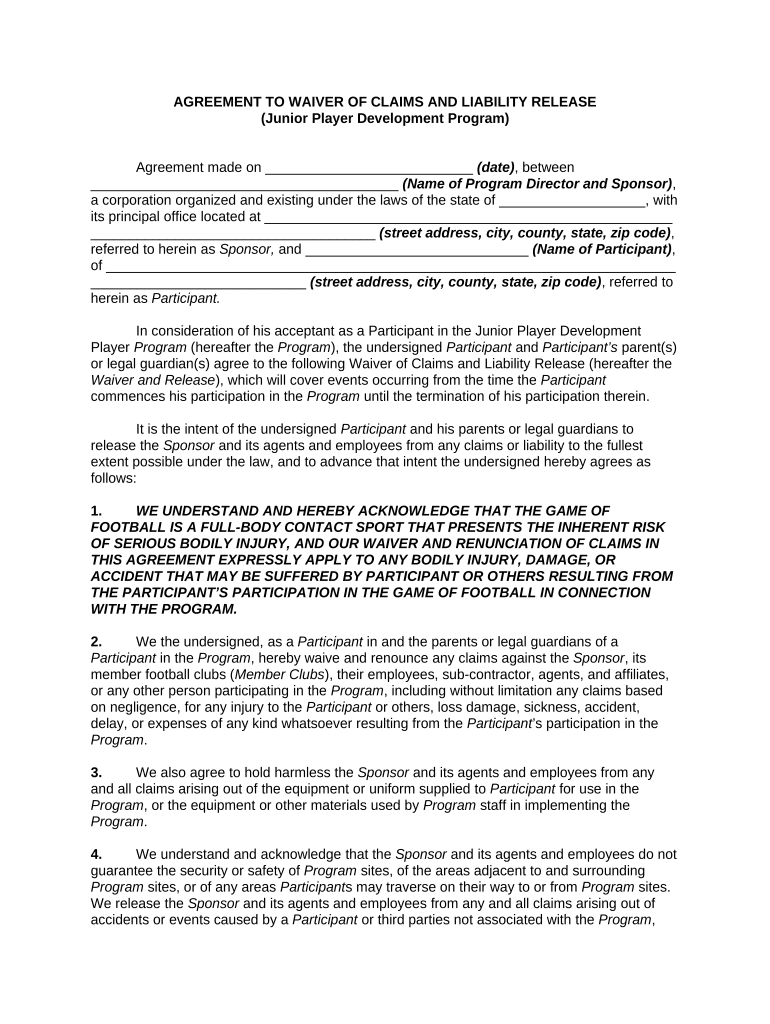
Agreement Waiver Release
What an Agreement Waiver Release Is and when it applies
Why a clear waiver and release matters
A carefully drafted Agreement Waiver Release reduces ambiguity about who gives up which claims, documents mutual intent, and creates a defensible record if a dispute arises. When executed electronically in compliance with ESIGN and UETA, it can be as enforceable as a paper document while preserving an auditable trail.
Who typically completes an Agreement Waiver Release
Common users include businesses, event hosts, contractors, institutions, and in-house legal teams that need a recorded release of claims before a payment, event, or transfer.
- Businesses and vendors use waivers to limit liability in commercial transactions and clarify expectations.
- Contractors and subcontractors often attach lien waivers and releases as condition of receiving payment.
- Event organizers and venues collect participant waivers to manage risk for activities that involve potential injury.
Typical signatory roles
Primary Signer
The individual who gives up personal claims. Provide full legal name, relationship to the entity if signing for someone else, and confirm authority; identity mismatches or lack of authority can invalidate the release.
Authorized Representative
An officer or agent signing on behalf of an organization. Record the signer’s title, basis of authority, entity legal name, and EIN where applicable to reduce later challenges to capacity.
Consequences of an incorrect or incomplete release
Common preparation mistakes to avoid
- Overly broad waiver language that sweeps in unrelated claims can lead a court to limit or void the release for vagueness or unconscionability.
- Using informal identifiers or nicknames rather than legal names causes disputes about who actually signed and can undermine enforceability.
- Skipping required notarization or witness formalities in jurisdictions that require them for certain releases increases the risk of invalidation.
- Relying on an unsigned image or weak audit trail without clear evidence of signer intent and consent can complicate enforcement.
Step-by-step: preparing and executing the waiver
-
01Draft: Describe the claims, scope, consideration, and effective date.
-
02Review: Have counsel or a risk manager examine the language for gaps.
-
03Sign: Obtain signatures, dates, and notarization or witness if required.
-
04Store: Retain original and an auditable electronic copy with metadata.
Typical electronic signing workflow for a waiver
-
Upload: Sender uploads the executed waiver to the platform
-
Prepare: Add signature, date, and initial fields
-
Authenticate: Use email, SMS code, or stronger methods
-
Complete: Signer signs and system records audit evidence
Configuring an online signing workflow
| Field | Configuration |
|---|---|
| Signer Authentication | Email link with optional SMS code or KBA |
| Signature Type | Click-to-sign, drawn signature, or uploaded image |
| Notary Integration | Include RON option or in-person notary step |
| Retention Settings | PDF/A output plus audit trail retention |
Digital signing and technical considerations
Choose a platform that supports secure uploads, audit trails, and the authentication level your waiver requires.
- File formats: PDF, DOCX, or HTML supported
- Integrations: CRM and cloud storage integration available
- Security: TLS in transit and AES-256 at rest
Typical timing and deadlines to watch
Effective Date:
Date when the waiver’s terms take effect
Signing Deadline:
Date by which parties must execute the document
Notary Window:
Timeframe to complete notarization if required
Record Retention:
Period to retain original and electronic copies
Dispute Period:
Statute of limitations impacts when challenges are permitted
Key processing stages from draft to archive
Drafting
Prepare clear scope, consideration, and definitions for the release
Internal Approval
Obtain signatory authority and legal review before sending
Execution
Collect signatures, notarization, or witness attestations as required
Archiving
Store executed copies with audit trail and metadata
Practical examples of how waivers are used
Participant Release
A recreation facility has patrons sign a release covering specified activities and dates
- The facility requires a liability waiver tied to an event date
- Clear activity descriptions, emergency contact data, and a dated signature helped the facility resolve a later negligence claim without litigation.
Payment-Linked Lien Waiver
A contractor provides a conditional release tied to final payment
- The release states the project, payment amount, and lien waiver conditions
- Linking release effectiveness to payment reduced downstream lien filings and clarified obligations at project close, simplifying owner audits.
eSignature vendor comparison for executing waivers and releases
| signNow | DocuSign | Adobe Sign | PandaDoc | HelloSign | |
|---|---|---|---|---|---|
| Starting Price | $8/user/mo | $15/user/mo | $14/user/mo | $19/user/mo | $15/user/mo |
| Free Trial | Yes, 7-day free trial | Varies by vendor | Varies by vendor | Varies by vendor | Varies by vendor |
| Bulk Send | Yes | Yes | Yes | Yes | No |
| Audit Trail | Yes | Yes | Yes | Yes | Yes |
| HIPAA Compliant | Yes | Yes | Yes | No | No |
| Envelope Cap | No cap | 100 envelopes/user/year limit | Varies | Varies | Varies |
Frequently asked questions about Agreement Waiver Releases
-
Can a waiver be signed electronically?
Yes. Electronic signatures are generally enforceable under the ESIGN Act (15 U.S.C. §7001) and UETA where adopted, provided intent, consent, attribution, and reproducible retention are satisfied.
-
Is notarization always required?
No. Notarization requirements depend on state law and the waiver’s subject matter; some states or use cases require notarization or witnesses for reliability.
-
How do I revoke a signed release?
Revocation after execution is difficult; a party seeking to rescind must show legal grounds such as fraud, duress, or lack of capacity, or rely on contractual termination clauses if present.
-
What if the signer used a different name?
A name mismatch can create challenges. Preserve identity evidence (ID, correspondence) and include an attestation of authority or alias language when appropriate.
-
Are waivers effective against future claims?
Depends on wording and public policy. Courts may decline to enforce waivers that attempt to bar claims for gross negligence, intentional misconduct, or where prohibited by statute.
-
How long should I keep executed waivers?
Retain waivers for at least the active term plus federal or industry-specific retention periods; e.g., IRS rules and HIPAA dictate minimum retention timelines for related records.