Establishing secure connection…Loading editor…Preparing document…

Oklahoma Release Lien

This template is fully customizable. Edit the text, fill out the fields, and send it for signature. Give it a try!
Oklahoma Release Lien

What the Oklahoma Release Lien Does

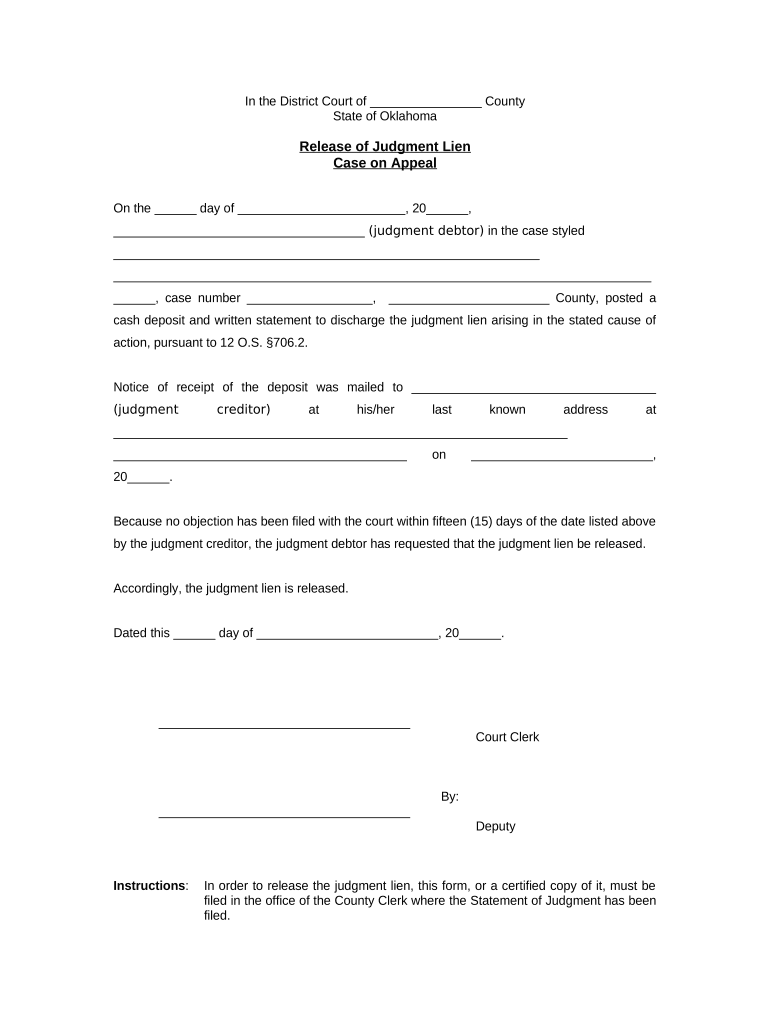
An Oklahoma Release Lien is a written instrument used to remove or discharge a previously recorded lien or claim against real property or personal property in Oklahoma. It confirms that the lienholder has released the lien, either because the debt was satisfied, the parties resolved the dispute, or a lien was recorded in error. The document is typically notarized and recorded with the county clerk or filed with the appropriate state registry to update the public record and restore clear title or free the encumbered asset.

Why a Proper Release Matters

A correctly executed release clears title, prevents recording disputes, and protects buyers, lenders, and subsequent purchasers from unexpected encumbrances. It also documents satisfaction of obligations and reduces liability for the releasing party by producing a public record of the lien termination.

Why a Proper Release Matters

Core Parts of a Professional Release of Lien

A complete Oklahoma Release Lien should clearly identify parties, the original lien, property description, consideration or reason for release, execution details, and recording instructions to ensure the county accepts the document.

Parties

Full legal names and capacity (individual, company, trustee) of lienholder and property owner to ensure accurate public indexing and legal attribution.
Lien Reference

Exact instrument number or recording book/page and original recording county so the county clerk can match and clear the correct lien.

Property Description

Legal description for real estate or VIN/serial number for personal property so the release precisely identifies the encumbered asset.

Reason for Release

Statement that debt is satisfied, settled, or released without consideration, providing context for the record and avoiding future disputes.

Execution Details

Signature block with printed name, title, date, and notarial acknowledgment to meet recording and evidentiary requirements.

Recording Instructions

Specify county clerk or state filing office and return address for the recorded document and any required cover sheet or fee payment.

Step-by-Step: Preparing and Recording the Release

Follow a consistent sequence to prepare, execute, and record an Oklahoma Release Lien so the public record is updated without delay.

  • 01
    Locate Original Lien: Find the instrument number and recording county.
  • 02
    Draft Release: Include all key components described earlier.
  • 03
    Execute and Notarize: Have authorized signer sign before a notary.
  • 04
    Record with County: Submit to county clerk with required fee.

Configuring an Online Release Workflow

When completing and filing electronically, set up a workflow that captures inputs, enforces fields, and creates a notarizable PDF for recording.

Field Configuration
Required Fields Make party names, instrument number, and legal description mandatory
Signature Type Collect handwritten e-signature or PKI digital signature where required
Notary Block Include a physical notary acknowledgment area for recording
Return Routing Auto-return recorded copy to specified address

Where to File and How the Filing Flows

The typical filing route depends on lien type and property: county recording for real property liens, or state filing for certain statutory liens and UCC releases.

  • County Clerk: Most real property releases record here
  • State Registry: Use for some statutory lien types
  • Secretary of State: Record UCC termination statements here
  • Return Address: Provide for recorded copy delivery

Digital Signing and eSubmission Basics

Electronic completion and submission speed the release process but require configuration for authentication and record retention.

  • Authentication: Email, SMS, or higher
  • Notarization: In-person or RON options
  • File Formats: PDF/A or standard PDF

eSignature Vendor Comparison for Recording-Ready Releases

Comparison of common eSignature providers that support document preparation and notarization workflows; signNow appears first per platform ordering conventions.

signNow DocuSign Adobe Sign PandaDoc HelloSign
Starting Price $8/user/mo $15/user/mo $14/user/mo $19/user/mo $15/user/mo
Free Trial 7-day free trial Varies by vendor and plan Varies by vendor and plan Varies by vendor and plan Varies by vendor and plan
Bulk Send Yes Yes Yes Yes No
Audit Trail Yes Yes Yes Yes Yes
Envelope Cap No cap 100 env/yr Varies Varies Varies

Essential Data Elements to Include

Full Legal Name: As on original lien
Instrument Number: Recording identifier
Property ID: APN or VIN
Execution Date: MM/DD/YYYY format
Notary Block: Acknowledge signature
Return Address: For recorded copy

Who Typically Prepares and Uses a Release

Multiple parties rely on releases to clear title and finalize transactions: lienholders, property owners, title companies, and lenders are the most common users.

  • Lienholders and lenders use releases to confirm debts have been satisfied and to remove encumbrances from collateral records.
  • Property owners and buyers require releases to obtain clear title, close sales, or refinance without unexpected liens surfacing.
  • Title companies and closing agents use releases as part of title curative work to clear exceptions before issuing policies.

Prepared accurately, a release protects all parties by providing a reliable public record that a lien has been terminated.

Who Signs the Release

Lienholder

The entity or individual who holds the lien signs to confirm release. If an agent signs, attach valid written authorization or power of attorney evidencing signing authority to avoid rejection.

Title Company

Title companies sometimes sign narrow releases as part of closing escrow when they hold settlement funds; include corporate officer name and title and ensure proper corporate authorization is documented.

Practical Examples of Release Use

Two common scenarios illustrate why a clear release is necessary for transactions and record accuracy.

Contractor Payment

A contractor receives final payment and issues a release

  • The release references the original mechanics lien instrument
  • Recording the release removes the cloud on the buyer's title and enables closing without delay.

UCC Financing

A lender accepts payment in full and files a UCC termination

  • The termination cites the financing statement number
  • The Secretary of State updates the UCC index, freeing the borrower to sell or lease equipment.

Practical Tips for Accurate Releases

Follow these best practices to reduce recording delays and prevent future disputes when preparing an Oklahoma Release Lien.

Match Original Instrument
Use the exact recording reference and party names from the original lien instrument to ensure the county clerk associates the release with the correct record.
Use Clear Legal Descriptions
Avoid shorthand; paste the full legal description or APN to prevent clerks from rejecting the filing for ambiguity.
Confirm Signatory Authority
If a corporate officer or agent signs, attach corporate resolution or power of attorney to show authority and speed up title clearance.
Check Clerk Requirements
Verify local county clerk formatting, page and margin rules, and any required cover sheets before submission to avoid rejections.

Common Errors to Avoid

  • Using abbreviated or inconsistent party names that prevent matching to the recorded lien and delay clearance.
  • Omitting the original instrument number, which typically causes clerks to return the release as unmatchable.
  • Failing to include a proper notary acknowledgment or using the wrong notary format for the recording jurisdiction.
  • Submitting the release to the wrong office—county clerk versus Secretary of State—depending on lien type.

Risks if a Release Is Incorrect or Missing

Title Risk: Clouded title
Recording Delay: Rejected filing
Liability: Potential claims
Closing Problems: Transaction holdups
Extra Costs: Attorney or re-record fees
Reputational: Business credibility harm

Frequently Asked Questions about Oklahoma Release Liens

Answers to typical questions about execution, notarization, recording, and electronic signing for Oklahoma Release Liens.


Need help? Contact support

be ready to get more
Join over 28 million airSlate SignNow users