Establishing secure connection…Loading editor…Preparing document…

Oklahoma Small Estate Affidavit

This template is fully customizable. Edit the text, fill out the fields, and send it for signature. Give it a try!
Oklahoma Small Estate Affidavit

What the Oklahoma Small Estate Affidavit Is and When It Applies

The Oklahoma Small Estate Affidavit is a sworn statement used to transfer certain personal property of a decedent without opening a full probate administration. It summarizes the decedent's identity, heirs, and assets, and explains the affiant's right to receive or distribute property. Courts and holders (banks, title companies) use the affidavit to release accounts, vehicles, or personal effects when the estate qualifies under Oklahoma statutory criteria and local clerk or custodian procedures. It is a simplified, nonprobate tool that often requires notarization and supporting documentation when presented to third parties.

Why a Small Estate Affidavit Can Matter for Oklahoma Estates

A Small Estate Affidavit speeds transfers, reduces probate costs, and provides a single sworn record of heirs and assets for custodians and institutions. It avoids full probate in qualifying cases and clarifies who may legally collect specific personal property.

Why a Small Estate Affidavit Can Matter for Oklahoma Estates

Who Typically Prepares and Uses This Affidavit

The affidavit is most often prepared by a close relative, designated personal representative, or beneficiary who needs to collect bank accounts, motor vehicles, or household effects.

  • Close family members seeking release of personal property from banks or other custodians.
  • Named beneficiaries who must present proof to transfer titles or retrieve assets.
  • Personal representatives handling limited nonprobate transfers without full estate administration.

Common Roles That Sign or Rely on the Affidavit

Affiant

A person with legal knowledge of the decedent and heirs who swears to the affidavit under oath. The affiant typically signs before a notary and provides supporting documents like death certificate and account statements.

Custodian / Holder

Banks, motor vehicle departments, and other custodians review the affidavit to determine whether they can release assets without formal probate. They may require notarization and additional identification before accepting the affidavit.

Essential Details to Include in the Affidavit

Decedent Name: Full legal name
Date of Death: MM/DD/YYYY
Affiant Identity: Name and relationship
Asset Description: Brief property list
Heirs Listed: Full names and shares
Notary Block: Signature and seal

Step-by-Step: Completing and Using the Affidavit

Follow a consistent sequence to prepare, notarize, and present the affidavit so holders can accept it without additional probate steps.

  • 01
    Gather Documents: Collect death certificate and account statements.
  • 02
    Draft Affidavit: Complete the form with accurate names and values.
  • 03
    Notarize: Sign before a notary and include seal.
  • 04
    Present to Holder: Submit the affidavit with attachments to the custodian.

Typical Processing Flow When You Submit the Affidavit

Custodians often follow a standard review sequence; understanding those steps speeds resolution and reduces back-and-forth requests for information.

  • Receipt: Holder logs the affidavit and attachments.
  • Verification: Institution checks death certificate and ID.
  • Approval: Custodian decides whether release is permitted.
  • Transfer: Assets distributed or title transferred.

Digital Workflow Settings to Prepare the Form Online

Configure basic fields, signer identity, and delivery options when digitizing the affidavit to ensure legal sufficiency and a clear audit trail.

Field Configuration
Signature Field Require signer signature and date
Authentication Email link or SMS code
Attachments Enable PDF uploads for death certificate
Storage Archive signed copy with audit trail

Digital Signing and Platform Considerations

Ensure the platform provides tamper-evident final documents, an audit trail with timestamps and IP addresses, and the ability to add notarization certificates or attach scanned seals when required.

  • File Formats: PDF and DOCX accepted
  • Integrations: Works with cloud storage
  • Authentication: Email, SMS, or stronger ID

Core Sections of a Professional Oklahoma Small Estate Affidavit

A complete affidavit is concise, accurate, and supported by attachments that verify identity, death, and asset ownership. Each section should be clear for third-party review.

Decedent Details

Full legal name, last residence address, date of death, and any aliases to ensure the affidavit identifies the correct person and matches certificates.
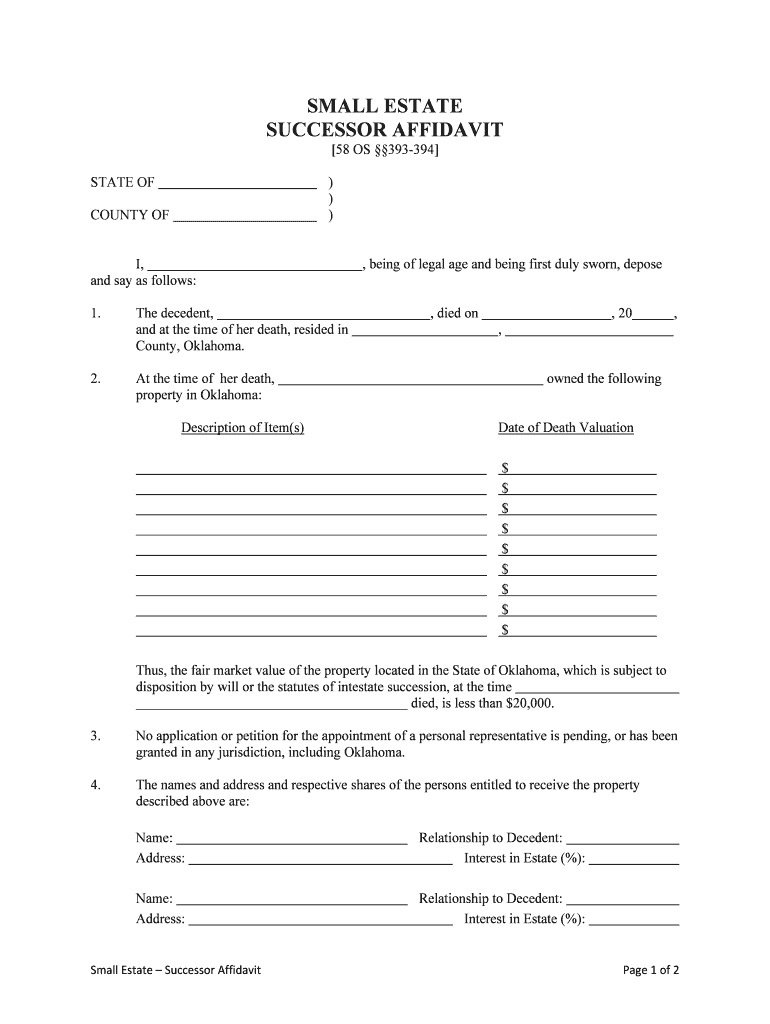
Affiant Declaration

A sworn statement explaining the affiant's relationship, basis for knowledge, and the legal authority to claim or distribute the property.

Asset Schedule

An itemized list of personal property being claimed, with identifying numbers or account details and estimated values to support custodian review.

Heir/Beneficiary List

Names and addresses of all individuals entitled to property under intestacy or the decedent's will for transparent distribution.

Oath and Notary

Signed oath language, affiant signature, and notarial acknowledgment with date, signature, and seal or stamp as required.

Attachments

Certified copy of death certificate, account statements, titles, and any power-of-attorney termination documents that verify authority and asset ownership.

Practical Tips for Accurate and Efficient Completion

Small details improve acceptance rates and shorten processing; follow consistent formatting and attach clear proofs to support each claim.

Match Official Documents Exactly
Use names and dates as they appear on the death certificate and title documents. Consistent formatting prevents custodian delays or identity mismatches.
Provide Clear Identifiers
Include last four digits of account numbers, VIN fragments, or serial numbers so custodians can quickly match items to institutional records.
Assemble a Single Packet
Combine the signed affidavit, death certificate, and attachments into one well-labeled packet for the custodian to reduce back-and-forth.
Confirm Local Acceptance Rules
Call the receiving bank or agency first to confirm any county or institutional requirements, such as additional affidavits or ID verification steps.

Risks and Consequences of Errors

Rejection: Delay or refusal
Civil Liability: Claims from heirs
Criminal Risk: Perjury exposure
Title Issues: Failed transfers
Tax Exposure: Understatement consequences
Record Retention: Loss of proof

Common Mistakes to Avoid When Preparing the Affidavit

  • Using informal or partial names that do not match the death certificate or title documents often leads custodians to reject the affidavit.
  • Failing to attach a certified death certificate and account statements forces custodians to request additional verification, delaying transfers.
  • Underreporting asset values or omitting items can trigger disputes from other heirs and potentially lead to civil litigation.
  • Skipping notarization or using an expired notary acknowledgment makes the affidavit invalid for many banks and record-keeping agencies.

Timing and Processing Expectations

There is no single federal deadline for presenting a small estate affidavit; processing varies by custodian and county—plan for document review and potential follow-up.

Prepare Promptly:

Assemble and notarize documents soon after death to avoid delays.

Custodian Review Time:

Expect 1–8 weeks for banks or agencies to review and act

Notary Recordkeeping:

Notaries may retain journal entries per state rules

Potential Follow-Up:

Custodians may request additional ID or proof

Attorney Response Time:

If counsel is used, factor in scheduling and review

eSignature Pricing and Feature Comparison for Completing the Affidavit Online

Compare common vendor pricing and capabilities for electronic completion and notarization-ready workflows. signNow is listed first as the baseline for features and pricing.

signNow DocuSign Adobe Sign PandaDoc HelloSign
Starting Price $8/user/mo $15/user/mo $14/user/mo $19/user/mo $15/user/mo
Free Trial 7-day free trial Varies Varies Varies Varies
Bulk Send Yes Yes Yes Yes No
Audit Trail Yes Yes Yes Yes Yes
HIPAA Compliant Yes Yes Yes No No
Envelope Cap No cap 100 envelopes/user/year Varies Varies Varies

Real-World Examples of How Affidavits Are Used

Practical scenarios illustrate common paths: retrieving bank funds and transferring vehicles without full probate when statutory conditions are met.

Bank Account Release

A surviving child prepared a notarized affidavit

  • bank checked the death certificate and last-four account digits
  • funds were released after a single follow-up for ID and a copy of the affidavit.

Vehicle Title Transfer

An executor used the affidavit with the motor vehicle department

  • VIN and title fragment were included on the form
  • the title was reissued in the heir's name after payment of fees.

Frequently Asked Questions About Oklahoma Small Estate Affidavits

Answers to common questions address standing, notarization, e-signing, where to file, and how to correct errors when preparing an affidavit.


Need help? Contact support

be ready to get more
Join over 28 million airSlate SignNow users