Establishing secure connection…Loading editor…Preparing document…

Wyoming Order Modifying Custody and Support

This template is fully customizable. Edit the text, fill out the fields, and send it for signature. Give it a try!
Wyoming Order Modifying Custody and Support

What the Wyoming Order Modifying Custody and Support Is

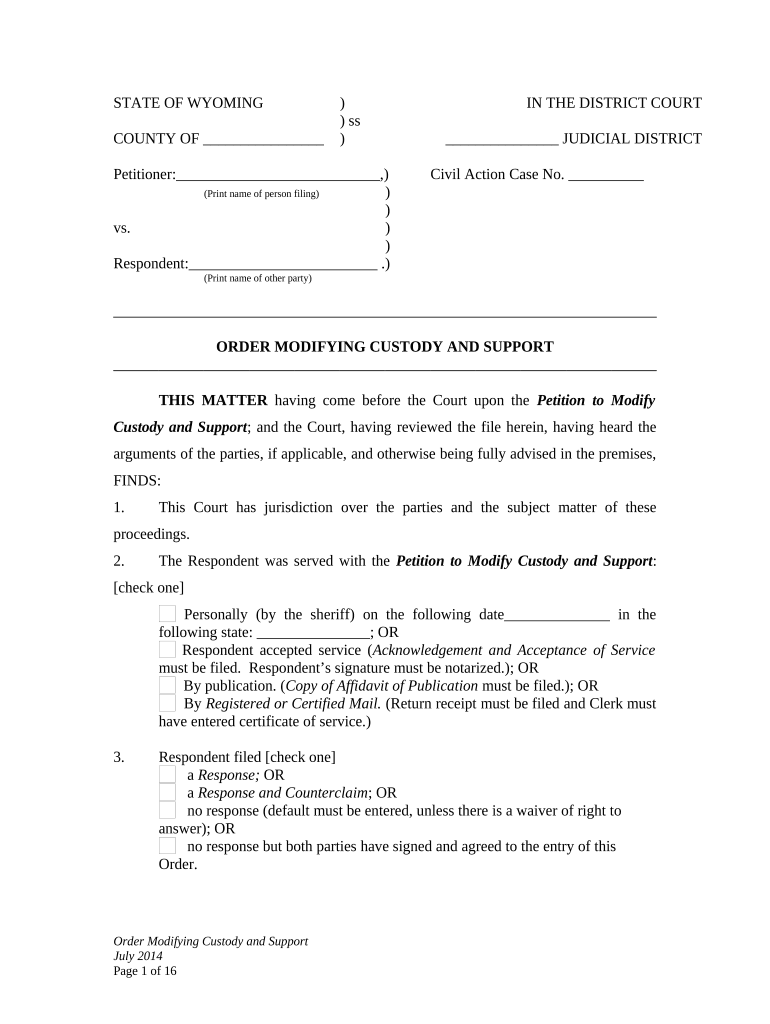
The Wyoming Order Modifying Custody and Support is a court-issued document that changes an existing child custody, parenting time, or child support arrangement previously established by a Wyoming family court. It may alter physical custody, legal custody, parenting time schedules, decision-making authority, and the child support obligation. Modifications are requested when there is a material change in circumstances affecting the child’s welfare or the parents’ ability to pay; the court reviews evidence, holds a hearing as required, then issues a signed order that replaces or amends prior orders.

Why Filing a Proper Modification Order Matters

A correctly drafted order clarifies parental responsibilities, avoids enforcement gaps, and makes support terms enforceable across jurisdictions under ESIGN and UETA when electronically preserved. Clear orders reduce future disputes and help courts, employers, and state agencies apply income-withholding or enforcement tools reliably.

Why Filing a Proper Modification Order Matters

Who Commonly Prepares or Relies on This Order

Various parties interact with modification orders depending on the case stage and purpose.

  • Parents and legal guardians seeking to change custody or support terms after a material change in circumstances
  • Family law attorneys preparing pleadings, proposed orders, and calculations for hearings
  • Court clerks and family court judges who enter, docket, and enforce the modified order

Each participant has specific responsibilities: parents provide facts, attorneys draft precise language, and the court ensures due process and enforceability.

Primary Signers and Their Roles

Custodial Parent

A parent with physical custody who requests modification based on changed circumstances; must provide updated financial disclosures, parenting proposals, and evidence supporting the requested change.

Family Law Attorney

An attorney who drafts the motion and proposed order, calculates support per state guidelines, and represents a party at hearing; ensures the order’s language is clear for enforcement and appeal purposes.

Key Security and Compliance Points for the Document

Encryption: AES-256 at rest
Transport Security: TLS 1.2/1.3 in transit
Legal Frameworks: ESIGN and UETA compliance
Healthcare Privacy: HIPAA (BAA required)
Auditing: Detailed audit trail
Certifications: SOC 2 Type II, ISO 27001

Consequences of an Incorrect or Incomplete Order

Void Order: Risk of being declared invalid
Enforcement Delay: Collection and withholding paused
Contempt Exposure: Misstatements can cause penalties
Support Shortfalls: Incorrect calculations reduce payments
Privacy Breach: Improper disclosures violate HIPAA
Jurisdiction Issues: Interstate enforcement complications

Common Preparation Pitfalls to Avoid

  • Failing to include a clear effective date or retroactivity language, which creates uncertainty about when obligations begin and whether arrears apply.
  • Submitting incomplete financial disclosures or outdated pay stubs, causing recalculation delays or court continuances for missing evidence.
  • Using vague custody language (like 'reasonable visitation') instead of a precise schedule, which prompts future disputes and enforcement motions.
  • Not serving the opposing party correctly under local rules, resulting in dismissed or delayed hearings and wasted filing fees.

Step-by-Step: Preparing and Filing a Modification Motion

Follow a clear sequence: assemble documents, draft a proposed order, file with the court, and ensure proper service and e-signature where accepted.

  • 01
    Gather Documents: Collect pay stubs, tax returns, school records, and any evidence of changed circumstances.
  • 02
    Draft Motion: Prepare a motion to modify and an attached proposed order with specific changes.
  • 03
    File Case: File the motion and proposed order with the family court clerk following local e-filing rules.
  • 04
    Serve Parties: Serve the other party per court rules and file a proof of service before the hearing.

Typical Workflow From Draft to Court Entry

A predictable workflow helps avoid delays: prepare, authenticate, submit, and obtain a signed court entry.

  • Prepare Documents: Assemble motion, proposed order, and supporting exhibits.
  • Authenticate Signatures: Use accepted eSignature methods or wet signatures per court requirements.
  • Submit to Court: E-file or deliver documents to the clerk following local procedure.
  • Receive Signed Order: Court signs and the clerk enters the order on the docket.

Essential Elements Every Professional Modification Order Should Include

A precise order reduces ambiguity. The following elements are routinely present in professionally drafted Wyoming modification orders.

Custody Allocation

Clear statement of legal and physical custody specifying which parent has decision-making authority for education, healthcare, and religion, including any limits on relocation and the geographic scope of custody.
Parenting Time Schedule

A detailed, calendared parenting time plan with weekdays, weekends, holidays, summer break, exchange logistics, and transportation responsibilities to minimize disputes about possession.

Child Support Terms

Support calculation referencing Wyoming child support guidelines, stated monthly obligation, income-withholding instructions, and how deviations or shared expenses are allocated between parents.

Medical and Educational Decisions

Designation of who may consent to routine and emergency medical care, authority for educational enrollment, and procedures for dividing extraordinary medical or educational expenses.

Enforcement Provisions

Language enabling income withholding, contempt remedies, modification standards, and identification of jurisdiction for enforcement and contempt proceedings.

Effective Date and Retroactivity

Explicit effective date for the modification, and a clear retroactivity clause if requesting back support or repayment for prior periods.

Digital Workflow Settings for Preparing the Order

Configure a consistent digital workflow to reduce errors and speed court submission.

Field Configuration
Template Name Use court-specific template with required headings.
Signature Type Allow e-signature or wet signature per court rule.
Authentication Email + SMS code or ID verification for parties.
Retention Store signed PDF and audit trail securely.

Technical and Platform Considerations for eSubmission

Confirm that your eSignature and document platform supports court requirements and secure recordkeeping.

  • File Formats: PDF/A, DOCX accepted
  • Integrations: Works with case management systems
  • Authentication: Supports multi-factor options

Ensure the platform you use preserves a tamper-evident PDF and an audit trail with timestamps and IP addresses; confirm acceptance of e-filed or uploaded signed orders with the relevant Wyoming county clerk or e-filing system.

Timing: Filing, Service, and Hearing Expectations

Timing varies by county and case complexity; plan for document preparation, service, and a hearing date when scheduling.

Motion Filing Window:

File upon material change; no set statewide filing deadline.

Service Deadline:

Serve as required before hearing; commonly 14–30 days.

Hearing Scheduling:

Courts typically set hearings within 30–90 days depending on docket.

Temporary Orders:

Judge may issue interim relief pending final hearing.

Entry of Final Order:

Final signed order entered on docket and effective as specified.

Key Milestones From Filing to Final Order

Track milestone dates to ensure compliance: filing, service, response, hearing, and entry.

01

File Motion

Submit the motion and proposed order to the clerk.

02

Serve Opposing Party

Complete service and file proof of service.

03

Attend Hearing

Present evidence and testimony at scheduled hearing.

04

Order Entry

Court signs and the clerk posts the final order.

How Wyoming Procedures Compare to Other Jurisdictions

Procedures and technology acceptance vary by state; the following compares common capability checkpoints in concise terms.

Criteria Wyoming Typical Other States
E-filing available varies
Remote notarization varies
Witness requirement varies
Court signature needed judge signs judge signs

eSignature Vendor Comparison Relevant to Filing and Signing

A neutral pricing comparison helps assess platform costs and compliance needs when preparing court documents; signNow appears first per vendor order rules.

signNow DocuSign Adobe Sign PandaDoc HelloSign
Starting Price $8/user/mo $15/user/mo $14/user/mo $19/user/mo $15/user/mo
Free Trial Yes, 7-day free trial No No Yes, limited Yes, limited
Bulk Send Yes Yes Yes Yes No
Audit Trail Yes Yes Yes Yes Yes
Envelope Cap No cap 100 envelopes/user/year Varies Varies Varies
HIPAA Compliant Yes Yes Yes No No

Representative Use Cases Showing Typical Outcomes

Realistic scenarios illustrate why clear drafting, service, and evidence matter to obtain an enforceable modification.

Family Court Attorney

An attorney filed a motion to modify custody after a custodial parent's relocation request slowed the case.

  • The court required detailed schedules and childcare arrangements.
  • The revised order included a fixed parenting time calendar and relocation consent conditions, reducing future litigation over exchange logistics and clarifying enforcement.

Parent Using Remote Notary

A noncustodial parent used remote notarization and electronic service to respond quickly from out of state.

  • The court accepted the remote-authenticated signature.
  • Timely response and properly authenticated signatures allowed the matter to proceed on schedule, avoiding default and enabling an evidence-based hearing.

Practical Tips for Accurate, Efficient Completion

Adopt these practices to reduce delays, errors, and enforcement obstacles when modifying custody or support.

Use Plain, Numbered Paragraphs
Draft the proposed order with numbered paragraphs and cross-references to the original order; specify exact text to be deleted and the replacement language to avoid ambiguity and litigation over interpretation.
Attach Supporting Worksheets
Include a completed child support guideline worksheet, income documentation, and any temporary order so the court has detailed financial context and can calculate support without needing additional discovery.
Confirm Local Court Rules
Verify county-specific formatting, caption, proposed-order style, page limits, and e-filing requirements; courts often have local rules that cause electronic submissions to be rejected if not followed.
Preserve Audit Records
When using electronic signatures, keep the tamper-evident PDF and full audit trail (timestamps, IP, signer authentication) to support admissibility and to demonstrate consent under ESIGN and UETA.

Frequently Asked Questions About Modifying Custody and Support

Answers to common procedural and technical questions about preparing, signing, and filing a modification in Wyoming courts.


Need help? Contact support

be ready to get more
Join over 28 million airSlate SignNow users