Establishing secure connection…Loading editor…Preparing document…

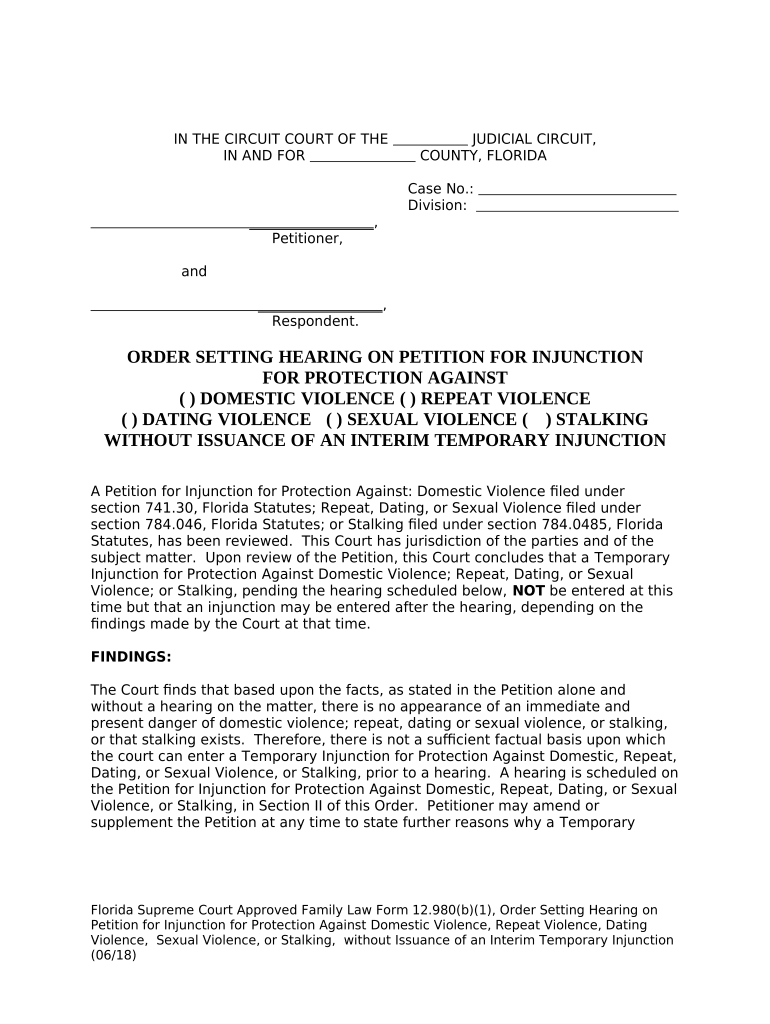
Florida Order Setting Hearing on Petition for Injunction for Protection Against Domestic Violence, Repeat Violence, Dating Violence, Sexual Violence, or Stalking

This template is fully customizable. Edit the text, fill out the fields, and send it for signature. Give it a try!
Florida Order Setting Hearing on Petition for Injunction for Protection Against Domestic Violence, Repeat Violence, Dating Violence, Sexual Violence, or Stalking

What an Order Setting Hearing Is and when it applies

A Florida Order Setting Hearing on a Petition for Injunction for Protection Against Domestic Violence, Repeat Violence, Dating Violence, Sexual Violence, or Stalking is a court proceeding scheduled after a petitioner files for protective relief. The hearing gives the judge a chance to review sworn allegations, hear testimony from both parties, and decide whether to continue, modify, or dismiss a temporary injunction. The order setting hearing is not a final determination on merits but sets the terms and schedule for a contested final hearing, service requirements, and any interim protections the court may impose.

Why the hearing matters for safety and due process

The hearing balances immediate safety needs with due process: it lets petitioners request continuing protections and lets respondents present defenses. A properly prepared order setting hearing clarifies interim remedies, service expectations, and evidence deadlines so both parties and the court can proceed efficiently.

Why the hearing matters for safety and due process

Who typically completes or relies on this hearing order

The order and hearing process involve multiple participants who each have defined roles and responsibilities.

  • Petitioners and advocates: Individuals seeking protection and their legal or victim‑advocate representatives who prepare the petition and evidence.
  • Respondents and counsel: People named in the petition and their attorneys who must receive service and prepare any defenses or cross‑motions.
  • Court personnel and judges: Clerks schedule the hearing, and judges manage evidence, witness testimony, and interim orders.

Clear role assignment reduces delays and ensures required service, documentation, and evidence are available at the scheduled hearing.

Step-by-step: preparing for an order setting hearing

Follow these core steps to prepare before filing and to ensure the hearing is effective and enforceable.

  • 01
    Prepare Petition: Complete petition with facts, dates, and requested protections.
  • 02
    File With Clerk: File the petition at the appropriate county clerk's office.
  • 03
    Serve Respondent: Arrange lawful service of process before the scheduled hearing.
  • 04
    Attend Hearing: Bring witnesses, exhibits, and certified documents to court.

Configuring an electronic workflow for orders and notices

When using digital tools, set authentication, delivery, and retention to meet court and statutory expectations.

Field Configuration
Signer Authentication Email plus SMS code or government ID verification for higher assurance
Delivery Method Secure email with download link or court e‑filing portal submission
Audit Trail Capture IP, timestamps, and signer actions for admissible records
Document Retention Store PDFs and audit logs for statutory retention periods

Technical considerations for e‑filing or e‑signing court forms

Confirm platform support for required formats, security, and court e‑filing rules before submitting any documents.

  • File Formats: PDF/A or searchable PDF preferred
  • Authentication: Multi-factor or ID verification
  • Integrations: Court e‑filing and cloud storage connectors

Use platforms that provide tamper-evident documents, complete audit trails, and exportable records for court submission and long‑term retention.

Typical process for filing, serving, and documenting an order setting hearing

A reliable sequence reduces rejection risk and provides the court a complete record at the hearing.

  • File Petition: Submit petition to county clerk by e‑file or in person
  • Clerk Schedules: Court issues docket date and any temporary order
  • Serve Respondent: Complete lawful service and record proof with the court
  • Prepare Evidence: Assemble declarations, exhibits, and witness lists

What a professional Order Setting Hearing entry should include

A complete order setting entry clarifies interim relief, hearing logistics, service requirements, evidence deadlines, and custody of exhibits.

Case Caption

Full court caption with case number, county, petitioner, and respondent so the record is unambiguous and properly routed.
Temporary Relief

Any interim protections should be clearly defined, time limited, and state conditions for extension or review by the court.

Hearing Schedule

Exact date, time, courtroom, and expected duration to enable parties and witnesses to plan attendance.

Service Requirements

Specify who must effect service, acceptable methods, and deadlines to establish jurisdiction and notice.

Evidence Deadlines

Deadlines for disclosure of witness lists and exhibits reduce surprise testimony and inform pre‑hearing motions.

Compliance Instructions

Provide steps for filing proofs, requests for continuance, and how to submit sealed or protected records.

Essential data elements the court expects on the order

Case Number: Assigned by clerk at filing
Petitioner Info: Full name, address, contact
Respondent Info: Full name, aliases, DOB
Allegation Summary: Concise factual basis
Hearing Date: Specific date and time
Service Method: Sheriff or process server

Consequences and legal risks of incorrect filings

Dismissal: Case may be dismissed
Contempt: Violation of court orders risks contempt
Service Defect: Improper service can void proceedings
Perjury: False statements may trigger criminal charges
Delay: Processing errors cause continuances
Privacy Exposure: Sensitive records mishandled risk disclosure

Common problems that delay order setting hearings

  • Incomplete service returns or defective proof of service that fail to establish respondent notification and jurisdiction.
  • Missing or unsigned exhibits, including affidavits or police reports, which prevent the court from evaluating immediate risk.
  • Unclear or inconsistent dates and locations in the petition that produce confusion about which incidents are at issue.
  • Failure to follow local court form or e‑filing requirements causing administrative rejection or reformatting delays.

Representative eSignature pricing and capability comparison

Compare common plan criteria for handling filings and signed court documents; signNow is listed first per table conventions.

signNow DocuSign Adobe Sign PandaDoc HelloSign
Starting Price $8/user/mo $15/user/mo $14/user/mo $19/user/mo $15/user/mo
Free Trial 7-day free trial Varies by plan Varies by plan Varies by plan Varies by plan
Bulk Send Yes Yes Yes Yes No
Audit Trail Yes Yes Yes Yes Yes
HIPAA Compliant Yes Yes Yes No No
Envelope Cap No cap 100 envelopes/user/year Varies by plan Varies by plan Varies by plan

Typical timing and processing expectations for hearing preparation

Expect immediate interim actions, service deadlines, and court scheduling constraints; local practice and clerk workload influence exact timing.

Immediate Relief:

Ex parte temporary orders can be issued same day to protect safety

Scheduling:

Clerk sets an order setting hearing date based on court calendar availability

Service Deadlines:

Service must be completed before the hearing to establish notice

Evidence Exchange:

Courts may require exhibit lists or witness disclosures ahead of the hearing

Continuances:

Requests for continuance must usually be filed promptly with justification

Key milestones from filing to the order setting hearing

A concise sequence of milestones helps parties track progress and meet judicial expectations.

01

File Petition

Petitioner files petition and any request for temporary relief with clerk

02

Court Issues Date

Clerk or judge sets the order setting hearing and any interim terms

03

Complete Service

Lawful service of petition and notice must be executed and proof filed

04

Attend Hearing

Parties appear, present testimony, and the court decides interim measures

Frequently asked questions about order setting hearings

Answers to common questions about filing, service, admissible evidence, and electronic document handling for order setting hearings.


Need help? Contact support

be ready to get more
Join over 28 million airSlate SignNow users