Establishing secure connection…Loading editor…Preparing document…

Oregon Restraining Order

This template is fully customizable. Edit the text, fill out the fields, and send it for signature. Give it a try!
Oregon Restraining Order

What an Oregon Restraining Order Is and when it applies

An Oregon Restraining Order is a court-issued protective order designed to limit contact, communication, or proximity between a petitioner and a respondent when the petitioner alleges abuse, harassment, stalking, or threats. Orders can be temporary (emergency or ex parte) or final after a full hearing. The court can require the respondent to stay away, avoid contact, vacate shared housing, and surrender firearms when authorized by law. These civil orders are enforceable by local law enforcement once served and entered on the court record.

Why an Oregon Restraining Order can matter for personal safety

A restraining order creates enforceable legal restrictions that help protect petitioners, document abusive behavior in an official record, and provide grounds for criminal enforcement or civil remedies if violated.

Why an Oregon Restraining Order can matter for personal safety

Who typically files or completes an Oregon Restraining Order

Individuals and organizations use these forms when safety or harassment concerns require court intervention; parties should confirm local court requirements before filing.

  • Survivors and victims filing for protection in family or civil courts to stop abuse or harassment.
  • Parents or guardians seeking protection for children or to enforce custody-related safety measures.
  • Attorneys, advocates, and court staff assisting petitioners with drafting, filing, and serving documents.

Courts or legal aid providers often offer blank forms, fee-waiver guidance, and self-help resources to streamline filing and service.

Common roles involved in an Oregon Restraining Order

Petitioner

An individual seeking protection who completes the petition and affidavit with dates, locations, and specific incidents. The petitioner must provide accurate contact details and, where possible, evidence or witness names to support the request and the judge's decision.

Respondent

The person the order is filed against; once served, the respondent has notice and the opportunity to appear at a hearing. A respondent may be represented by counsel and may present evidence and witnesses at the full hearing.

Essential information included on the form

Full names: Legal names for petitioner and respondent
Contact details: Addresses and phone numbers
Incident timeline: Dates and times of alleged events
Police reports: Report numbers, if available
Witness details: Names and contact info for witnesses
Requested relief: Specific prohibitions and remedies sought

Legal risks and consequences to be aware of

Perjury risk: False statements may lead to criminal charges
Contempt: Violating an order can result in arrest
Dismissal risk: Incomplete evidence may result in denial
Service failure: Improper service can void the order
Limited scope: Orders cover specified acts, not all conduct
Appeals: Orders can be contested or modified in court

Common mistakes to avoid when preparing the petition

  • Providing vague or unsupported allegations without dates, locations, or witnesses that reduce credibility at hearing.
  • Filing in the wrong county or court division because jurisdiction rules and venue matter for acceptance.
  • Failing to arrange proper service on the respondent, which can prevent enforcement of any order issued.
  • Omitting requested relief details (for example, whether housing exclusion or firearm surrender is sought).

Step-by-step: Completing and filing an Oregon Restraining Order

Follow these steps to prepare, file, and pursue a restraining order; procedures and deadlines may vary by county.

  • 01
    Prepare petition: Describe incidents clearly, include dates and witness names.
  • 02
    File with court: Submit forms to the appropriate county court clerk's office.
  • 03
    Temporary order: Judge may grant an ex parte order pending hearing.
  • 04
    Serve respondent: Arrange lawful service before the final hearing.

Where the petition goes and how the process flows

The court intake, judicial review, and service steps form the core workflow; e-filing availability depends on local court rules.

  • Court intake: Clerk accepts petition and assigns a case number.
  • Judge review: Judge reviews facts and may issue temporary relief.
  • Service: Law enforcement or private process server delivers notice.
  • Hearing outcome: Judge issues final order or dismisses petition.

Configuring an online version of the petition for digital completion

Set up form fields, conditional sections, and notifications to mirror the court's paper petition and reduce completion errors.

Template selection Use official court form or accurate replica
Conditional fields Show firearm or housing questions only when relevant
Authentication Use signer email and optional SMS code
Attachments Allow uploads for police reports and photos
Notifications Send copies to petitioner and counsel automatically

Technical considerations for e-filing and electronic completion

Courts vary in their e-filing and electronic acceptance; ensure the platform can produce court-ready PDF/A and signed copies.

  • File formats: PDF and PDF/A are widely accepted
  • Identity checks: Use email plus optional SMS or KBA for signer attribution
  • Court systems: Confirm compatibility with local e-filing portals

Where courts accept electronic submissions, produce a timestamped PDF and retain an audit trail showing signer identity and actions.

Typical timelines and what to expect next

Timing varies by county and case facts; the entries below describe common stages and their typical scheduling.

Ex parte / emergency:

Judge may issue same-day temporary protection when immediate danger exists

Full hearing scheduling:

Hearing often set within two weeks, but county calendars vary

Service timing:

Respondent must be served before the full hearing to ensure notice

Duration of order:

Final orders may last months to years; length depends on judge's findings

Modification requests:

Either party can seek modification or extension through the court

eSignature vendor comparison for completing and sharing forms

Comparing common eSignature plans and capabilities for document completion and secure distribution; signNow appears first per vendor requirements.

signNow DocuSign Adobe Sign PandaDoc HelloSign
Starting Price $8/user/mo $15/user/mo $14/user/mo $19/user/mo $15/user/mo
Free Trial 7-day free trial Varies Varies Varies Varies
Bulk Send Yes Yes Yes Yes No
Audit Trail Yes Yes Yes Yes Yes
HIPAA Compliant Yes Yes Yes No No

Key sections a complete restraining order petition should include

A professional petition organizes facts, relief requested, and supporting evidence so the judge can evaluate immediate risk and long-term remedies.

Cover sheet

Case caption and identifying information for petitioner, respondent, and court; ensures proper case assignment and routing for hearings and service.
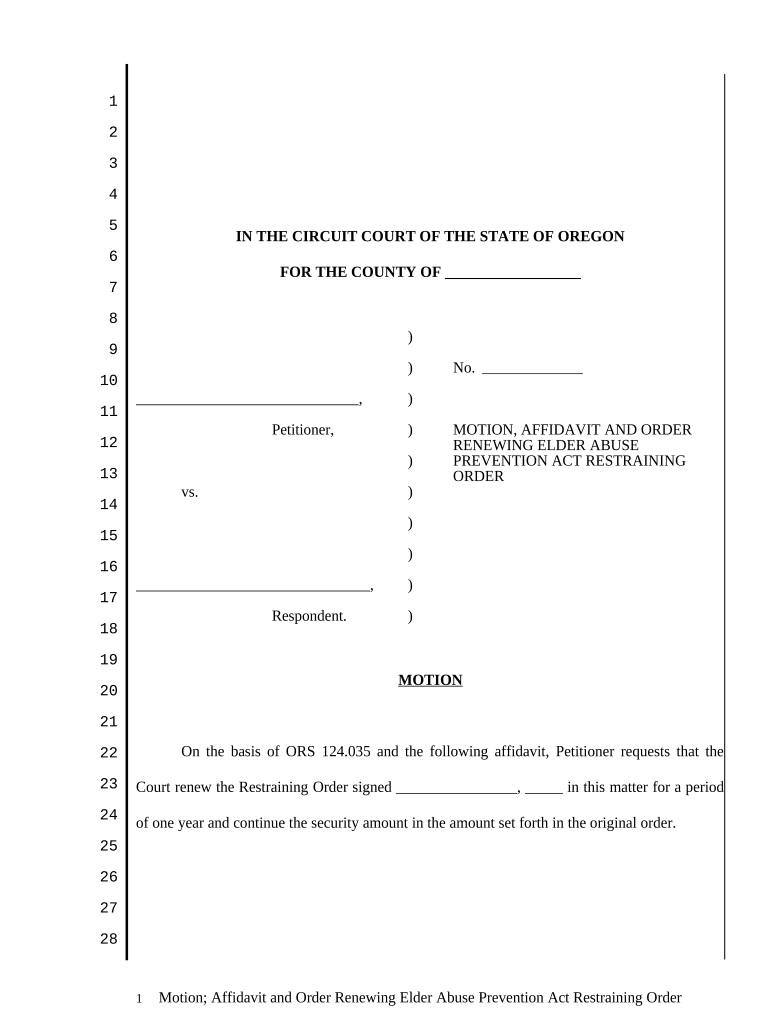
Affidavit of facts

Detailed, date-stamped narrative of incidents with locations and witnesses; factual specificity strengthens emergency and final relief requests.

Relief requested

Clear list of prohibitions, contact restrictions, housing exclusion, and any firearm surrender orders sought from the court.

Temporary order box

Section where the judge indicates ex parte relief granted pending hearing; must be consistent with emergency facts presented.

Service instructions

How the respondent should be served and documentation required to prove service to the court.

Supporting exhibits

Attach police reports, medical records, photos, or witness affidavits labeled and referenced in the affidavit.

Realistic use scenarios for an Oregon Restraining Order

Two concise scenarios show how petition details and attachments influence judicial decisions and enforcement.

Domestic Violence Scenario

A petitioner documents repeated assault incidents with dates, photos, and a police report

  • Evidence shows escalating threats and a recent arrest
  • The court issues an ex parte temporary order, schedules a full hearing, and law enforcement enforces the order once served.

Workplace Harassment Scenario

An employee documents repeated unwanted contact from a former coworker, including timestamps and witness statements

  • Employer submits supporting HR records
  • The court considers workplace safety provisions and may order no-contact and workplace-specific restrictions.

Practical tips for accurate, efficient petitioning

Adopt these practices to improve completeness, avoid delays, and preserve enforceability when filing with the court.

Be specific and chronological
List incidents in order with dates, times, locations, and witnesses to help the judge quickly assess immediacy and pattern of conduct.
Attach corroborating evidence
Include police reports, medical documents, photos, and text logs; label exhibits and reference them in your affidavit to strengthen credibility.
Confirm jurisdiction
File in the correct county; venue mistakes can delay hearings and adversely affect temporary relief options.
Keep records and copies
Retain original signed petitions and certified copies of orders; maintain an audit trail for any electronic completion and service documentation.

Frequently asked questions about Oregon Restraining Orders

Answers to common questions about filing, enforcement, and electronic completion; consult local court resources or counsel for case-specific guidance.


Need help? Contact support

be ready to get more
Join over 28 million airSlate SignNow users