Event Details
List the event name, venue (with full address), date, start and end times, check-in window, and any rehearsal or call-time requirements so attendees know exact expectations and arrival logistics.
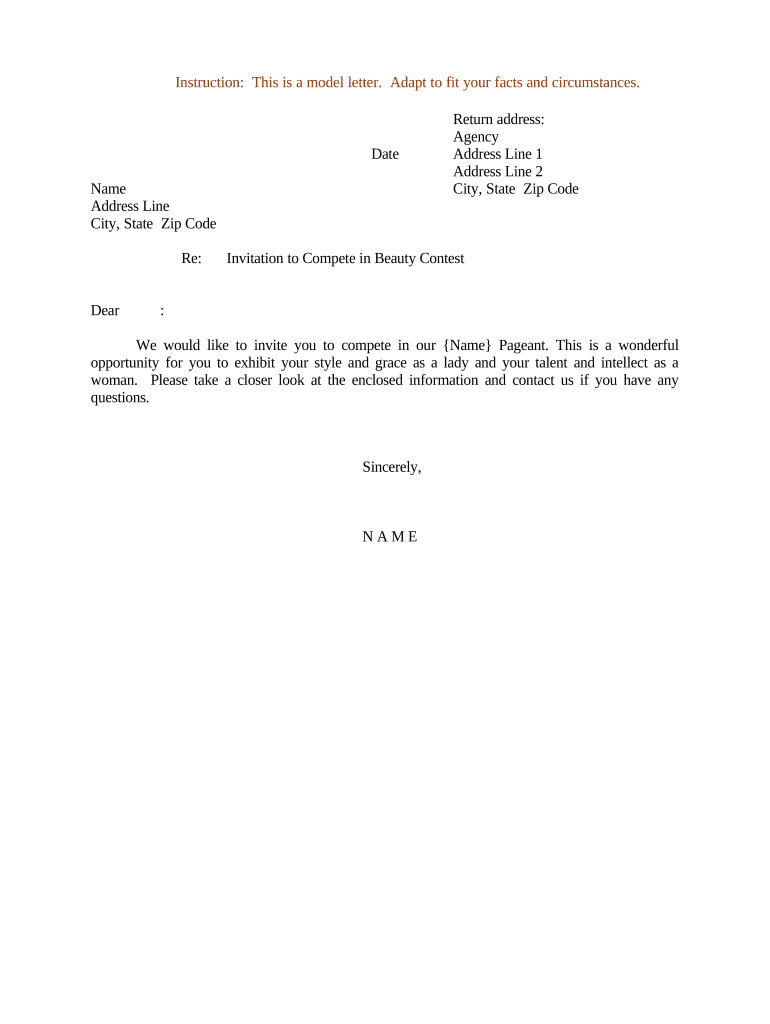
A Pageant Invitation Template streamlines communication, reduces omissions, and standardizes consent language so organizers can collect necessary permissions and logistical details while maintaining a consistent record for sponsors, legal review, and safety planning.

Organizers, volunteers, and event staff rely on a template to issue and track invitations across multiple channels and audiences.
The Event Director typically authorizes official invitations and approves publicity language. They coordinate with legal counsel regarding consent clauses, confirm insurance and venue requirements, and their signature indicates organizational approval of event terms, schedule, and major commitments.
The Sponsorship Manager signs sponsor invitations and hospitality agreements, confirming branding placements and sponsor benefits. They verify billing and fulfillment contacts, ensure sponsor deliverables are described correctly, and bind the organization to promised recognition or hospitality obligations.
List the event name, venue (with full address), date, start and end times, check-in window, and any rehearsal or call-time requirements so attendees know exact expectations and arrival logistics.
Describe contestant qualifications, age ranges, category descriptions, eligibility verification process and any documentation required at check-in, including deadlines for withdrawals or substitutions to avoid confusion.
Include explicit checkboxes and text for photo, video, and publicity releases; state whether consent is required for participation and describe permitted uses, duration of consent, and opt-out procedures.
Provide RSVP deadline, preferred response method, ticketing instructions or promo codes, maximum guest allowances, and waitlist policy to streamline capacity planning and vendor coordination.
Note applicable health protocols, emergency contacts, age-specific supervision requirements, accessibility accommodations, and any insurance or waiver language to limit liability and ensure participant safety.
Designate who must sign (organizer, participant, guardian if minor), include signature lines with printed names and dates, and clearly state that electronic signatures are acceptable when permitted.
Complete legal review and finalize template at least 8–12 weeks before event.
Issue invitations and RSVP requests 6–8 weeks before event.
Close RSVPs 2–4 weeks before event to confirm counts.
Store signed documents and media consents for required retention period.
Recommended 6–8 weeks before the event date.
Set a clear deadline, typically 2–4 weeks before the event.
For minors, collect signed parental consent at least 2 weeks before event.
Inform media contacts 3–4 weeks prior with accreditation instructions.
Begin archiving signed materials within one week after event completion.
| Field | Configuration |
|---|---|
| Authentication Level | Email or SMS code; use higher for sensitive consents. |
| Signature Type | Allow typed or drawn signatures; enable PKI for high-assurance. |
| Conditional Fields | Show guardian consent only when participant is under 18. |
| Audit Trail | Enable full audit trail with IP, timestamps, and signer info. |
Platforms should support secure eSignature, mobile-responsive signing, audit trails, and integrations with storage or CRM systems for efficient distribution and records management.
| signNow | DocuSign | Adobe Sign | PandaDoc | HelloSign | |
|---|---|---|---|---|---|
| Starting Price | $8/user/mo | $15/user/mo | $14/user/mo | $19/user/mo | $15/user/mo |
| Free Trial | 7-day trial | Varies | Varies | Varies | Varies |
| Bulk Send | Yes | Yes | Yes | Yes | No |
| Audit Trail | Yes | Yes | Yes | Yes | Yes |
| HIPAA Compliant | Yes | Yes | Yes | No | No |
| Envelope Cap | No cap | 100 envelopes/user/year | Varies | Varies | Varies |