Establishing secure connection…Loading editor…Preparing document…

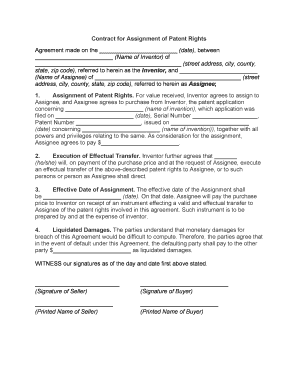
Contract for Assignment of Patent Rights

This template is fully customizable. Edit the text, fill out the fields, and send it for signature. Give it a try!
Contract for Assignment of Patent Rights

What the Contract for Assignment of Patent Rights Is and when it applies

A Contract for Assignment of Patent Rights is a written agreement in which an inventor or owner (assignor) transfers ownership of one or more patent applications or issued patents to another party (assignee). It documents the scope of transferred rights, the effective date, any retained rights or licenses, and compensation or consideration. The contract supports recordation with the U.S. Patent and Trademark Office (USPTO) and serves as the primary evidence of transfer for enforcement, licensing, and corporate IP management.

Why a formal assignment matters for patent ownership and enforcement

A signed, dated assignment establishes legal title for the assignee, enables recordation at the USPTO, and reduces disputes over inventorship, ownership, and licensing. Under U.S. law, clear written assignments help support enforcement of patent rights and facilitate transactions such as licensing, securitization, or sale.

Why a formal assignment matters for patent ownership and enforcement

Who typically prepares and signs patent assignment contracts

Proper identification of the assignor and assignee roles and signatures helps ensure recordability and enforceability across corporate and institutional transactions.

  • Individual inventors transferring rights to a company or co-inventors after an assignment agreement is negotiated.
  • Employers documenting assignment of employee inventions pursuant to employment agreements or IP policies.
  • Universities and research institutions assigning inventions to spin-outs or licensees under sponsored-research arrangements.

Who should sign and why

Assignor — Individual

An inventor or prior owner signing to transfer title. The text should identify the person, any aliases, and the capacity (individual or officer) to prevent later challenges to authority or identity.

Assignee — Entity

A company, university, or other legal entity accepting assignment. Include full legal entity name, organizational jurisdiction, and the signer’s job title and authority to bind the entity.

Core elements to include in a professional patent assignment

A complete assignment contains clause-level detail to transfer rights clearly, allocate consideration, and address recordation, representations, and post-assignment obligations.

Parties

Full legal names, organizational form, and addresses for assignor and assignee; include corporate identifiers (EIN, state of incorporation) where relevant.
Description of Rights

Clear statement of what is assigned (specific patent numbers, application serial numbers, provisional filings, continuations, and all continuations-in-part and reissues as applicable).

Consideration

Monetary amount, stock issuance, or other consideration; specify timing and method of payment to avoid ambiguity in value transfer.

Effective Date

The date when title transfers; affects recordation and royalty accounting. Use MM/DD/YYYY format for clarity.

Representations

Assignor warranties about ownership, no conflicting encumbrances, and authority to assign — helps prevent future title disputes.

Recordation and Further Assurances

Obligation to record the assignment with the USPTO and to execute additional documents needed to perfect title.

Step-by-step process to complete the assignment

Follow this ordered checklist to prepare, sign, and record a Contract for Assignment of Patent Rights efficiently and accurately.

  • 01
    Draft: Assemble parties, patent IDs, consideration, and standard clauses.
  • 02
    Review: Legal review for clarity on scope, encumbrances, and retained rights.
  • 03
    Sign: Obtain authorized signatures and notarization if required.
  • 04
    Record: Record assignment with the USPTO and retain certified copies.

Typical workflow from negotiation to USPTO recordation

A standard workflow ensures the assignment is enforceable and properly recorded for public notice.

  • Negotiate Terms: Agree on scope, consideration, and effective date.
  • Prepare Document: Draft the assignment including exhibits with patent lists.
  • Execute Signatures: Collect signatures and notarization where required.
  • File with USPTO: Submit recordation cover sheet and assignment documents to USPTO.

Configuring an online signing workflow for patent assignments

Set up an eSignature workflow that collects required signer data, enforces signing order, and captures evidence needed for recordation.

Field Configuration
Signer Order Sequential — assignor signs first, then assignee
Authentication Email + SMS code or advanced ID verification for entities
Signature Type Electronic signature with audit trail (PKI optional)
Attachments Include patent exhibits and corporate authority documents

Technology and format considerations for eSigning and submission

Ensure the platform supports trusted retention, produces a certificate of completion, and allows export of originals for USPTO and corporate recordkeeping.

  • File Formats: PDF/A or flattened PDF for USPTO compatibility
  • Audit Trail: Timestamp, IP address, and signer attribution required
  • Integrations: Connect to document storage (Box, Google Drive, NetSuite) for records

Potential risks and legal consequences of defective or missing assignments

Unrecorded Transfer: May allow downstream disputes over title or priority with licensees or purchasers
Incorrect Party Name: Mismatched legal name can delay USPTO recordation and cloud chain of title
Missing Authority: Signatures without authority (officer/title) can render assignment voidable
Ambiguous Scope: Failure to list continuations or related filings may exclude rights unintentionally
Improper Consideration: Vague consideration terms can create enforceability issues
Failure to Record: Can impair notice to third parties and affect licensing or sale value

Common drafting and execution mistakes to avoid

  • Using informal language that fails to specify patent application numbers or continuation rights
  • Omitting the effective date or using an unclear date format
  • Failing to confirm the signer's authority for corporate assignors
  • Not recording the assignment with the USPTO or keeping proof of submission

Examples of how patent assignments are used in practice

Real-world examples illustrate typical scenarios and practical considerations for assignments.

Startup Acquisition

A founder assigns patent applications to the acquiring company as part of an asset purchase

  • Assignment enumerates application serial numbers and effective date
  • The assignee recorded the assignment with the USPTO, enabling clear title for future enforcement and investor due diligence.

University License

A researcher assigns rights to the university under an employment agreement

  • University secures recordation and negotiates a license to a spin-out
  • The assignment and subsequent license clarified ownership, enabled patent prosecution funding, and supported commercialization.

Practical tips for a clean, enforceable assignment

Use consistent naming, include exhibits, and document authority to avoid delays or challenges.

Use Exact Names
Match entity and individual names to formation documents or government IDs to ensure recordation acceptance.
Attach Patent List
Include an exhibit listing patent numbers, application serials, and titles to remove ambiguity.
Confirm Authority
For corporate assignors, attach a board resolution or officer certificate authorizing the signature.
Record Promptly
Submit assignment to the USPTO as soon as practical to provide public notice and protect chain of title.

Timing and deadlines to keep in mind

Certain tasks should be completed promptly to preserve rights and ensure smooth transactions.

Effective Date vs Signing:

Clarify whether the effective date is the signing date or another mutually agreed date

USPTO Recordation:

Record assignments promptly after execution to provide public notice

Tax Reporting:

Report transfers that have tax consequences within relevant tax-year filing deadlines

Contractual Deadlines:

Observe any milestone dates tied to payment, royalty commencement, or prosecution costs

Retention Deadlines:

Keep signed originals per retention rules to support future disputes

Key milestones from signature to recorded title

Track these milestones to confirm the assignment becomes effective and is visible in public records.

01

Execution

Parties sign and date the assignment document

02

Notarization

If required by state practice, notarize signatures to authenticate identity

03

Submission

Submit assignment to the USPTO with the cover sheet and required fees

04

Confirmation

Obtain USPTO acknowledgment and retain evidence of recordation

Representative eSignature vendor pricing and feature comparison for assignments

Compare price and capabilities that matter for executing and retaining patent assignments; signNow is listed first per vendor ordering rules.

signNow DocuSign Adobe Sign PandaDoc HelloSign
Starting Price $8/user/mo $15/user/mo $14/user/mo $19/user/mo $15/user/mo
Free Trial Yes, 7-day free trial Varies Varies Varies Varies
Bulk Send Yes Yes Yes Yes No
Audit Trail Yes Yes Yes Yes Yes
HIPAA Compliant Yes Yes Yes No No
Envelope Cap No cap 100 envelopes/user/year Varies by plan Varies by plan Varies by plan

Security and compliance considerations for digital assignments

Encryption: TLS 1.2/1.3 in transit; AES-256 at rest
Audit Trail: Immutable timestamp, IP address, and signer attribution
HIPAA: HIPAA-compliant with BAA available for protected health information
21 CFR Part 11: Compliant controls for FDA-regulated records where required
SOC 2 / ISO: SOC 2 Type II and ISO 27001 certifications available
Retention: Exportable records for long-term archival and legal holds

Frequently asked questions about preparing and submitting patent assignments

Answers to common questions about execution, recordation, eSigning, and avoiding title issues.


Need help? Contact support

be ready to get more
Join over 28 million airSlate SignNow users