Establishing secure connection…Loading editor…Preparing document…

Pay in Lieu of Notice Guidelines

This template is fully customizable. Edit the text, fill out the fields, and send it for signature. Give it a try!
Pay in Lieu of Notice Guidelines

What the Pay in Lieu of Notice Guidelines cover

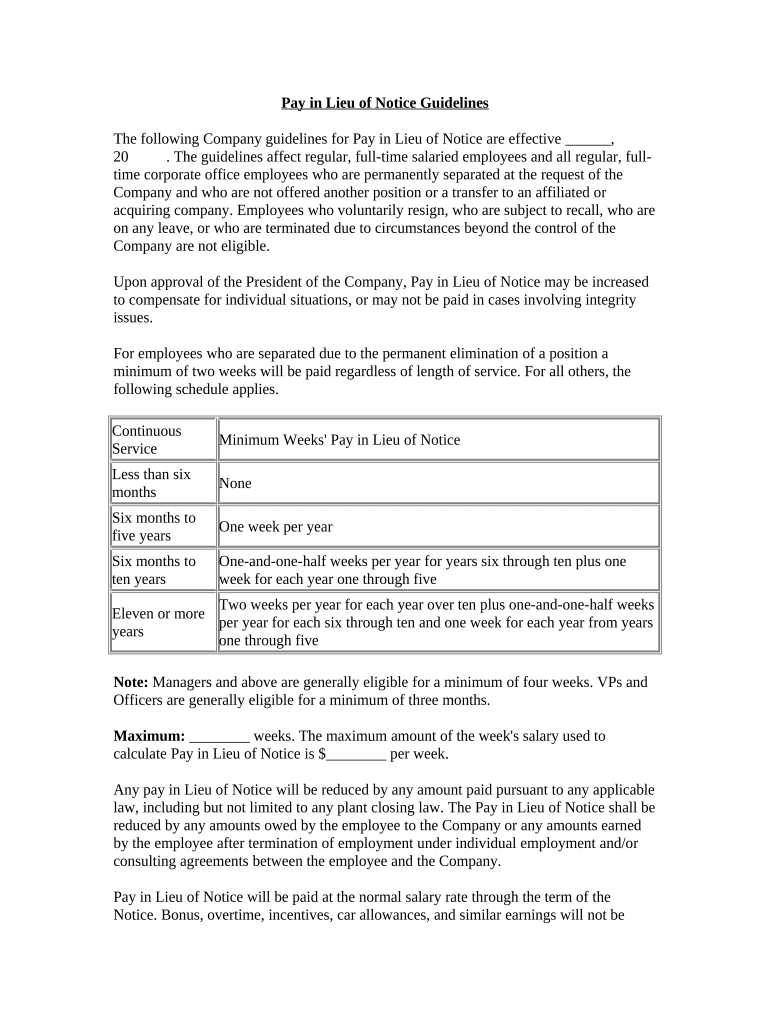
Pay in Lieu of Notice Guidelines explain when and how an employer may provide payment instead of requiring an employee to work through a notice period. The document defines eligibility, calculation method for pay in lieu, required approvals, and any offsets such as unused vacation or final paycheck rules. It also clarifies tax and withholding treatment, timing for payment, and employee acknowledgement requirements. Use these guidelines to ensure consistent application, reduce disputes, and document the employer’s approach for payroll and HR records.

Why having clear guidelines matters

Clear guidelines reduce legal risk by documenting consistent treatment of employees, simplify payroll processing by defining calculation and withholding rules, and help managers apply pay-in-lieu decisions uniformly. They also preserve evidence of consent or notice for potential unemployment, wage claim, or litigation matters, and support accurate record retention for tax and regulatory compliance.

Why having clear guidelines matters

Who should use these guidelines

Legal counsel and benefits administrators should review atypical cases or where state law or collective bargaining agreements may alter requirements.

  • HR leadership and generalists responsible for offboarding and policy enforcement
  • Payroll staff calculating final wages, withholdings, and tax reporting
  • People managers who approve early separation or immediate exits

Step-by-step: issuing pay in lieu of notice

Follow a consistent procedure to document eligibility, calculate payment, obtain approvals, and record the transaction for payroll and personnel files.

  • 01
    Determine eligibility: Confirm employee contract, handbook, or CBA provisions permit pay in lieu.
  • 02
    Calculate amount: Compute pay for the notice period, add accrued leave offsets, and apply tax withholdings.
  • 03
    Obtain approvals: Get manager and HR sign-off; involve legal for exceptions.
  • 04
    Document and pay: Record decision in file, issue payment on next payroll or special check.

Key parts of professional pay-in-lieu guidelines

A complete guideline explains scope, calculation, approvals, offsets, tax treatment, and recordkeeping expectations.

Scope

Define which employee groups and contract types are eligible, including exempt/nonexempt status and union-represented roles, so application is consistent and defensible.
Calculation

Describe formula for pay in lieu (salary, hourly equivalent, average earnings) and rules for prorating or rounding to prevent payroll errors.

Offsets

Specify how accrued vacation, PTO, or severance interacts with pay in lieu to avoid double payment or underpayment disputes.

Approval process

List required signatures, department approvals, and when legal review is necessary for high-risk separations or policy exceptions.

Tax treatment

Clarify withholding, FICA, and federal/state tax withholding rules and how the payment appears on final wage statements and W-2 reporting.

Recordkeeping

State retention period for payroll and HR records, required documentation, and how to store electronic copies for audit and compliance.

Essential information to capture

Employee ID: Payroll identifier
Separation Date: MM/DD/YYYY
Gross Amount: Payment value
Tax Withholdings: Federal/state/FICA
Approver: Manager or HR
Signature Method: E-sign or wet

Configuring the online form workflow

Set up a digital workflow that enforces required fields, obtains approvals, and pushes payment tasks to payroll automatically.

Field Configuration
Required Fields Employee ID, separation date, amount
Approval Steps Manager → HR → Payroll
Notifications Email alerts on approval or rejection
Payroll Integration Export or API transfer

Digital delivery and signing considerations

Ensure chosen tools comply with ESIGN and UETA; for regulated data include HIPAA or other required safeguards when applicable and retain the audit record for the retention period.

  • Authentication: Email, SMS, or stronger methods
  • Audit Trail: Timestamps and IP logs
  • Integrations: Payroll and HRIS connectivity

Where to send completed forms and payments

Define routing destinations and responsible parties so each completed pay-in-lieu request triggers the correct payroll and record actions.

  • HR File: Store signed form in personnel file
  • Payroll: Send payroll task or export for processing
  • Legal: Route for review if contested
  • Benefits: Notify benefits admin for coverage end

Timing and deadlines to observe

Key dates influence tax reporting, unemployment eligibility, and benefits cessation; set clear internal deadlines for payment and documentation.

Payment Timing:

Issue on next payroll or within statutory final-pay period

Wage Statement:

Include payment on final pay stub

Tax Reporting:

Report on W-2 for the year paid

Unemployment Notice:

Document separation reason promptly

Record Retention:

Preserve records per retention policy

Key milestones from notice to closure

Track the sequence from decision through payment and record closure to ensure compliance and defensible documentation.

01

Decision Date

Document the business reason and authorization for pay in lieu.

02

Employee Notification

Provide written notice or acknowledgement of payment terms.

03

Payroll Submission

Submit payment request to payroll within defined internal deadline.

04

File Closure

Save executed form and supporting calculations to personnel file.

Common mistakes to avoid

  • Failing to check employment agreements or collective bargaining agreements before applying pay in lieu can breach contract terms and create liability.
  • Miscomputing prorated pay or ignoring offsets like accrued PTO leads to overpayments or underpayments and can trigger wage claims.
  • Not documenting approvals or the employee’s acknowledgement makes it difficult to defend the employer’s decision during unemployment or litigation.
  • Delaying payment beyond state final pay deadlines can result in penalties or waiting-time wages under state law.

Consequences of incorrect pay-in-lieu handling

Wage Claims: Unpaid or miscalculated amounts create wage disputes
Penalties: State waiting-time or penalty wages may apply
Tax Errors: Incorrect W-2 reporting or withholding
Unemployment Risk: Misstated separation reason affects benefits
Contract Breach: Violating employment agreement terms
Reputational: Employee relations and morale impact

Practical scenarios showing common applications

Two examples illustrate typical use: immediate exit with payment and negotiated early separation with mutual agreement.

Immediate Exit with Payment

A manager requests immediate separation due to security concerns; employer agrees to a two-week pay-in-lieu.

  • Employer documents business reason and approvals.
  • The final pay includes two weeks’ salary less standard withholdings, a signed acknowledgement, and a payroll record to support W-2 reporting and unemployment determinations.

Negotiated Early Separation

An employee negotiates early departure for relocation; parties agree on one month’s pay in lieu.

  • HR obtains legal review for clawback provisions.
  • The agreement specifies gross amount, tax treatment, repayment terms if rehire occurs, and retention of the signed agreement in the personnel file.

Tips for accurate and efficient completion

Adopt consistent practices to reduce errors, speed processing, and improve documentation quality.

Template use and version control
Always use a standardized template stored in a controlled document library and note the policy version and effective date to ensure consistent language and legal compliance.
Automate calculations where possible
Use payroll system formulas or approved spreadsheets to calculate pay-in-lieu amounts and withholdings, reducing manual math errors and audit rework.
Require digital approvals
Collect manager and HR approvals via authenticated eSignature or workflow system to maintain a timestamped audit trail and simplify retrieval.
Document rationale
Record the business reason, applicable policy citation, and any exceptions; this supports unemployment determinations and reduces litigation risk.

Typical eSignature vendor comparison for pay-in-lieu forms

Compare common plan features and pricing for eSignature vendors used to distribute and sign pay-in-lieu documents; signNow appears first per vendor order rules.

signNow DocuSign Adobe Sign PandaDoc HelloSign
Starting Price $8/user/mo $15/user/mo $14/user/mo $19/user/mo $15/user/mo
Free Trial 7-day free trial Varies Varies Varies Varies
Bulk Send Yes Yes Yes Yes Varies
Audit Trail Yes Yes Yes Yes Yes
HIPAA Compliant Yes Yes Yes No No

Common questions about pay in lieu of notice

Answers to frequently asked questions about calculation, legality, and digital handling of pay-in-lieu documents.


Need help? Contact support

be ready to get more
Join over 28 million airSlate SignNow users