Establishing secure connection…Loading editor…Preparing document…

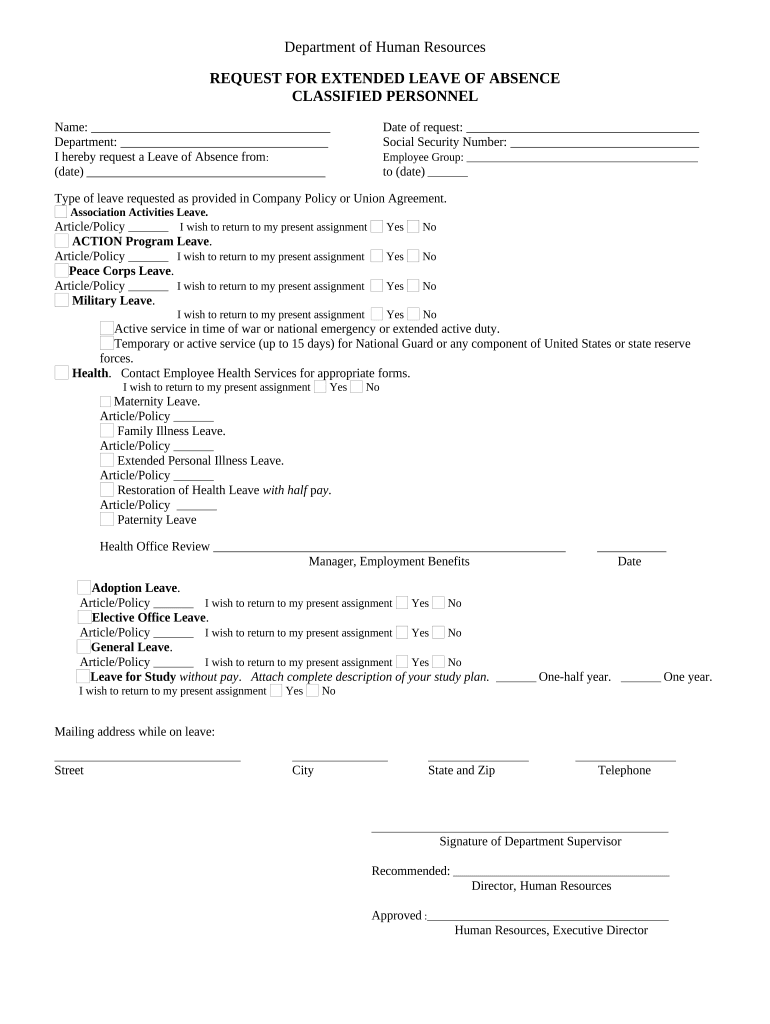
Request for Extended Leave of Absence

This template is fully customizable. Edit the text, fill out the fields, and send it for signature. Give it a try!
Request for Extended Leave of Absence

What a Request for Extended Leave of Absence Is

A Request for Extended Leave of Absence is a formal written notice an employee submits to an employer to request time away from work beyond routine vacation or short-term sick leave. Typical reasons include serious health conditions, family caregiving, parental leave, military service, or extended education. The request should state the leave type, anticipated start and end dates, expected return-to-work status, and any supporting documentation such as medical certifications. Employers evaluate requests against company policy and applicable federal or state laws, including the Family and Medical Leave Act and disability accommodations.

Why a Clear, Formal Request Matters

A clear Request for Extended Leave documents employee needs, preserves job protections, enables benefits coordination, and helps employers plan coverage. Properly completed requests reduce ambiguity, expedite approvals, and create an auditable record for compliance with federal and state leave laws.

Why a Clear, Formal Request Matters

Who typically completes and handles this request

Employees and HR professionals use this Request for Extended Leave to document and manage prolonged absence requests.

  • Individual employees requesting medical, family, military, educational, or personal extended leave.
  • Human resources teams processing leave, verifying eligibility, and coordinating benefits and coverage.
  • Supervisors and managers planning staffing, temporary coverage, and return-to-work logistics.

Primary roles involved

Employee

Employees seeking leave should complete the form with precise dates, reason, and supporting documents. Include physician statements or military orders when applicable. Providing clear contact and expected return information reduces processing delays and helps preserve job protections under federal or state statutes.

HR Manager

HR managers use the completed request to assess eligibility, calculate leave balances, determine benefit continuation, and document approvals or denials. Keep the original in the personnel file and note any accommodation discussions, coordination with payroll, and required notifications to supervisors.

Key data elements and privacy considerations

Protected Health Info: Handle under HIPAA when medical details included.
Personal Identifiers: Full legal name and employee ID.
Employment Details: Job title, department, and manager contact.
Leave Dates: Start and anticipated end dates.
Supporting Docs: Medical certificates, military orders, or school records.
Signature: Handwritten or electronic signature with date.

Risks and consequences of errors

Missed Deadlines: May delay approval.
Incomplete Information: Could lead to denial.
Incorrect Dates: Pay or benefit errors.
Unverified Medical Claims: May trigger audit.
Failure to Notify: Job protection risk.
Privacy Breach: HIPAA or state liability.

Common preparation and submission challenges

  • Submitting vague reason descriptions such as 'personal matters' prevents clear eligibility assessment and often delays employer response while HR seeks clarification.
  • Missing or illegible supporting documents, especially medical certifications, require follow-up and extend processing time for leave approval and benefits coordination.
  • Failing to indicate precise return-to-work expectations or intermittent leave needs causes confusion, complicates scheduling, and increases administrative overhead for managers.
  • Using an incorrect form version or omitting required signatures leads to re-submission, duplicate records, and unnecessary delays for both HR and the employee.

Step-by-step: completing and submitting the request

Follow these steps to prepare, submit, and track an extended leave request to ensure timely review and documentation.

  • 01
    Gather Details: Collect dates, reasons, and supporting documents.
  • 02
    Complete Form: Enter personal, employment, and contact information accurately.
  • 03
    Attach Evidence: Include medical notes, orders, or academic proofs.
  • 04
    Submit and Follow: Send to HR and confirm receipt.

Typical processing flow for an extended leave request

Typical routing: employee submits request, HR reviews eligibility, manager assesses coverage, HR issues final determination and documents outcome.

  • Submit Request: Employee sends form via email or eHR system.
  • Eligibility Review: HR verifies FMLA, ADA, or company policy.
  • Manager Review: Supervisor evaluates staffing and temporary coverage.
  • Final Decision: HR documents approval, denial, or modification.

Essential components to include on a professional request

A complete Request for Extended Leave of Absence contains specific sections that document who is requesting leave, why it is needed, and how the absence will be managed.

Employee Details

Provide full legal name, employee identification number, job title, department, manager name, work location, and best contact information so HR can match records and communicate about documentation or return-to-work planning.
Leave Reason

State the specific reason for extended leave with sufficient detail to determine eligibility under company policies or federal statutes; avoid vague descriptions and indicate whether leave is continuous or intermittent.

Duration

Specify the requested start date, anticipated end date, and any flexibility points; identify known temporary return dates and whether extensions may be requested later with updated documentation.

Medical Certification

When leave is medical, include a dated healthcare provider statement with diagnosis, expected duration, work restrictions, and fitness-for-duty provisions consistent with employer request procedures.

Intermittent Leave Plan

If requesting intermittent or reduced schedule leave, outline expected frequency, duration of absences, how coverage will be arranged, and any proposed accommodations to minimize workplace disruption.

Signatures & Dates

All applicable parties should sign and date the request; include digital signature metadata or notarization where employer policy or state law requires additional authentication.

Key timing and notification expectations

Timely notice and responsive documentation speed processing and protect employee rights under applicable leave laws.

Submit as Early as Possible:

Give employer notice as soon as practicable; 30 days for foreseeable leave.

Medical Certification Deadline:

Provide requested medical certification within 15 calendar days when requested.

FMLA Notice Timing:

Employees eligible for FMLA must provide 30 days' notice when the need is foreseeable.

Intermittent Leave Updates:

Update employer promptly when your return date changes or absences vary.

Return-to-Work Clearance:

Provide fitness-for-duty note if employer requests prior to reinstatement.

Milestones from submission to return

Key milestones from submission through return-to-work define processing stages and responsible parties at each step.

01

Submission Received

HR logs request and confirms receipt to employee.

02

Eligibility Determined

HR verifies statutory and policy eligibility.

03

Coverage Plan

Manager arranges temporary staffing or reassignment.

04

Final Documentation

HR records decision and updates personnel file.

Digital workflow configuration basics

Typical configuration options when setting up electronic submission and automated routing for an extended leave request within an HR workflow system.

Field Configuration
Signature Type Electronic signature with audit trail or scanned signature accepted
Authentication Level Email link standard; SMS or KBA for higher assurance
Routing Rules Auto-send to HR and manager; escalate on missing response
Storage Location Secure HR folder with restricted access and retention policy

Consolidated form versus separate certifications

Compare using a single consolidated request form with a split workflow that gathers separate medical or authorization documents where required for privacy or verification.

Criteria Consolidated Form Separate Docs
Medical Detail summary allowed full certification required
Processing Time faster routing multiple verifications
Privacy Control single record risk segregated access better
Audit Trail one auditable file multiple linked records

eSignature vendor comparison for managing leave requests

Comparing common eSignature vendors helps HR teams choose a platform that supports secure signatures, audit trails, and required compliance features for leave processing.

signNow DocuSign Adobe Sign PandaDoc HelloSign
Starting Price $8/user/mo $15/user/mo $14/user/mo $19/user/mo $15/user/mo
Free Trial 7-day trial No No Yes, limited Yes, limited
Bulk Send Yes Yes Yes Yes No
Audit Trail Yes Yes Yes Yes Yes
HIPAA Compliant Yes Yes Yes No No

Real-world examples of documented extended leave workflows

Two brief examples illustrate how organizations standardized extended leave requests to improve compliance, privacy, and processing speed.

University HR

A university centralized its extended leave requests into a single digital form to manage faculty sabbaticals and parental leaves.

  • Cut manual processing time by 60%.
  • Centralized documentation simplified tenure-clock adjustments, coordinated payroll and benefits, and made it easier to produce records for accreditation and internal audits without exposing sensitive medical details to unauthorized staff.

Healthcare System

A regional health system standardized extended leave requests with secure medical attachments and role-based access for HR and occupational health.

  • Improved HIPAA-aligned handling and audit trails.
  • This reduced privacy incidents, sped approvals for medically necessary leave, and ensured that clinicians and HR only saw necessary data while legal retention requirements were tracked centrally.

Practical tips to reduce rework and ensure compliance

Best practices help minimize disputes, accelerate approvals, and maintain appropriate confidentiality and recordkeeping for leave requests.

Provide Clear Instructions and Templates
Offer a standard form with field-level guidance, examples, and a checklist of required attachments. A consistent template reduces incomplete submissions and supports HR reviews, which shortens processing times and improves documentation quality for audits or appeals.
Securely Collect and Store Medical Information
When medical information is included, treat records as protected health information, limit access on a need-to-know basis, and store documents in encrypted systems compliant with HIPAA (BAA required) and company retention policies.
Confirm Receipt and Next Steps
Send an acknowledgment on receipt that outlines expected timelines, any additional documentation needed, and the contact person. Clear communication reduces follow-ups and helps employees plan while HR processes eligibility and benefits.
Maintain an Audit Trail for Decisions
Record dates, reviewers, correspondence, and reasons for approval or denial. An audit trail provides defensible documentation for compliance with FMLA, ADA, state leave laws, and internal policy disputes.

Frequently asked questions about extended leave requests

Answers to common questions about preparing, submitting, correcting, and tracking Requests for Extended Leave of Absence within HR systems.


Need help? Contact support

be ready to get more
Join over 28 million airSlate SignNow users