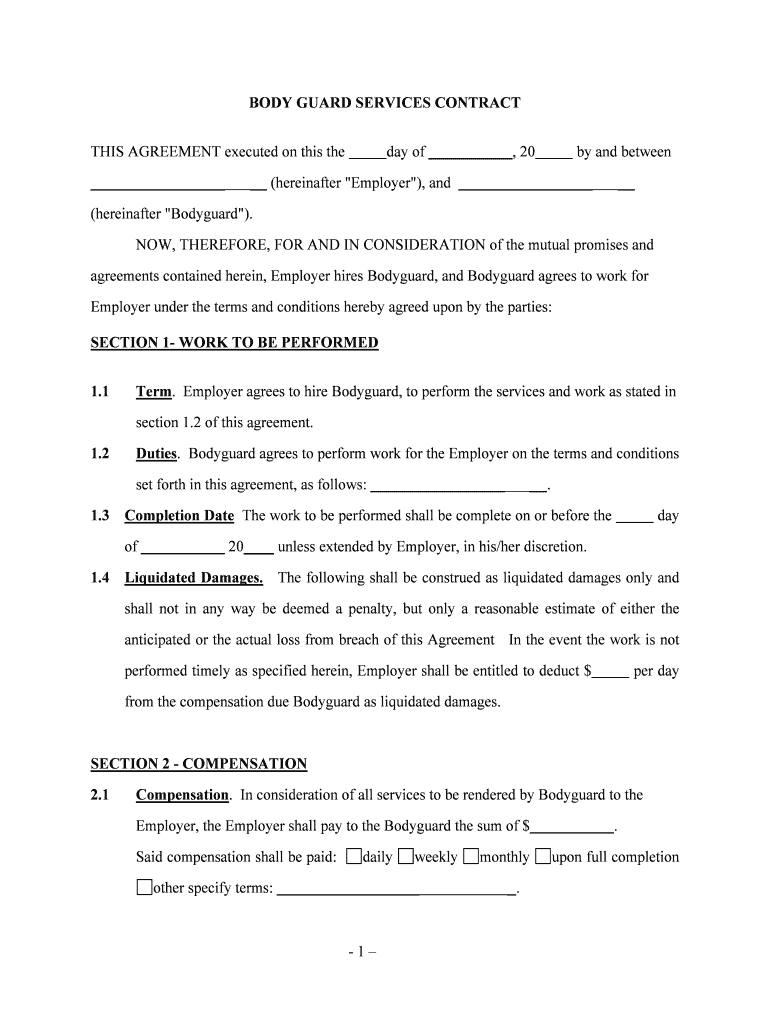
Personal Services Contract
What a Personal Services Contract Is and When It Applies
Why a Clear Personal Services Contract Matters
A well-drafted Personal Services Contract clarifies payment and performance obligations, reduces misclassification risk, establishes intellectual property ownership, and provides contractual remedies. It protects both parties by documenting expectations, limiting exposure, and creating an enforceable record of the agreement under contract law and applicable statutes.
Who Commonly Uses Personal Services Contracts
Typical users include hiring managers, freelancers, consultants, and small-business owners who engage individuals for time-based or expertise-based work.
- Hiring managers and project leads who need to define deliverables, schedules, and acceptance criteria for contracted specialists.
- Independent contractors, consultants, and gig workers who want to document scope, fees, and intellectual property rights before starting work.
- In-house legal and procurement teams that standardize terms, reduce liability, and ensure consistent tax classification across engagements.
Use the contract to document responsibilities clearly and to provide evidence of agreed terms for payment, tax reporting, and dispute resolution.
Step-by-Step: Completing a Personal Services Contract
-
011. Identify Parties: Enter full legal names and business entities for each party.
-
022. Define Scope: Describe services, deliverables, milestones, and acceptance criteria.
-
033. Set Payment Terms: Specify amounts, schedule, invoicing, and late fees.
-
044. Sign and Date: All parties must sign and include execution dates.
How Electronic Completion and Delivery Typically Works
-
Upload Document: Sender uploads the contract file to the signing platform.
-
Place Fields: Add signature, date, and required data fields for each signer.
-
Invite Signers: Send email or link to signers; include any consent disclosures.
-
Audit Trail: System records timestamps, IPs, and actions for evidence.
Recommended Online Workflow Settings for Contract Execution
| Field | Configuration |
|---|---|
| Authentication Level | Email + SMS code for most contractors |
| Signing Order | Specify sequential signing when approvals must follow order |
| Consent Disclosure | Include ESIGN consumer disclosure for consumer-facing agreements |
| Audit Trail Retention | Enable long-term retention and exportable certificate |
Platform and File Requirements for Digital Execution
Ensure the signing platform supports secure file formats, required authentication, and audit-trail export.
- File Formats: PDF and DOCX supported
- Integrations: Works with NetSuite and Google Workspace
- Authentication: SMS or KBA options available
Choose a provider that preserves an auditable chain of custody, stores signed PDFs with certificates, and supports your compliance needs.
Primary Legal Risks and Penalties to Watch For
Common Mistakes When Preparing a Personal Services Contract
- Using informal or ambiguous scope descriptions that lead to disputes over deliverables and acceptance criteria.
- Failing to specify payment timing, invoicing requirements, or late fees, causing delayed payments and accounting confusion.
- Not confirming signer authority when a company signs, which can render the agreement unenforceable or lead to ratification issues.
- Omitting tax and classification language; lack of indemnity for tax liabilities can leave the hiring party exposed.
Key Deadlines and Timing to Include or Observe
Provide W-9 on request:
No filing deadline — supply immediately upon payer request
1099-NEC to recipient:
Jan 31 each year for nonemployee compensation
1099-MISC electronic to IRS:
Mar 31 if filing electronically
I-9 retention:
Retain for 3 years after hire or 1 year after termination
Payment terms:
Specify Net 30 or negotiated schedule in the contract
Typical Contract Lifecycle Milestones
Draft and Negotiate
Draft contract, exchange redlines, agree on scope and fees
Execute Agreement
Signatures and effective date establish obligations
Deliver Services
Contractor performs per scope and submits deliverables
Close and Retain
Finalize compensation, close project, and retain records
How a Personal Services Contract Compares to Employment Documents
| Criteria | Independent Contractor Agreement | Employment Agreement |
|---|---|---|
| Use case | project-based work | ongoing employment |
| Taxes | contractor reports own taxes | employer withholds payroll taxes |
| Benefits | no benefits implied | benefits often provided |
| Control | contractor controls methods | employer controls work methods |
eSignature Provider Pricing and Feature Snapshot
| signNow | DocuSign | Adobe Sign | PandaDoc | HelloSign | |
|---|---|---|---|---|---|
| Starting Price | $8/user/mo | $15/user/mo | $14/user/mo | $19/user/mo | $15/user/mo |
| Free Trial | 7-day free trial | Varied | Varied | Varied | Varied |
| Bulk Send | Yes | Yes | Yes | Yes | Varied |
| Audit Trail | Yes | Yes | Yes | Yes | Yes |
| HIPAA Compliant | Yes | Yes | Yes | No | No |
Real-World Examples of Personal Services Contract Use
Optica Ventures
Optica Ventures standardized contractor agreements for recurring engagements to reduce negotiation time.
- The company centralized templates and routing.
- Brian Fitzgibbons, COO, noted the interface is simple and easy-to-use for the team and for customers, helping lower administrative friction and improving response times on contractor assignments.
Martin Properties
A small real estate firm used online Personal Services Contracts for property inspections and maintenance.
- They implemented standardized payment terms and insurance requirements.
- The founder reported the platform supported mobile signing and compliance needs, enabling faster vendor onboarding and consistent documentation across multiple properties.
Representative Signers and Their Responsibilities
Hiring Manager — Small Business
Typically responsible for specifying scope, acceptance criteria, and payment milestones. The hiring manager ensures the contract aligns with project timelines, approves invoices, and confirms that the contractor carries required insurance or certifications.
General Counsel — Mid-Market
Reviews and tailors standard clauses for liability limits, IP assignment, confidentiality, and dispute resolution. Legal confirms signer authority and recommends retention and recordkeeping practices to align with corporate policy.
Frequently Asked Questions About Personal Services Contracts
-
Can a contract be signed electronically?
Yes. Electronic signatures are generally enforceable under the ESIGN Act (15 U.S.C. ch. 96) and UETA where adopted. Exceptions (wills, some court filings) still require traditional formats.
-
What if the signer uses a different name?
Ensure the legal name in the signature block matches government ID or business registration. Mismatched names can create enforceability or tax-reporting issues and may require an affidavit or clarification.
-
Is notarization required?
Most Personal Services Contracts do not require notarization. Use notarization only when specified by statute or when adding a self-proving affidavit. Remote notarization (RON) is subject to state rules.
-
How do I avoid misclassification?
Document independence in the contract: contractor controls methods, provides own tools, and accepts responsibility for taxes. Review IRS and state guidance and consult counsel for borderline cases.
-
Can I rely on an image signature?
An image overlay can be valid if paired with a robust audit trail showing signer intent, attribution, and retention. For higher-assurance needs, use stronger authentication or cryptographic signatures.
-
How long should I retain contracts?
Retain for at least the contract term plus three years; industry rules may extend retention (e.g., HIPAA six years, IRS three years). Verify state requirements for longer periods.