Establishing secure connection…Loading editor…Preparing document…

Employee Computer and Internet Use Policy

This template is fully customizable. Edit the text, fill out the fields, and send it for signature. Give it a try!
Employee Computer and Internet Use Policy

What an Employee Computer and Internet Use Policy Covers

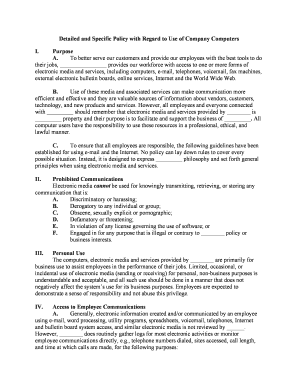
An Employee Computer and Internet Use Policy is a written employer rule set that defines acceptable use of workplace computers, networks, email, internet access, and connected devices. It explains permitted personal use, monitoring practices, data protection expectations, password and account responsibilities, rules for installing software, and consequences for violations. The policy clarifies ownership of work product and sets requirements for handling confidential and customer data, including any restrictions tied to HIPAA, FERPA, or other sector-specific laws. Employers commonly distribute it at hiring, on intranets, and during periodic policy reviews.

Why a Clear Use Policy Matters for Employers

A concise Employee Computer and Internet Use Policy reduces legal and security risk, supports regulatory compliance, and sets consistent expectations for behavior and data handling across the workforce.

Why a Clear Use Policy Matters for Employers

Who Uses and Relies on This Policy

Employers, HR teams, and IT managers use the policy to align security, privacy, and disciplinary practices across employees and contractors.

  • HR and compliance teams ensuring policy aligns with employment law and disciplinary procedures.
  • IT administrators enforcing technical controls, monitoring, and incident response requirements.
  • Employees and contractors understanding permitted use, privacy expectations, and reporting obligations.

Essential Sections to Include in the Policy

A professional Employee Computer and Internet Use Policy organizes rules into clear sections so employees can find expectations, responsibilities, and consequences quickly.

Acceptable Use

Define authorized work tasks, limits on personal browsing and email, social media conduct, and remote access standards to reduce productivity and security conflicts.
Monitoring & Privacy

Describe what monitoring occurs, how data is collected, limits to surveillance, and the company stance on privacy versus business needs.

Access Controls

Specify account ownership, password requirements, multi-factor expectations, privileged access rules, and procedures for onboarding and offboarding access.

Prohibited Activities

List unauthorized actions such as sharing credentials, installing unapproved software, accessing offensive material, or attempting to bypass security controls.

Software & Devices

Set rules for approved devices, BYOD policies, software installation, patching requirements, and encryption for mobile and remote endpoints.

Enforcement & Reporting

Explain disciplinary steps, incident reporting channels, investigation procedures, and how violations will be documented and resolved.

Technical and Security Elements to Document

Encryption: Use AES-256 at rest and TLS 1.2/1.3 in transit.
Access Control: Role-based access and multi-factor authentication.
Audit Trail: Retain signed acknowledgements and activity logs.
HIPAA Considerations: Include BAA and PHI handling rules when applicable.
Password Policy: Complexity, rotation, and lockout thresholds.
Remote Access: VPN, device security, and approved clients only.

Step-by-Step: Implementing the Policy

Follow these sequential steps to draft, approve, and operationalize the Employee Computer and Internet Use Policy across your organization.

  • 01
    Draft: Assemble legal, HR, and IT input to draft policy terms.
  • 02
    Legal Review: Have counsel confirm compliance with federal and state laws.
  • 03
    Communicate & Train: Distribute policy and deliver role-based training sessions.
  • 04
    Record Acknowledgement: Collect signed acknowledgements and store audit logs securely.

Configuring an Electronic Acknowledgement Workflow

Set up a consistent eSignature workflow so employees can sign the policy and HR can track acknowledgements automatically.

Field Configuration
Document Template Upload final policy PDF or DOCX as master template.
eSignature Fields Add signature, printed name, and date fields for each signer.
Routing Order Define the sign sequence: employee, manager, HR.
Authentication Require email plus optional SMS or SSO verification.

How Electronic Policy Acknowledgement Works

A typical eAcknowledgement flow reduces friction and preserves an auditable record of acceptance and receipt.

  • Upload: Upload the finalized policy document to the signing platform.
  • Place Fields: Add signature and date fields where required.
  • Send: Distribute by email link or bulk send to target group.
  • Archive: Store signed copies and the audit trail in secure HR storage.

Choosing a Platform for eAcknowledgements and Recordkeeping

Pick a platform that supports common file formats, secure authentication, and a tamper-evident audit trail to capture employee acknowledgements.

  • File formats: PDF, DOCX, HTML supported.
  • Integrations: Connectors for Google Workspace and Microsoft 365.
  • Authentication: Supports email, SMS, and SSO options.

Key Deadlines and Review Intervals

Establish clear timelines for issuing, reviewing, and retraining on the policy so obligations and evidence are current and defensible.

Effective Date:

Date when the current policy version takes effect for all employees.

Annual Review:

Review and update policy at least once per year or after material legal changes.

Incident Reporting:

Require internal reporting of suspected misuse or breaches within 72 hours where feasible.

Acknowledgement Deadline:

Set a deadline (for example, 30 days) for employees to sign and return acknowledgements.

Training Recurrence:

Complete role-specific training annually or upon major policy revisions.

Penalties and Risks from Poor or Missing Policies

Data Breach Fines: Regulatory fines and remediation costs.
HIPAA Violations: Civil penalties for mishandled PHI.
Employee Litigation: Claims for unlawful monitoring or wrongful discipline.
Reputational Harm: Customer and partner trust erosion.
Regulatory Scrutiny: Investigations and corrective actions.
Operational Disruption: Loss of access and service downtime.

Common Mistakes to Avoid When Creating the Policy

  • Writing vague monitoring language that fails to specify what is collected, how it is used, and retention periods, which can lead to disputes and privacy claims.
  • Failing to align technical controls with written rules, for example saying employees cannot use personal cloud storage but not preventing file uploads.
  • Collecting acknowledgements without retaining an auditable record or failing to secure signed documents with tamper-evident storage and access logs.
  • Neglecting role-based exceptions and failing to document alternate rules for contractors, executives, or regulated employees.

Comparing eSignature Pricing and Capabilities for Policy Acknowledgements

High-level plan differences and starting prices help organizations estimate recurring costs and feature coverage for employee policy acknowledgements.

signNow DocuSign Adobe Sign PandaDoc HelloSign
Starting Price $8/user/mo $15/user/mo $14/user/mo $19/user/mo $15/user/mo
Free Trial 7-day free trial Varies by vendor Varies by vendor Varies by vendor Varies by vendor
Bulk Send Yes (Business Premium) Varies by plan Varies by plan Varies by plan Varies by plan
Audit Trail Yes Yes Yes Yes Yes
Envelope Cap No cap 100 envelopes/user/year Varies Varies Varies

Real-World Examples of eAcknowledgement Use

Organizations across sizes use eSignature and automated workflows to collect policy acknowledgements and keep auditable records.

Optica Ventures

Optica Ventures streamlined HR acknowledgements using eSign to distribute policies and capture signatures across remote teams.

  • Reduced turnaround time and improved tracking across departments.
  • "The interface is simple and easy-to-use for our team; more importantly, it is just as easy for our customers." This enabled HR to confirm receipt and maintain audit logs without manual follow-up.

Martin Properties

A real estate firm used mobile signing to get field staff to acknowledge acceptable use rules immediately.

  • Field acknowledgements captured during site visits cut delays.
  • "Whether on mobile or working offline, I can get forms back to their necessary parties efficiently." The firm retained tamper-evident signed copies for compliance and audits.

Frequently Asked Questions About the Policy and eAcknowledgements

Answers to common implementation, legal validity, and practical questions employers raise when adopting an Employee Computer and Internet Use Policy.


Need help? Contact support

be ready to get more
Join over 28 million airSlate SignNow users