Establishing secure connection…Loading editor…Preparing document…

Pre Incorporation Agreement

This template is fully customizable. Edit the text, fill out the fields, and send it for signature. Give it a try!
Pre Incorporation Agreement

What a Pre Incorporation Agreement Is and when it matters

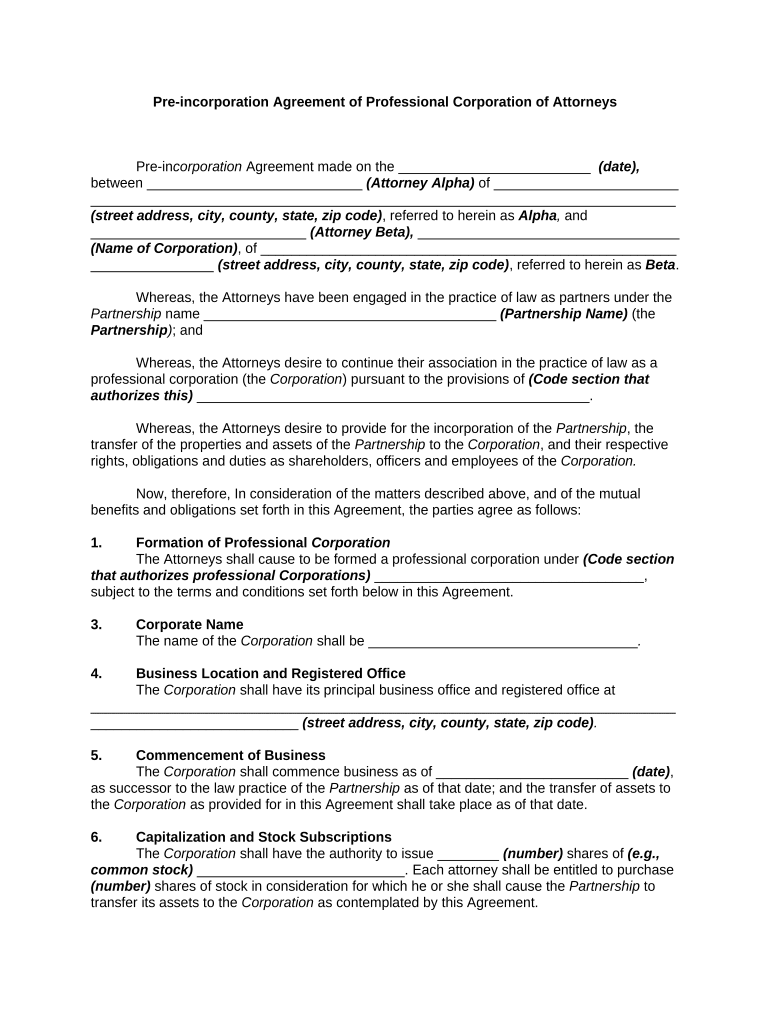
A Pre Incorporation Agreement is a written contract between prospective founders, promoters, or other parties that sets out the rights, obligations, capital contributions, equity allocations, and steps to incorporate an entity before it is legally formed. It typically covers who will take actions to form the company, how initial funds or property will be provided, how founders’ shares will be allocated or vested, and contingencies if incorporation does not occur. This agreement helps memorialize expectations, reduces later disputes, and documents transfers that will be ratified by the corporation once formed.

Why use a Pre Incorporation Agreement

A Pre Incorporation Agreement clarifies founder contributions, ownership percentages, and obligations before incorporation so parties have a documented basis for future corporate records and stock issuances.

Why use a Pre Incorporation Agreement

Who commonly prepares and signs this agreement

Founders, early investors, incorporators, and corporate counsel typically draft or sign a Pre Incorporation Agreement to lock in terms before formation.

  • Founders and co‑founders — Individuals committing cash, IP, or services in exchange for future equity; documents preserve allocation and vesting terms.
  • Early investors and angels — Parties providing seed capital conditionally; the agreement records investment terms and conditions for later ratification.
  • Incorporators and counsel — Registered agent or attorney who files formation documents and ensures the agreement aligns with state corporate statutes.

Use this agreement to create a clear record that the board and corporation can later accept or ratify after formation.

Core sections to include in a professional agreement

A complete Pre Incorporation Agreement should be organized and precise so the eventual corporation can adopt it without ambiguity during ratification.

Parties

Identify each prospective founder, incorporator, and investor by full legal name and capacity.
Contributions

Detail cash, services, intellectual property, or assets being contributed and valuation method.

Equity Allocation

Specify share classes, percentage ownership, and any vesting schedules or transfer restrictions.

Incorporation Actions

Assign responsibility and timing for filing articles, bylaws, and initial director elections.

Conditions and Contingencies

Address failure to incorporate, dissolution, and procedures if a party withdraws before formation.

Governing Law

State the law that will interpret the agreement and any dispute resolution procedures.

Essential data fields to capture

Party Names: Full legal names
Entity Type: Corporation, LLC, etc.
Contributions: Cash, IP, services
Equity Split: Shares or percentage
Effective Date: MM/DD/YYYY
Governing State: Chosen jurisdiction

Step-by-step: completing a Pre Incorporation Agreement

Follow these steps to ensure the agreement is complete and ready for ratification once the company is formed.

  • 01
    Draft core terms: Record parties, contributions, and equity splits clearly.
  • 02
    Agree vesting: Specify vesting schedules and triggers in plain language.
  • 03
    Assign incorporator: Designate who will file formation paperwork and when.
  • 04
    Sign and store: Execute with signatures and retain copies for corporate records.

How to set up an online completion workflow

Configure a digital workflow that matches the agreement’s signing order and authentication needs for each signer.

Template Fields Add signature, date, and initial fields where required
Signing Order Choose simultaneous or sequential signing
Authentication Use email, SMS code, or additional KBA if needed
Notifications Enable reminders and completion receipts
Storage Save completed PDF with audit trail

Technical requirements for eSigning and eSubmission

Confirm file formats, signer authentication, and integration points before sending the agreement for signature.

  • File Formats: PDF or DOCX accepted
  • Authenticators: Email, SMS, or SSO
  • Integrations: Salesforce, NetSuite, Google Workspace

Use a platform that provides an audit trail and encrypted storage to support legal enforceability and record retention.

Where to send or file documents and related records

After execution, route the agreement copies to corporate records, incorporator, registered agent, and any lenders or investors who require documentation.

  • Corporate Records: Store original signed agreement in the corporate minute book.
  • Incorporator: Provide execution copy to the incorporator for filings.
  • Registered Agent: Share contact details for legal service and notices.
  • Investors: Send executed copy to investors for their records.

Typical timelines and filing expectations

Key dates relate to execution, incorporation filing, issuance of shares, and tax registrations.

Execution Date:

Sign before or at formation so obligations are documented.

File Articles of Incorporation:

File with the state Secretary of State per chosen timetable.

Issue Shares:

Issue stock certificates or ledger entries after corporate adoption.

Apply for EIN:

Apply to IRS for Employer Identification Number after formation.

Tax Registrations:

Register for state and local tax accounts where required.

Common mistakes to avoid when preparing the agreement

  • Failing to record vesting: leaving vesting terms informal makes enforcement and equity allocation disputes more likely after incorporation.
  • Using vague contribution descriptions: describing noncash contributions without valuation or delivery dates creates later disagreements and accounting complications.
  • Ignoring governing law: not naming a governing state can cause uncertainty about how disputes or statutory timelines apply.
  • Skipping ratification language: failing to include explicit board ratification steps may complicate later approval of pre‑formation transfers.

Key legal and financial risks from incorrect or incomplete agreements

Breach risk: Contract damages
Tax exposure: Misclassification or late reporting
Equity disputes: Title or ownership conflicts
Regulatory noncompliance: State filing violations
Investor disputes: Funding withdrawal risk
Recordkeeping gaps: Audit and due diligence issues

Practical examples of how parties use the agreement

Two condensed scenarios show common pre‑formation arrangements and how the agreement resolves key questions.

Startup Contribution Example

Three founders agree on cash, code, and client introductions to form a corporation.

  • They set a four‑year vesting schedule with a one‑year cliff to protect early work.
  • After incorporation, the board ratifies the transfers, entries are made in the stock ledger, and investors review the executed pre‑incorporation agreement during due diligence to confirm founder ownership and vesting terms.

Investor Conditional Funding

An angel agrees to seed funding contingent on incorporation within 60 days.

  • Agreement includes funding amount, closing conditions, and deadlines.
  • If incorporation occurs on time, funds are wired and shares issued; if not, the agreement specifies termination rights, return of any escrowed funds, and reimbursement of documented expenses incurred by the investor.

Practical tips for accurate, efficient completion

Follow these best practices to reduce errors and speed later corporate actions.

Use precise language
Avoid ambiguous terms. Define key terms such as 'contribution', 'vesting', and 'effective date' to minimize interpretive disputes and facilitate board ratification.
Record valuation methods
Document how noncash contributions are valued and who performed the valuation. This prevents later tax and accounting disagreements and clarifies equity calculations.
Coordinate timing
Align the agreement’s effective date, incorporation filings, and share issuance schedule. Coordinated timing prevents gaps in authority and eases banking and tax registrations.
Preserve audit trail
Keep executed originals and digital audit logs that show sign‑time, signer identity, and an unalterable certificate of completion for due diligence and compliance.

FAQs: common questions about Pre Incorporation Agreements

Answers to frequent practical and legal questions encountered when preparing or executing these agreements.


Need help? Contact support

be ready to get more
Join over 28 million airSlate SignNow users