Establishing secure connection…Loading editor…Preparing document…

Letter Regarding Mortgage Priority Issue

This template is fully customizable. Edit the text, fill out the fields, and send it for signature. Give it a try!
Letter Regarding Mortgage Priority Issue

What the Letter Regarding Mortgage Priority Issue Is

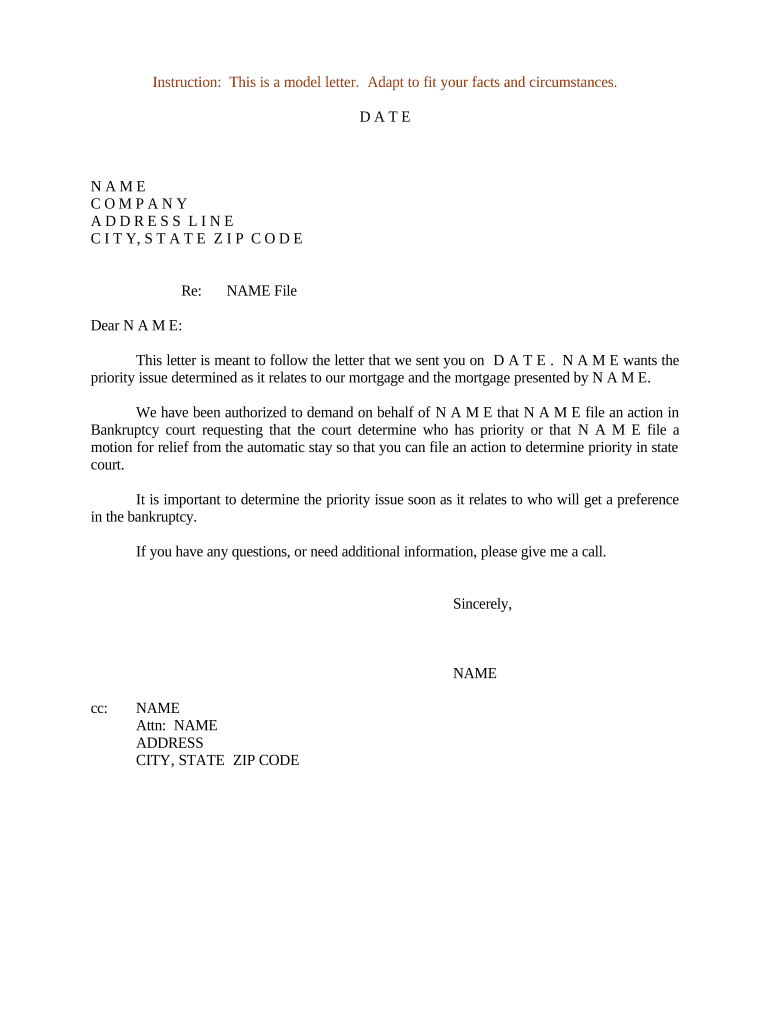
A Letter Regarding Mortgage Priority Issue is a formal written notice used to document, explain, or dispute the order of liens or mortgages affecting a specific property. Typical senders include title companies, lenders, attorneys, or borrowers who identify a conflict in lien positions — for example, when a junior mortgage claims priority over an earlier lien, or when recorded instruments contain ambiguous dates or indexing errors. The letter summarizes facts, cites recording details, requests corrective recording or clarification, and may attach supporting documents such as recorded deeds, mortgage instruments, payment histories, or title commitments. It is used to preserve rights, prompt corrective action, and create a clear administrative record.

Why this letter matters for property and title clarity

The letter establishes a concise, dated record of an observed priority issue, helps prompt title cure actions, and supports claims to insurers or courts; it also reduces closing delays and protects parties from downstream disputes when supported by clear documentation and proper signatures.

Why this letter matters for property and title clarity

Who commonly prepares or receives this letter

Use depends on the issue: administrative disputes often remain between title and recording offices, while contested priority may require counsel involvement or court intervention.

  • Title companies and abstractors who discover recording discrepancies during search and examination
  • Lenders and mortgage servicers asserting or defending lien position in a refinance or sale
  • Property owners or borrower counsel disputing priority or requesting corrective indexing

Core elements to include in a professional priority letter

A complete letter is structured to identify parties, describe the property and instruments, state the priority concern, cite record references, list requested actions, and provide contact and signature details.

Sender and recipient

Name, title, company, mailing and email addresses for each party responsible for next steps.
Property identification

Street address, county, and legal description or parcel ID to ensure record-level matching.

Affected instruments

Record book/page or instrument number for deeds, mortgages, assignments, releases, or subordinations.

Statement of issue

Concise factual description of the priority discrepancy and how it was discovered.

Requested remedy

Clear request such as re-indexing, corrective instrument, subordination, or title company action.

Attachments and signature

List of supporting documents attached and signature block with date and contact info.

Step-by-step completion checklist

Follow these sequential steps to prepare, verify, and transmit a letter that effectively documents a mortgage priority issue.

  • 01
    1. Gather records: Collect recorded deeds, mortgages, assignments, releases, and title commitment excerpts.
  • 02
    2. Verify references: Confirm instrument numbers, recording dates, and party names against county records.
  • 03
    3. Draft factual statement: Write a concise description of the priority discrepancy and identify the desired corrective action.
  • 04
    4. Sign and attach: Sign the letter, attach exhibits, notarize if required, and prepare delivery method documentation.

Typical routing and resolution flow

Resolution often proceeds through a short administrative path that preserves evidence and creates a recorded trail of the request.

  • Sender to Title/Lender: Submit the letter with exhibits to the counterparty and title insurer for initial review.
  • Title search review: Title examiner re-checks chain of title and confirms conflicting instruments.
  • Corrective action: Parties agree on remedy such as recording a release, re-indexing, or executing a subordination.
  • Record and confirm: Record corrective instrument and circulate proof of recording to all interested parties.

How to set up a standard digital workflow for this letter

Configure the document workflow to ensure all required fields, attachments, and signature steps are included for a compliant record.

Field Configuration
Property ID Required text field; validate against title commitment
Instrument Attachments PDF upload required; allow multiple file uploads
Signature Signer field followed by date and, if required, notary section
Routing Sequential send to title, lender counsel, and recording evidence email

Digital delivery and signing considerations

Use an eSignature provider that can produce a tamper-evident signed PDF and export a complete certificate of completion for title underwriting or litigation records.

  • Supported formats: PDF, DOCX, and scanned images
  • Audit trail: IP, timestamp, and action log preserved
  • Integrations: CRM and document storage connections

Typical timing expectations and response windows

Timely action preserves priority rights; set internal deadlines and track responses to avoid forfeiting remedies.

Initial acknowledgment:

Request an acknowledgment within 14 calendar days of sending the letter

Title review period:

Allow 14–30 days for title examiner review, depending on complexity

Corrective recording:

Record corrective instruments promptly after agreement — recorder processing times vary by county

Escalation window:

If no resolution in 30–60 days, escalate to counsel or title insurer as applicable

Retention of proof:

Keep delivery and receipt evidence for at least 7 years post-resolution

Common pitfalls to avoid when preparing the letter

  • Using incomplete or incorrect instrument references that prevent the recorder or title examiner from locating the relevant documents
  • Failing to attach supporting exhibits such as recorded instruments, which forces additional follow-up and delays resolution
  • Omitting notarization where state law or the recorder requires it, which can render a corrective instrument invalid or unrecordable
  • Sending to the wrong office or incorrect contact within a lender or title company and losing priority by missing statutory or contractual timelines

Risks of incomplete or incorrect letters

Delayed title: Extended closing times and lender pullbacks
Coverage denial: Title insurer may reserve coverage or deny claim
Loss of rights: Failure to timely preserve priority may forfeit remedies
Increased costs: Additional attorney or re-recording fees
Regulatory exposure: Potential scrutiny if consumer notices are mishandled
Recording rejection: County recorder may reject defective instruments

Practical tips for accurate and efficient completion

Adopt standardized templates, verify references, and preserve an auditable trail to minimize follow-up and support title underwriting.

Use exact recorded language
Copy grantor/grantee names, legal descriptions, and instrument numbers exactly from recorded documents to avoid retrieval errors and mismatched searches.
Attach a chain-of-title exhibit
Provide a short exhibit showing sequential recordings to make the priority problem immediately visible to the reviewer and reduce research time.
Include contact and escalation path
List a primary contact, backup, and expected response window to accelerate communications and avoid missed deadlines.
Preserve delivery receipts
Keep certified mail receipts, email delivery confirmations, or eSignature certificates of completion as proof of notice and timing.

Real-world examples of how organizations used a priority letter

These compact examples show practical outcomes when a clear letter and supporting exhibits are used.

Martin Properties — Tim Martin, Founder

A title examiner found an indexing error during a refinance search and sent a priority letter to the recorder

  • The county re-indexed the earlier mortgage, restoring proper priority
  • Tim Martin reported that recording the corrective instrument and supplying a clear exhibit prevented a delayed closing and preserved title insurance coverages.

BIS — Dan Rotelli, CEO

A construction lender disputed lien priority after a subcontractor recorded a lien improperly

  • The lender’s counsel issued a priority letter with assignment and payment exhibits
  • The contractor executed a release and the title company cleared the matter with updated endorsements to proceed to funding.

eSignature vendor comparison for sending and signing the letter

Comparison shows starting prices and key features relevant to preparing, signing, and delivering a Letter Regarding Mortgage Priority Issue.

signNow DocuSign Adobe Sign PandaDoc HelloSign
Starting Price $8/user/mo $15/user/mo $14/user/mo $19/user/mo $15/user/mo
Free Trial 7-day free trial Varies by vendor Varies by vendor Varies by vendor Varies by vendor
Bulk Send Yes (Business Premium) Yes Yes Yes Yes
Audit Trail Yes Yes Yes Yes Yes
HIPAA Compliant Yes Yes Yes No No
Envelope Cap No envelope cap 100 envelopes/user/year Varies Varies Varies

Frequently asked questions about the Letter Regarding Mortgage Priority Issue

Answers to common legal and workflow questions frequently asked by title professionals, lenders, and property owners.


Need help? Contact support

be ready to get more
Join over 28 million airSlate SignNow users