Establishing secure connection… Loading editor… Preparing document…
Navigation

Fill and Sign the Profit Sharing Agreement Form

Fill and Sign the Profit Sharing Agreement Form

How it works

Open the document and fill out all its fields.
Apply your legally-binding eSignature.
Save and invite other recipients to sign it.

Rate template

4.7
50 votes
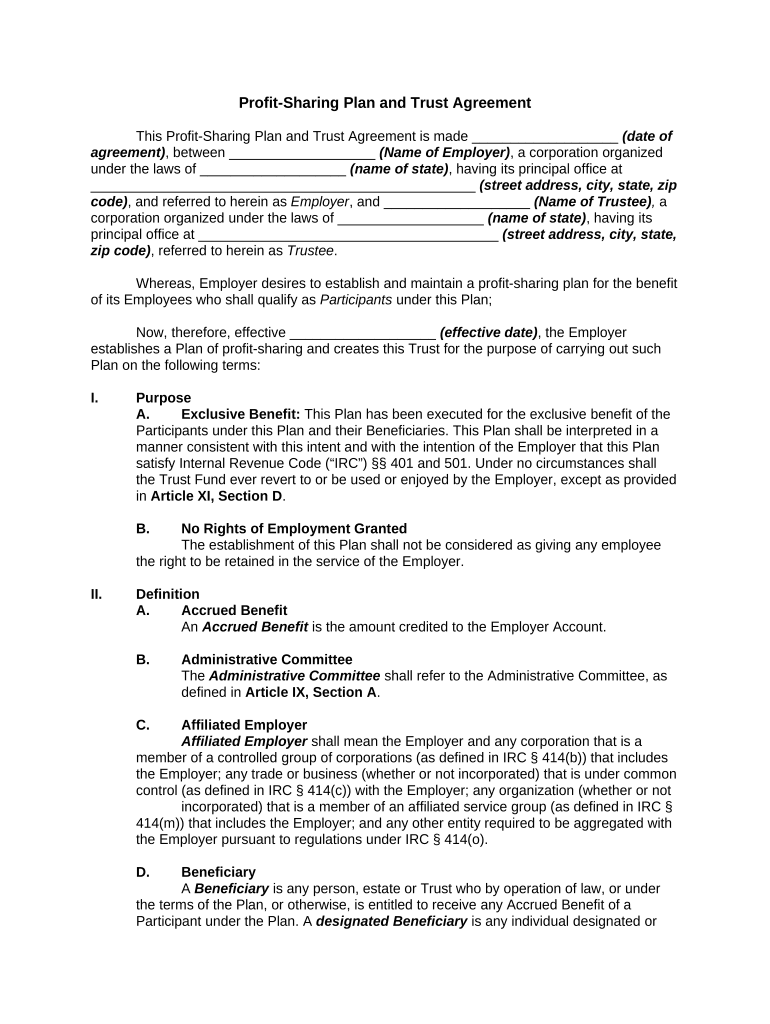
Profit-Sharing Plan and Trust Agreement This Profit-Sharing Plan and Trust Agreement is made ___________________ (date of agreement) , between ___________________ (Name of Employer) , a corporation organized under the laws of ___________________ (name of state) , having its principal office at __________________________________________________ (street address, city, state, zip code) , and referred to herein as Employer , and ___________________ (Name of Trustee) , a corporation organized under the laws of ___________________ (name of state) , having its principal office at _______________________________________ (street address, city, state, zip code) , referred to herein as Trustee . Whereas, Employer desires to establish and maintain a profit-sharing plan for the benefit of its Employees who shall qualify as Participants under this Plan; Now, therefore, effective ___________________ (effective date) , the Employer establishes a Plan of profit-sharing and creates this Trust for the purpose of carrying out such Plan on the following terms: I. Purpose A. Exclusive Benefit: This Plan has been executed for the exclusive benefit of the Participants under this Plan and their Beneficiaries. This Plan shall be interpreted in a manner consistent with this intent and with the intention of the Employer that this Plan satisfy Internal Revenue Code (“IRC”) §§ 401 and 501. Under no circumstances shall the Trust Fund ever revert to or be used or enjoyed by the Employer, except as provided in Article XI, Section D . B. No Rights of Employment Granted The establishment of this Plan shall not be considered as giving any employee the right to be retained in the service of the Employer. II. Definition A. Accrued Benefit An Accrued Benefit is the amount credited to the Employer Account. B. Administrative Committee The Administrative Committee shall refer to the Administrative Committee, as defined in Article IX, Section A . C. Affiliated Employer Affiliated Employer shall mean the Employer and any corporation that is a member of a controlled group of corporations (as defined in IRC § 414(b)) that includes the Employer; any trade or business (whether or not incorporated) that is under common control (as defined in IRC § 414(c)) with the Employer; any organization (whether or not incorporated) that is a member of an affiliated service group (as defined in IRC § 414(m)) that includes the Employer; and any other entity required to be aggregated with the Employer pursuant to regulations under IRC § 414(o). D. Beneficiary A Beneficiary is any person, estate or Trust who by operation of law, or under the terms of the Plan, or otherwise, is entitled to receive any Accrued Benefit of a Participant under the Plan. A designated Beneficiary is any individual designated or determined in accordance with Article V , Section E , except that it shall not include any person who becomes a beneficiary by virtue of the laws of inheritance or intestate succession. E. Cash-Out A Cash-Out may be involuntary or voluntary. An involuntary Cash-Out is a distribution of Accrued Benefit to a former Participant that meets the following requirements: 1. The former Participant's entire non-forfeitable Accrued Benefit is distributed to him or her; 2. The present value of the non-forfeitable Accrued Benefit of the Participant does not exceed $_____________; and 3. The distribution is made on account of the Employee's termination of participation in the Plan and no later than the end of the Plan Year following such termination. In determining the Accrued Benefit of a Participant under this paragraph, the Plan shall use an interest rate not greater than the interest rate that would be used (as of the date of distribution) by the Pension Benefit Guaranty Corporation for purposes of determining the present value of a lump- sum distribution on Plan termination. A voluntary Cash-Out is a distribution of Accrued Benefits to a former Participant that meets the following requirements: (i) the former Participant has voluntarily elected to receive the distribution; and (ii) the distribution is made on account of the Employee's termination of participation in the Plan and no later than the end of the Plan Year following such termination. F. Compensation Compensation refers to all compensation paid during the Plan Year under consideration as wages, salary or commissions/wages or salary , by the Employer to an Employee during the time he or she was a Participant , ___________________ ( including or excluding ) overtime payments and bonuses, but excluding director's fees. It excludes all contributions by the Employer to the Plan and to any other retirement or deferred compensation Plan maintained by the Employer (except amounts deferred pursuant to IRC § 401(k)(2) or 403(b) or contributed pursuant to IRC § 125) and excludes amounts in excess of $______________ (as adjusted for the cost of living) for contributions for the Plan Year or such other amount as may be prescribed by law. In determining the Compensation of an Employee for purposes of the Compensation limitation, the rules of IRC § 414(q)(6) shall apply, except that in applying such rules, the term family shall include only the spouse of the Employee and any lineal descendants of the Employee who have not attained age ___________________ (age of descendant) before the close of the Plan Year. G. Early Retirement Age Early Retirement Age shall be ___________________ (early retirement age) years of age with ___________________ (number) years from the time he or she begins initial participation in the Plan . H. Employee An Employee is an individual who is employed by the Employer or who is on a Leave of Absence. Employee shall not include a salaried individual hourly paid individual . Independent contractors shall not be Employees. I. Employer The Employer shall mean ___________________ (name of employer) . J. Employer Account The Employer Account is the separate account maintained for each Participant to which all Employer contributions shall be allocated and to which Forfeitures shall be reallocated. K. ERISA ERISA refers to the Employee Retirement Income Security Act of 1974, as amended. L. Forfeiture Forfeiture refers to the amount of non-vested Accrued Benefits in a Participant's Employer Account that are reallocated to the Employer Accounts of other Participants. M. Highly Compensated Employee 1. Highly Compensated Employee means a highly compensated active employee and a highly compensated former employee. A highly compensated active employee includes any employee who performs service for the Employer during the determination year and who, during the look-back year: (i) received compensation from the Employer in excess of $_______________ (as adjusted pursuant to IRC § 415(d)); (ii) received compensation from the Employer in excess of $_______________ (as adjusted pursuant to IRC § 415(d)) and was a member of the top-paid group for such year; or (iii) was an officer of the Employer or an Affiliated Employer and received compensation during such year that is greater than _____% of the dollar limitation in effect under IRC §415(b)(1) (A). The term highly compensated active employee also includes: (i) Employees who are both described in the preceding sentence if the term determination year is substituted for the term look-back year and the employee is one of the ____________ (number) employees who received the most compensation from the Employer or Affiliated Employer during the determination year; and (ii) Employees who are 5% owners at any time during the look-back year or determination year. 2. If no officer has satisfied the compensation requirement of (iii) above during either a determination year or look-back year, the highest paid officer for such year shall be treated as a highly compensated employee. 3. For this purpose, the determination year shall be the Plan year unless the Employer elects a calendar year. The look-back year shall be the 12-month period immediately preceding the determination year, or, if elected by the Employer, the calendar year ending with or within the applicable determination year (or, in the case of a determination year that is shorter than 12 months, the calendar year ending with or within the 12-month period ending with the end of the applicable determination year), or, if elected, the calendar year immediately preceding the calendar year determination year. 4. A highly compensated former employee includes any employee who separated from service (or was deemed to have separated) before the determination year, performs no service for the Employer during the determination year, and was a highly compensated active employee for either the separation year or any determination ear ending on or after the employee's 55th birthday. 5. The determination of who is a Highly Compensated Employee, including the determinations of the number and identity of employees in the top-paid group, the top ________________ (number of employees) employees, the number of employees treated as officers, and the compensation that is considered, will be made in accordance with IRC § 414(g) and the regulations under that section. 6. For Plan Years beginning after December 31, ______ (identification of year) , the preceding definition of a Highly Compensated Employee shall be limited to anyone who was a 5% owner during the current or preceding Plan Year, or had compensation from the Employer in excess of $_____________ (adjusted for the cost of living) in the preceding Plan Year. If the Employer elects (in the manner determined by the Internal Revenue Service), those earning $_____________ must also have been in the top-paid group for the preceding Plan Year. N. Hour of Service Hour of Service means: 1. Each hour for which an Employee is directly or indirectly compensated or entitled to compensation from the Employer for the performance of duties during the applicable computation period; 2. Each hour for which an Employee is directly or indirectly compensated or entitled to compensation from the Employer (irrespective of whether the employment relationship has terminated) for reasons other than performance of duties (such as vacation, holidays, sickness, disability, lay- off, military duty or leave of absence) during the applicable computation period; 3. Each hour for which back pay is awarded or agreed to by the Employer, without regard to mitigation of damages; and 4. Each hour before or after the effective date of this Plan for which an Employee was directly or indirectly paid or entitled to be paid by the Predecessor Employer, except that such hours before the effective date of this Plan shall not be considered for the purposes of determining Hours of Service for Accrual of Benefits or Years of Service for Vesting. (Select one of the following) 5. Service will be determined on the basis of actual hours for which an Employee is paid or entitled to payment. (or) 5. Service will be determined on the basis of days worked. An Employee will be credited with ______ (number) hours of service if under this Section of the Plan an Employee would be credited with at least one hour of service during the day. (or) 5. Service will be determined on the basis of weeks worked. An Employee will be credited with ______ (number) hours of service if under this Section of the Plan an Employee would be credited with at least one hour of service during the week. (or) 5. Service will be determined on the basis of months worked. An Employee will be credited with _____ (number) hours of service if under this Section of the Plan an Employee would be credited with at least one hour of service during the month. 6(i). Hours of Service will be credited for employment with other members of an affiliated service group (under IRC § 414(m)), a controlled group of corporations (under IRC § 414(b)), or a group of trades or businesses under common control (under IRC § 414(c)) of which the Employer is a member or any other entity required to be aggregated with the Employer pursuant to regulations under IRC § 414(o). (ii). Hours of Service will also be credited for any individual considered an Employee for purposes of this Plan under IRC § 414(n). (iii). Notwithstanding Paragraph II above, no more than ______________ (number) hours of Service are required to be credited to an Employee on account of any single continuous period during which the Employee performs no duties (whether or not such period occurs in a single computation period), and an hour for which an Employee is directly or indirectly paid, or entitled to payment, on account of a period during which no duties are performed is not required to be credited to the Employee if such payment is made or due under a Plan maintained by the Employer solely for the purpose of complying with applicable worker's compensation, unemployment compensation or disability insurance laws. In addition, Hours of Service are not required to be credited for a payment that solely reimburses an Employee for medical or medically related expenses incurred by the Employee. The provisions of Sections 2530.200b-2(b) and (c) of the Department of Labor Regulations are incorporated in this Article by reference. (iv). For the purposes of this Section N, a payment shall be deemed to be made by or due from the Employer regardless of whether such payment is made by or due from the Employer directly or indirectly through a Trust, fund or insurer to which the Employer contributes or pays premiums. O. IRC IRC refers to the Internal Revenue Code of 1986, as amended. P. Leave of Absence A Leave of Absence shall refer to that period during which the Participant is absent without Compensation and for which the Administrative Committee, in its sole discretion, has determined him or her to be on a Leave of Absence instead of having terminated his or her employment. (However, such discretion of the Administrative Committee shall be exercised in a nondiscriminatory manner.) In all events, a Leave of Absence by reason of service in the armed forces of the United States shall end no later than the time at which a Participant's reemployment rights as a member of the armed forces cease to be protected by law and a Leave of Absence for any other reason shall end after _________ (number) months, except that if the Participant resumes employment with the Employer prior to that time, the Leave of Absence shall end on such date of resumption of employment. The date that the Leave of Absence ends shall be deemed the Termination Date if the Participant does not resume employment with the Employer. In determining a Year of Service for Accrual of Benefits, all such Leaves of Absence shall be considered to be periods when the Employee is a Participant. Q. Net Profits The Net Profits mean the Employer's net profits for the taxable year of the Employer (coinciding with or within which the Plan Year ends) as calculated at the end of the taxable year, in accordance with the Employer's regular accounting practices, before state and federal income taxes and without reduction by reason of the Employer's contributions under the Plan, and any other Plan maintained by the Employer and described in IRC §§ 401(a) and 403(a). R. Normal Retirement Age The Normal Retirement Age shall be the time at which the Participant attains _______________ (normal retirement age) years of age. S. One Year Break in Service A. One Year Break in Service means a Plan Year in which the Participant has completed not more than ______ (number) Hours of Service. However, in determining a One Year Break in Service for a Plan Year in which, or following which, a maternity or paternity absence (as defined below) occurs, the following shall apply: the Hours of Service that normally would have been credited but for the maternity or paternity absence or _______ (number) Hours of Service per day if the Administrative Committee is unable to determine the Hours of Service that normally would have been credited) shall be credited to the Plan Year in which such absence begins, if the Employee would incur a One Year Break in Service if the hours were not so credited; in all other cases the Hours of Service shall be credited to the following Plan Year. The total Hours of Service credited under a maternity or paternity absence shall not exceed ________ (number) hours. A maternity or paternity absence is one in which the Employee is absent from work because of: (i) the pregnancy of the Employee; (ii) the birth of a child of the Employee; (iii) the placement of a child with the Employee in connection with the adoption of such child by the Employee; or (iv) the caring for such child immediately following such birth or placement. As a condition of an Employee being credited with Hours of Service pursuant to this paragraph, the Administrative Committee can require that the Employee timely furnish such information as is reasonably necessary to establish that the absence from work was for a cause stated in clauses (i) -- (iv) and the number of days attributable to such cause. T. Participant A Participant shall refer to every Employee or former Employee who has met the applicable participation requirements of Article III . U. Plan Plan refers to this Profit-Sharing Plan and Trust Agreement. V. Plan Administrator The Plan Administrator shall be the Employer, unless a different person is designated Plan Administrator in a resolution adopted by the board of directors of the Employer, and such person accepts the designation in writing. W. Plan Year A Plan Year is the period from the first day of _____________ (name of month) to the last day of _______________ (name of month) , annually. X. Predecessor Employer Predecessor Employer refers to ___________________ (name) , a ________________________ (Corporation, Limited Liability Company, Sole Proprietorship, or Partnership) which was the predecessor of the present Employer. Y. Retirement Retirement refers to the termination of employment of an Employee who has attained at least the ____________________ (Normal Retirement Age or Early Retirement Age) . The Employee may work beyond Normal Retirement Age, in which case Employer contributions and Forfeitures shall continue to be allocated to the Employer Account of the Employee. Z. Rollover Contribution Rollover Contribution means: 1. Amounts transferred to this Plan directly from another qualified corporate or qualified non-corporate Plan; 2. Lump sum distributions received by an Employee from another qualified Plan that are eligible for tax-free rollover treatment and are transferred by the Employee to this Plan within _________ (number) days following his or her receipt of the same; 3. Amounts transferred to this Plan from a conduit individual retirement account, provided that such account has no assets other than assets that were previously distributed to the Employee by another qualified Plan other than a qualified Plan; and further provided that such amounts met the applicable requirements of IRC § 408(d)(3) for rollover treatment on transfer to the conduit individual retirement account; and 4. Amounts distributed to an Employee from a conduit individual retirement account meeting the requirements of Subparagraph 3 above which are transferred by the Employee to this Plan within ________ (number) days of his or her receipt from such account. AA. Termination Date The Termination Date shall be the date on which the earliest of the following events occurs: (a) a Participant's retirement; (b) a Participant's termination of employment as a result of Total and Permanent Disability; (c) a Participant's death; or (d) a Participant's termination of employment for any other reason. BB. Total and Permanent Disability Total and Permanent Disability shall refer to the Participant suffering from a physical or mental condition as determined by the Administrative Committee, based upon appropriate medical reports and examinations may be expected to result in death or be of long and indefinite duration and which renders the Participant unable to perform any substantial gainful activity/any substantial gainful activity for purposes of IRC § 72(m)(7) , his or her customary duties for the Employer. CC. Total Service for Vesting 1. Total Service for Vesting shall mean the sum of each separate Year of Service for Vesting credited to the Participant; however, if the Participant incurs at least __________ (number) consecutive One Year Breaks in Service, his or her Years of Service for Vesting rendered after such break in service shall only be counted for purposes of determining his or her vested benefits accruing after such break in service, not for determining his or her vested benefits accruing before such break. 2. If, at any time when the Participant is 0% vested as to his or her Employer Account, the Participant incurs a One Year Break in Service or two or more consecutive One Year Breaks in Service, and the number of such One Year Breaks in Service equals or exceeds his or her Years of Service for Vesting rendered before such break in service, then Total Service for Vesting shall not include any Years of Service for Vesting occurring before such break in service. DD. Trust Trust means the Trust created under this Profit-Sharing Plan and Trust Agreement. EE. Trust Fund The Trust Fund consists of the Employer and Participant contributions held by the Plan and any income or appreciation on the same. FF. Year of Service for Accrual of Benefits 1. A Year of Service for Accrual of Benefits means a Plan Year during which the Employee had not less than ________ (number) Hours of Service as a Participant. If the Participant entered the Plan other than on the first day of the Plan Year, all Hours of Service rendered by the Participant during that Plan Year whether or not rendered as a Participant, shall be treated as if they were Hours of Service as a Participant. 2. Notwithstanding the preceding paragraph, if the number of Employees who have less than _________ (number) but more than _________ (number) Hours of Service as a Participant for the Plan Year is such that the Plan would not otherwise meet the requirements of IRC § 401(a)(26) (generally requiring the participation of the lesser of 50 Employees or 40% of the Employees) and 410(b) (generally requiring that the participation of the non-highly compensated employees be at least 70% of the participation of the highly compensated employees), then if the requirements of IRC §§ 401(a)(26) and 410(b) are still not met, the _________ (number) Hours of Service requirement of the first paragraph of this section will be reduced to not more than _________ (number) hours of Service, but only to the extent necessary to permit a sufficient additional number of Employees to receive an allocation in the Plan Year to meet the requirements of IRC §§ 401(a)(26) and 410(b). The Employees (or former Employees) so qualifying shall be determined by first selecting the Employee with the highest number of Hours of Service (less than ________ (number) hours for the Plan Year and continuing in descending order until a sufficient number of Employees receive an allocation in the Plan Year. GG. Year of Service for Participation A Year of Service for Participation means the 12-consecutive-month period, the first day of which is the day the Employee was first required to be credited with an Hour of Service, provided the Employee was credited with not less than ________ (number) Hours of Service during such period. HH. Year of Service for Vesting A Year of Service for Vesting shall mean a Plan Year during which the Employee had not less than ___________ (number) Hours of Service. III. Eligibility to Participate A. Initial Entry Every Employee who has attained the age of _________ (age of employee) will be eligible to and shall participate in the Plan on the first day of the Plan Year or the first day of the _________ (ordinal number) month of the Plan Year that first occurs on or after such completion, provided that he or she is an Employee on such date. All Participants shall be required to furnish such information to the Administrative Committee as it may reasonably request for the proper administration of the Plan. B. Notwithstanding the preceding Subparagraph A , an individual shall not be eligible to participate in the Plan during any time period for which he or she is included in a unit of the employees covered by a collective bargaining agreement between employee representatives and one or more employers, if there is evidence that retirement benefits were the subject of good faith bargaining between such employee representatives and the employer. C. Resumption of Participation If a Participant incurs at least a One Year Break in Service, then his or her active participation in the Plan shall be suspended until he or she completes a Year of Service for Participation following such One Year Break in Service for Participation following such One Year Break in Service. Following such One Year Break in Service and upon then completing a Year of Service for Participation, measured from his or her reemployment commencement date, the Participant will be readmitted to active participation in the Plan retroactive to the beginning of such Year of Service for Participation . IV. Contributions to the Trust A. Employer Contributions to Participants Subject to the rights of the Employer under Article XI , the Employer may make a contribution to the Trust beginning with the first Plan Year ending on or after the effective date of the Plan. The amount of the contribution shall be discretionary with the Employer and shall be paid to the Trustee on or before the time required by law for filing the Employer's federal income tax return (including extensions) for the year with respect to which the contribution is made. However, no Employer contributions may be made in any Plan Year to the extent that they would not be deductible. B. Manner of Allocation All contributions by the Employer for any Plan Year, and all Forfeitures, if any, during such year, shall be allocated as of the last day of such year to the Employer Account of each individual Participant who is an Employee on such date and who has a Year of Service for Accrual of Benefits for the Plan Year, in the same proportion that each such Participant's Compensation for the Plan Year bears to the total Compensation of all Participants for the Plan Year. C. Permissible Types of Employer Contributions Payments on account of the contributions due from the Employer for any year may be made in cash or in kind; except that assets may not be contributed if such contribution violates the prohibited transaction rules of IRC § 4975, or the corresponding rules under ERISA § 406, if applicable. D. Loans to Participants 1. The Administrative Committee may authorize the Trustee to loan to any Participant an amount or amounts that, when added to the outstanding balance of all prior loans to the Participant under the Plan and all other plans maintained by the Employer, does not exceed the lesser of (i) $____________ (reduced by the excess, if any, of (A) the highest outstanding balance of loans from the Plan during the one-year period ending on the day before the date such loan is made over (B) the outstanding balance of loans from the Plan on the date on which such loan is made), or (ii) one-half of such Participant's vested Accrued Benefit. For the purposes of the preceding sentence all qualified retirement plans maintained by the Employer shall be treated as included with this Plan for purposes of the limitations relating to the dollar amounts of permissible loans and the length of time of repayment, except that only Accrued Benefits under this Plan shall be taken into account, in applying the limitations of (ii). A loan may not be made to an owner-employee or shareholder-employee, as defined in IRC § 4975(d). 2. Loans may not be made to Participants who are highly compensated Employees, officers, or shareholders in percentage amounts greater than amounts made available to other Participants, and such loans must be made available to all Participants on a reasonable equivalent basis. Any loans made must bear a reasonable rate of interest, considering all relevant factors, specifically including current bank interest rates, and must be adequately secured, as determined by the Administrative Committee. The Employer Account of the borrower may be pledged as security for such loans. The loan shall be repaid in substantially level amortization (with payments not less frequently than quarterly) over a term not to exceed ________ (number) years. Notwithstanding the preceding sentence, the repayment of loans may be extended a reasonable time beyond _________ (number) years if such loan is used to acquire a dwelling unit that is to be used as a principal residence of the Participant. All costs and expenses in connection with obtaining the loans and perfecting the Plan's security interest, including but not limited to taxes, recording fees, filing fees and attorney's fees, shall be prepaid by the Participant or shall be deducted from the total proceeds of the loan. 3. Any loan shall be allocated to the accounts of the Participant to whom the loan is made and repayment of principal and interest on the loan shall be allocated to such accounts in the proportion in which the funds were borrowed. 4. The Administrative Committee may adopt a loan policy, provided that it shall not conflict with the Plan. 5. Loan repayments will be suspended under this Plan as permitted under IRC § 414(u)(4). E. Rollover Contributions 1. Any Employee may make a Rollover Contribution to this Plan, subject to the consent of the Employer; provided, however, that the Trust from which the funds are to be transferred must permit the transfer to be made, and provided, further, that, in the opinion of the Employer's legal counsel, such transfer will not jeopardize the tax exempt status of this Plan or Trust or create adverse tax consequences for the Employer. Rollover Contributions shall be made by delivery to the Trustee (or to the Employer for delivery to the Trustee) for deposit in the Trust. All Rollover Contributions must be in cash or property satisfactory to the Trustee, whose decision in this regard shall be final. The Trustee will not accept rollovers of accumulated deductible employee contributions from a Simplified Employee Pension Plan; nor will the Trustee accept rollovers in the form of a direct transfer from any qualified Plan that is required to provide benefits in the form of a qualified joint and survivor annuity or a qualified preretirement survivor annuity, as defined in IRC § 417(b) and (c). 2. If the Administrative Committee accepts such transfer of funds, it shall allocate them to the Participant Account of the transferor, or to a separate or segregated account established for such purpose ( Rollover Account ). If the funds are allocated to a segregated account, they shall be invested separately and any appreciation, depreciation, gain, or loss with respect to such account, and any related expenses shall be allocated to such account; for all other purposes such funds shall be treated as if they had been allocated to a Participant Account. 3. Rollover Contributions shall not be considered to be Participant contributions for the purpose of calculating the limitations under Article V, Section D . V. Administration of Accounts A. Investments The amounts allocated to the Employer and Participant Accounts, if applicable, shall be invested by the Trustee (except as provided in Article IX, Section D ) in accordance with Article VIII . B. Invest in Single Fund and Reasonable Rules The Trustee may cause all contributions paid to it by the Employer and the income from such contributions, without distinction between principal and income, to be held and administered as a single fund, and the Trustee shall not be required to invest separately any share of any Participant except as provided in Article IV, Section E, and Article VII, Section D . The Trustee may adopt reasonable rules for the administration of such common fund and for the determination of the proportionate interest of each Participant in the fund. C. Valuation of Assets and Allocation of Changes The assets of the Trust Fund will be valued as of the close of the last day of each Plan Year at their fair-market value and the Employer Account (or Employer Accounts if the Participant has Accrued Benefits for service incurred both prior and subsequent to ___________ (number) consecutive One Year Breaks in Service), including any Employer Account held in suspense, shall be adjusted for any net appreciation or net depreciation in the assets of the Plan and any net income or net loss of the Trust for such year, with each account being credited or charged in the ratio that the amount of the account (as of the close of the last day of the Plan Year) bears to the total (as of the close of the last day of the Plan Year) of all remaining non-segregated accounts. For the purpose of such adjustment of accounts, any contribution made by the Employer with respect to that Plan Year shall be considered as having been made immediately after such valuation and adjustment. In making the adjustments required by this Section, the cash value of any life insurance, and the value of any amounts segregated in accordance with Article IV, Section E , and Article VII, Section D shall not be considered in determining the amount of net appreciation, depreciation, gain or loss to be allocated to such account. The amount of any net appreciation, depreciation, gain or loss with respect to such cash value or segregated account shall be allocated to the individual account with respect to which it arose. D. Limitations on Allocations to Each Participant 1. Defined Contribution Plan Limitations Notwithstanding any other provision of this Plan, the maximum annual addition for any Plan Year that can be made to any individual Participant's Employer accounts, taken together, is the lesser of $___________or ______% of the Participant's Compensation. For the purposes of this Paragraph I and Paragraph II of this Section D , the annual addition is the sum of the following amounts allocated to the accounts of the individual Participant for the Plan Year of the Trust (which shall be the limitation year for purposes of IRC § 415, unless the Employer otherwise elects) under this and all other defined contribution type Plans maintained by the Employer: a. Employer contributions; b. Forfeitures (if applicable); c. Participant contributions; d. Amounts allocated to an individual medical account (as defined in IRC § 415(l)(2)) that is part of a defined benefit Plan maintained by the Employer; and e. Amounts derived from contributions paid or accrued after December 31, ________ (year) , in taxable years ending after such date, that are attributable to postretirement medical benefits allocated to the separate account of a Key Employee (as defined in IRC § 419A(d)(3)) under a welfare benefit fund (as defined in IRC § 419(e)) maintained by the Employer. If Subsections D(1) and D(2) of this Article limit the amount that can be allocated to the Employer Account of any Participant for a Plan Year, the excess amount that cannot be allocated for the Plan Year shall be held in the suspense account to be allocated on the last day of each succeeding Plan Year until the funds in the suspense account have been completely reallocated. No further Employer contributions may be made to the Plan until the suspense account has been completely reallocated. No investment gains and losses or other income shall be allocated to the suspense account. 2. Defined Benefit Plan Limitations As to any defined benefit Plan maintained by the Employer for any Plan Year, the annual benefit cannot exceed the lesser of: a. $__________ (or such other figure as determined in accordance with the cost of living adjustment procedure of IRC § 415(d) but only for the year in which such a adjustment is effective), or b. 100% of the Participant's average annual Section 415 Compensation for the Participant's three highest paid consecutive Plan Years; however, benefits of up to $__________ a Plan Year can be paid without regard to the 100% limitation if the total retirement benefits payable to an Employee under all defined-benefit Plans (as defined in IRC § 414(j)) maintained by the Employer for the present and any prior Plan Year do not exceed $__________ and the Employer has not at any time maintained a defined-contribution Plan (as defined in IRC § 414(i)) in which the Employee was a Participant. c. If the Participant has less than 10 years of participation in the Plan (as defined in IRC § 415(b)(5)), the applicable limitation in subsection D(2)(a) above shall be reduced by multiplying such limitation by a fraction. The numerator of such fraction shall be the number of years, or part of a year, of participation in the defined benefit Plan maintained by the Employer; the denominator shall be 10 years. d. If the Participant has less than 10 years of service as an Employee (as defined in IRC § 415(b)(5)), the applicable limitation in subsection D(2)(b) shall be reduced by multiplying such limitation by a fraction. The numerator of such fraction shall be the number of years, or part of a year, of service with the Employer; the denominator shall be 10 years. e. For the purposes of this Subsection D(2) , the annual benefit means a benefit payable annually in the form of a straight life annuity with no ancillary or incidental benefits and with no Employee or Rollover Contributions. To the extent that ancillary benefits are provided, the limits set forth in Subsections D(2)( a) and (b) shall be reduced actuarially, using an interest rate assumption equal to _______% to reflect such ancillary benefits. f. If distribution of retirement benefits begins before the Social Security Retirement Age, the $__________ limitation as described in this Subsection D(2) shall be reduced actuarially on the following basis: If the Social Security Retirement Age is 65 and distribution of benefits begins after the Participant has attained age 62 but before the Social Security Retirement Age, the reduction shall be 5 / 9 of 1% per month for each month by which the first distribution precedes the Social Security Retirement Age; g. If the Social Security Retirement Age exceeds 65 and the distribution of benefits begins after the Participant has attained age 62, the reduction shall be the sum of (1) and (2), where (1) is 5 / 9 of 1% per month for each of the first 36 months, and (2) is 5 / 12 of 1% per month for each additional month (up to 24 months) by which benefits commence before the month of the Participant's Social Security Retirement Age; and h. If the distribution of benefits begins before the Participant has attained age 62, the limitation will be the actuarial equivalent of what it would have been if the first distribution had been made when the Participant had attained age 62; the assumed interest rate for such calculation shall be _____%. i. Social Security Retirement Age means the age used as the retirement age under section 216(l) of the Social Security Act, which is presently age 65 for a person born before 1938, age 66 for a person born between 1938 and 1954, and (description of Social Security retirement ages for different years of birth) . j. For the purposes of this Subsection D(2), the average annual Section 415 Compensation for a Participant's three highest paid consecutive years shall mean the Participant's greatest aggregate Section 415 Compensation during the period of three consecutive Plan Years in which the individual was an active Participant in the Plan. 3. Section 415 Compensation Section 415 Compensation means (EITHER:) wages as defined in IRC § 3401(a) and all other payments of compensation to an employee by the employer (in the course of the Employer's trade or business) for which the Employer is required to furnish the Employee a written statement under IRC §§ 6041(d) and 6051(a)(3). Compensation must be determined without regard to any rules under IRC § 3401(a) that limit the remuneration included in wages based on the nature or location of the employment or the services performed (such as the exception for agricultural labor in IRC § 3401(a)(2)). (OR:) wages within the meaning of IRC § 3401(a) for the purposes of income tax withholding at the source but determined without regard to any rules that limit the remuneration included in wages based on the nature or location of the employment or the services performed (such as the exception for agricultural labor in IRC § 3401(a)(2)). Notwithstanding the preceding, for Plan Years beginning after December 31, _______ (identification of year) , Section 415 Compensation will include any elective deferral under IRC §§ 401(k), 403(b), 457, or 125. For any self-employed individual compensation will mean earned income. For the purposes of applying the limitations of this Section D , compensation for a limitation year is the compensation actually paid or made available during such limitation year. Notwithstanding the preceding sentence, compensation for a Participant in a defined contribution Plan who is permanently and totally disabled (as defined in IRC § 22(e)(3)) is the compensation such Participant would have received for the limitation year before becoming permanently and totally disabled; such imputed compensation for the disabled Participant may be taken into account only if the Participant is not a Highly Compensated Employee (as defined in IRC § 414(q)) and contributions made on behalf of such Participant are non- forfeitable when made. 4. Overall Permitted Disparity Limits under IRC § 401(l) The overall permitted disparity limits for purposes of IRC § 401(l), and as set forth in Treasury Regulation § 1.401(l)-5, may not be exceeded for all qualified retirement Plans maintained by the Employer, including any Affiliated Employer. If the limits would otherwise be exceeded with respect to all such Plans, then (EITHER:) the Participant's permitted disparity under the defined- benefit Plan will be reduced to the extent necessary to comply with the Permitted disparity limits before any such reductions in permitted disparity to this Plan or any other defined-contribution Plan maintained by the Employer or an Affiliated Employer are made. (OR:) the Participant's permitted disparity under this Plan will be reduced to the extent necessary to comply with the permitted disparity limits before any such reductions in permitted disparity to any other defined contribution Plan or defined-benefit Plan of the Employer or an Affiliated Employer are made. E. Designation of Beneficiary Each Participant may designate from time to time in writing one or more Beneficiaries, who will receive the Participant's vested Accrued Benefit in the event of the Participant's death. If the Participant dies without having made a Beneficiary designation, the Trustee shall distribute such benefits in the following order of priority to the deceased Participant's: (a) spouse; (b) lineal descendants; (c) parents; or (d) estate. However, in the event of the death of a married Participant, the surviving spouse must be the sole beneficiary unless the surviving spouse has consented in writing to a different election, has acknowledged the effect of such election, and the consent and acknowledgment are witnessed by a member of the Administrative Committee or a notary public. The consent of the spouse shall not be necessary if it is established to the satisfaction of the Administrative Committee that there is no spouse, the spouse cannot reasonably be located, or for such other reasons as the regulations may prescribe. The consent of the spouse or reason for not requiring such consent shall be applicable only to that spouse. If the spouse of a Participant becomes locatable or if a Participant remarries, it shall be the duty of the Participant to bring that fact to the attention of the Administrative Committee. If the Participant so notifies the Administrative Committee, the Administrative Committee shall then, if applicable, proceed to make available to such spouse the consent of spouse procedures described in this Section. F. Life Insurance 1. Portions of the Trust Fund may be used to purchase and pay premiums on life insurance contracts on the lives of Participants as to which the insured Participant shall have the power to designate beneficiaries. 2. Each life insurance contract shall be purchased and premiums paid on the contract in accordance with uniform policies, established by the Administrative Committee and providing for treatment of Participants in similar circumstances in a similar fashion (except those Participants declared uninsurable at standard rates by an insurance company, for whom no insurance need be purchased) from the Employer Account of the Participant whose life is insured. If life insurance is not purchased ratably for all Participants (except those Participants uninsurable at standard rates), the consent of Participants on whose behalf life insurance contracts are purchased must be obtained. The aggregate premiums paid for any Plan Year on such insurance contracts on the Participant's life from his or her Employer Account shall, in the case of whole life insurance, at all times be less than _____% of the aggregate of the Employer contributions allocated to the credit of such Participant's Employer Account; and in the case of term life insurance, shall at all times be less than _____% of such Employer contributions. 3. As to such life insurance contract on any Participant's life, upon or before the happening of any of the circumstances (other than the Participant's death) upon which, pursuant to Article VII, the Participant becomes eligible for payments under the Plan, the Trustee shall: a. Convert its entire value into cash; b. Convert its entire value to provide periodic income to the Participant, provided that no portion may be used to continue life insurance for the Participant; or c. Distribute it to the Participant. In no event, however, shall this Section F be interpreted to permit receipt by a Participant of such cash, periodic income, or contracts (with modes of settlement, as to all three alternatives, limited to those provided elsewhere in the Plan) before he or she is eligible to receive benefits pursuant to Article VII . 4. If contracts of life insurance are purchased pursuant to this Section F , amounts paid for premiums on such policies shall be subtracted from the Employer Accounts of the Participants upon such payments, and such contracts and the cash or reserve values of the contracts shall not be deemed part of the Trust Fund for purposes of the allocation of profit and loss of the Trust under Se ction C of this Article V . Dividends paid upon, and return of premiums with respect to, any policy of life insurance held under this Plan shall be credited to the Employer Account of the Participant insured. VI. Vesting A. Employer Account Vesting on Death, Retirement, or Total Permanent Disability If a Participant's employment is terminated for death, on or after ___________ (Normal/Early) Retirement Age, or for Total and Permanent Disability, then 100% of the Accrued Benefit in his or her Employer Account shall vest in the Participant (or in his or her Beneficiary, as the case may be) and shall be distributed or set aside in accordance with the provisions of Article VII . B. Employer Account Vesting on Termination If a Participant's employment is terminated except for death, Total and Permanent Disability, or on or after ___________ (Normal/Early) Retirement Age, the following percentages of the Accrued Benefit in the Employer Account of the Participant shall vest in the Participant and shall be distributed to or set aside for him or her in accordance with the provisions of Article VII :  One year or less of total service: 0%  (Description of vesting schedule for interim years) _______________________ __________________________________________________________________ ;  _____________ (Number of years for full vesting) years or more: 100%. The Accrued Benefit of a Participant that is not vested as above provided shall be retained by the Trustee for allocation as a Forfeiture, in accordance with the provisions of Article IV, Section B , and Article VII, Sections H and J . ( OPTIONAL: If a Participant's employment is terminated, except for death, Total and Permanent Disability, or on or after (Normal/Early) Retirement Age, then 100% of the Accrued Benefit in the Employer Account of the Participant shall vest in the Participant and shall be distributed to or set aside for him or her in accordance with the provisions of Article VII .) C. Forfeiture for Certain Acts Notwithstanding the provisions of Sections A and B of this Article, a Participant who has less than _____________ (number of years) years of Total Service for Vesting shall forfeit all of the Accrued Benefit in his or her Employer Account if he or she should commit any criminal act or willful or malicious act that damages the Employer or other Employees. D. Restoration of Forfeitures If a Participant is less than 100% vested and he or she receives a deemed or actual distribution from the Plan and forfeits part of his or her Accrued Benefit, then if the Participant resumes employment with the Employer before the occurrence of ______ (number) consecutive One Year Breaks in Service, until such time as there is a _______________ (ordinal number of consecutive one-year breaks in service) consecutive One Year Break in Service, the Participant's vested portion of the balance in his or her account at any time shall be equal to an amount (“X”) determined by the formula X = P(AB + D) — D, where “P” is the vested percentage of the Participant at such time, “AB” is the balance in the Participant's account at such time, and “D” is the amount distributed as a severance of employment benefit and not previously repaid by the Participant in accordance with Article VII, Section J . If an Employee is deemed to receive a distribution pursuant to Article VII, Section B , and the Participant resumes employment covered under the Plan before the date the Employee incurs _____ (number) consecutive One Year Breaks in Service, upon the reemployment of such Employee, the balance of the Employer Account of the Employee will be restored to the amount on the date of such deemed distribution. If the Participant's forfeited Accrued Benefit is restored pursuant to this Section D , the restoration shall be made first out of Forfeitures, if any, and then by additional Employer contributions. VII. Distribution of Benefits A. Method of Distribution of Employer Accounts The Participant shall elect to receive distribution of his or her accounts in one of the following forms: (a) a lump-sum distribution; (b) an installment distribution consisting of approximately equal annual or more frequent installments (subject to the limitations of Section B of this Article) over a term certain; (c) a Cash-Out; or (d) a direct rollover as described in Section G of this Article. Notwithstanding the preceding, if a Participant's vested Accrued Benefit at the time he or she terminates employment (through severance, death, or Total and Permanent Disability) does not exceed $___________, the entire amount of such Accrued Benefit shall be distributed in the form of a Cash-Out within ______ (number) days after such termination of employment. B. Time of Distribution 1. After the Participant has attained the Normal Retirement Age, has died, or has terminated his or her employment, then the first installment, the lump-sum payment, Cash-Out, or Direct Rollover, as the case may be, shall be made no more than ______ (number) days after the end of the Plan Year in which the event occurs, or as soon thereafter as administratively feasible; provided, however, unless the distribution is made in the form of a Cash-Out, the distributions shall be made no earlier than the time at which, the Participant has incurred a One Year Break in Service or is 100% vested as to his or her Employer Account. If the distribution is made before the time the Participant attains the later of age 62 or the Normal Retirement Age under the Plan, the Participant must consent to the distribution, unless it is in the form of an involuntary Cash-Out. If the distribution is delayed until the Participant incurs a One Year Break in Service or is 100% vested, it shall be made within ______ (number) days of the occurrence of such event. If the Participant is 0% vested in his or her Accrued Benefit, his or her account balance will be deemed to have been distributed to him or her in the form of a Cash-Out. However, in all events such distributions shall begin no later than ______ (number) days after the end of the Plan Year in which occurs the latest of the following: a. The date on which the Participant attains the earlier of age _____ (age of participant) or the Normal Retirement Age; b. The ______ (number) anniversary of the year in which the Participant commenced participation in the Plan; or c. The Termination Date. 2. Distributions shall commence no later than the later of (i) the first day of April of the calendar year following the calendar year in which the Participant attains age 701/2, or (ii) the calendar year in which the Participant retires if the Participant is not a 5% owner of the Employer. 3. If distributions are made in installments rather than a lump-sum distribution or a Cash-Out, then (i) the installments must be over a period of ________ (number) years or less, or (ii) the amount of the installment to be distributed each year must be at least an amount equal to the quotient obtained by dividing the Participant's entire interest by the life expectancy of the Participant or the joint and last survivor expectancy of the Participant and his or her designated Beneficiary. Life expectancy and joint and last survivor expectancy are computed by the use of the return multiples contained in Treasury Regulations § 1.72-9, or, in the case of payments under a contract issued by an insurance company, by use of the life expectancy tables of the insurance company. For the purposes of this computation, a Participant's life expectancy may be recalculated no more frequently than annually, but the life expectancy of a non-spouse Beneficiary may not be recalculated. If the Participant's spouse is not the designated Beneficiary, the method of distribution selected must assure that at least 50% of the present value of the amount available for distribution is paid within the life expectancy of the Participant. 4. If the Participant dies after distributions to him or her have begun but before his or her entire Accrued Benefit has been distributed to him or her, the remaining portion of his or her Accrued Benefit shall be distributed from the Plan at least as rapidly as under the method of distribution previously established for him or her, if such method was irrevocable at the time of his or her death. 5. If the Participant dies before distribution of his or her interest commences, then distributions of the Participant's remaining Accrued Benefit must be completed by the end of the fifth calendar year following the year of his or her death. However, installment distributions to a designated Beneficiary that begin not later than the end of the calendar year following the death of the Participant shall be treated as complying with this five-year distribution requirement (even though the installment payments are not completed within five years of the Participant's death) if the distributions are made at a rate that is not longer than that calculated (in the manner described in Section III of this Article) to provide payment of all the Participant's Accrued Benefit during the anticipated life expectancy of the designated Beneficiary. Provided that if the designated Beneficiary is the surviving spouse of the deceased Participant, the distributions can begin as long after the Participant's death as the date on which the deceased Participant would have attained the age of 701/2; if the surviving spouse dies before distributions to the surviving spouse have begun, the Plan may make distributions at such times as described in this Article as it would have if the surviving spouse had been a deceased Participant. 6. For the purposes of this Section B , any amount paid to a child of a Participant will be treated as if it had been paid to the surviving spouse of the Participant if such remaining amount becomes payable to the surviving spouse when the child reaches the age of majority. 7. If a distribution is one to which IRC §§ 401(a)(11) and 417 do not apply, such distribution may commence less than 30 days after the notice required under § 1.411(a)-11(c) of the Income Tax Regulations is given, provided that: a. The Plan Administrator clearly informs the Participant that the Participant has a right to a period of at least _______ (number) days after receiving the notice to consider the decision of whether or not to elect a distribution (and, if applicable, a particular distribution option); and b. The Participant, after receiving the notice, affirmatively elects a distribution. The notice specified in the first sentence of this Section shall not be required if the Participant's vested Accrued Benefit at the time of the distribution does not exceed $____________. C. Segregation if Installment Distribution The Administrative Committee may determine that the Employer and Participant Accounts, if applicable, of a Participant who is no longer an Employee shall be segregated and set aside, in which event the Administrative Committee shall direct the Trustee to segregate the vested portion (as defined in Article VI ) of the entire balance of the Participant's Employer Account and Participant Account, if applicable, and to deposit such portion in a separate interest bearing account at a bank or savings and loan association, and the account shall cease to participate in the income or net loss or appreciation or depreciation of the Trust Fund, as of the beginning of the Plan Year in which such segregation occurs, and instead will be credited with the full amount of interest earned on the account. D. Non-segregation if Installment Distribution If the Administrative Committee does not segregate (as provided in Section C above) the Employer Account and Participant Account, if applicable, of a Participant, the account shall continue to be treated, without interruption, in the same manner as when the Participant was an Employee, in which case the installment distributions shall be adjusted upward or downward to reflect appreciation or depreciation, or income or loss in the account balance. E. Distribution after Death of Participant In the event of the death of a Participant after installment payments have begun, but before completion of such payments, the full amount of such unpaid benefits shall continue to be paid in the form of the previously established installments except that the Beneficiary may request that the remaining Accrued Benefit be paid in a lump sum. In the event of the death of the Participant before the start of any payment of his or her Accrued Benefit, distributions shall be made in the form and at the time or times selected by the Beneficiary pursuant to Sections A and B of this Article VII. F. Distribution after Death of Beneficiary In the event of the death of a Beneficiary (or a contingent Beneficiary, if applicable) before the completion of payment of benefits due the Beneficiary from the Plan, the full amount of such unpaid benefits shall at once vest in and become the property of the estate of the Beneficiary. In determining the amount of such unpaid benefits, no adjustment shall be made by reason of any net income, or net loss, of the Trust, or any net appreciation or net depreciation by the Trust's assets subsequent to the beginning of the Plan Year in which such final distribution occurs. G. Direct Rollover Notwithstanding any other provision of the Plan, the Plan Administrator shall advise any distributee entitled to receive an eligible rollover distribution, at the same time as the notice required to be given pursuant to this Article VII (or such other time as is permitted by law) of his or her right to elect a direct rollover to an eligible retirement Plan, pursuant to the provisions of this Section. To elect a direct rollover the distributee must request in writing to the Plan Administrator that all or a specified portion of the eligible rollover distribution be transferred directly to (an eligible retirement plan/one or more eligible retirement plans) . (EITHER :) If more than one direct rollover distribution will be made, the notice specified in the first sentence of this Section must state that the distributee's initial election to make or not to make a direct rollover will remain in effect unless he or she gives the Plan Administrator written instructions to change the election, in which case the new election will remain in effect until changed. (OR :) If a distribution will be made on behalf of the distributee in more than one year, the notice specified in the first sentence of this Section must be given to the distributee in each year in which there is an eligible rollover distribution, and the distributee must file a new election with the Plan Administrator if he or she wishes to have the eligible rollover distribution transferred directly to an eligible retirement Plan. For the purposes of this Section G , the following definitions shall apply: 1. A direct rollover is a payment by the Plan to the eligible retirement Plan specified by the distributee. 2. A distributee includes an Employee or former Employee. In addition, the Employee's or former Employee's surviving spouse and the Employee's (or former Employee's) spouse or former spouse who is the alternate payee under a qualified domestic relations order, as defined in IRC § 414(p), are distributees with regard to the interest of the spouse or former spouse. 3. An Eligible Retirement Plan is a retirement Plan/Trust that meets the requirements of IRC § 401(a), an annuity described in IRC § 403(a), an individual retirement account described in IRC § 408(a), or an individual retirement annuity (other than an endowment contract) described in IRC § 408(b), the terms of which permit the acceptance of a direct rollover of the distributives’ eligible rollover distribution. However, in the case of an eligible rollover distribution to the surviving spouse, an eligible retirement Plan is an individual retirement account or an individual retirement annuity. The ___________________ (Administrative Committee/Plan Administrator) may establish reasonable procedures for ascertaining that the eligible retirement Plan meets the preceding requirements. 4. An eligible rollover distribution is any distribution from this Plan of all or any portion of the balance to the credit of the distributee, except for distributions (or portions of distributions) that are: a. Part of a series of substantially equal periodic payments (not less frequently than annually) made over the life of the Employee (or the joint lives of the Employee and the Employee's designated beneficiary), the life expectancy of the Employee (or the joint life and last survivor expectancy of the Employee and the Employee's designated beneficiary), or a specified period of ________ (number) years or more; b. Required under IRC § 401(a)(9) (relating to the minimum distribution requirements); or c. The portion of any distribution that is not includable in gross income (determined without regard to the exclusion for net unrealized appreciation in employer securities described in IRC § 402(e)(4)). H. Suspens

Practical advice on setting up your ‘Profit Sharing Agreement’ online

Are you fed up with the complications of managing paperwork? Look no further than airSlate SignNow, the premier electronic signature platform for individuals and small to medium-sized businesses. Bid farewell to the tedious process of printing and scanning documents. With airSlate SignNow, you can swiftly complete and sign paperwork online. Utilize the robust features included in this intuitive and cost-effective platform to transform your approach to document management. Whether you need to sign forms or collect electronic signatures, airSlate SignNow simplifies everything with just a few clicks.

Adhere to this step-by-step guide:

  1. Log into your account or sign up for a complimentary trial with our service.
  2. Hit +Create to upload a file from your device, cloud storage, or our form library.
  3. Access your ‘Profit Sharing Agreement’ in the editor.
  4. Select Me (Fill Out Now) to prepare the document on your end.
  5. Add and designate fillable fields for other participants (if needed).
  6. Proceed with the Send Invite options to solicit eSignatures from others.
  7. Save, print your version, or convert it into a reusable template.

Don’t fret if you need to work with others on your Profit Sharing Agreement or send it for notarization—our solution provides all you need to accomplish these tasks. Create an account with airSlate SignNow today and elevate your document management to new levels!

Here is a list of the most common customer questions. If you can’t find an answer to your question, please don’t hesitate to reach out to us.

Need help? Contact Support
Profit sharing agreement template
Profit sharing agreement template word
Profit sharing agreement pdf
Profit sharing agreement in business partnership
Profit sharing agreement with employee
Profit sharing agreement template free
Profit sharing agreement between company and individual
Profit sharing agreement for investors
Profit sharing agreement template
Profit sharing agreement pdf
Profit sharing agreement template word
Profit sharing agreement in business partnership

The best way to complete and sign your profit sharing agreement form

Save time on document management with airSlate SignNow and get your profit sharing agreement form eSigned quickly from anywhere with our fully compliant eSignature tool.

How to Sign a PDF Online How to Sign a PDF Online

How to complete and sign forms online

In the past, coping with paperwork took lots of time and effort. But with airSlate SignNow, document management is quick and easy. Our powerful and easy-to-use eSignature solution allows you to easily complete and eSign your profit sharing agreement form online from any internet-connected device.

Follow the step-by-step guide to eSign your profit sharing agreement form template online:

  • 1.Sign up for a free trial with airSlate SignNow or log in to your account with password credentials or SSO authorization option.
  • 2.Click Upload or Create and import a file for eSigning from your device, the cloud, or our form collection.
  • 3.Click on the document name to open it in the editor and utilize the left-side toolbar to complete all the blank fields appropriately.
  • 4.Put the My Signature field where you need to eSign your form. Provide your name, draw, or upload a picture of your handwritten signature.
  • 5.Click Save and Close to accomplish modifying your completed form.

After your profit sharing agreement form template is ready, download it to your device, save it to the cloud, or invite other individuals to electronically sign it. With airSlate SignNow, the eSigning process only requires several clicks. Use our powerful eSignature tool wherever you are to manage your paperwork productively!

How to Sign a PDF Using Google Chrome How to Sign a PDF Using Google Chrome

How to fill out and sign documents in Google Chrome

Completing and signing paperwork is simple with the airSlate SignNow extension for Google Chrome. Installing it to your browser is a quick and productive way to deal with your paperwork online. Sign your profit sharing agreement form sample with a legally-binding eSignature in a few clicks without switching between applications and tabs.

Follow the step-by-step guidelines to eSign your profit sharing agreement form template in Google Chrome:

  • 1.Go to the Chrome Web Store, find the airSlate SignNow extension for Chrome, and install it to your browser.
  • 2.Right-click on the link to a form you need to approve and select Open in airSlate SignNow.
  • 3.Log in to your account using your credentials or Google/Facebook sign-in buttons. If you don’t have one, sign up for a free trial.
  • 4.Use the Edit & Sign menu on the left to fill out your sample, then drag and drop the My Signature field.
  • 5.Add a picture of your handwritten signature, draw it, or simply enter your full name to eSign.
  • 6.Make sure all the details are correct and click Save and Close to finish editing your paperwork.

Now, you can save your profit sharing agreement form template to your device or cloud storage, email the copy to other individuals, or invite them to eSign your form with an email request or a protected Signing Link. The airSlate SignNow extension for Google Chrome enhances your document processes with minimum time and effort. Start using airSlate SignNow today!

How to Sign a PDF in Gmail How to Sign a PDF in Gmail How to Sign a PDF in Gmail

How to fill out and sign documents in Gmail

Every time you receive an email with the profit sharing agreement form for approval, there’s no need to print and scan a document or download and re-upload it to another program. There’s a much better solution if you use Gmail. Try the airSlate SignNow add-on to quickly eSign any documents right from your inbox.

Follow the step-by-step guidelines to eSign your profit sharing agreement form in Gmail:

  • 1.Visit the Google Workplace Marketplace and locate a airSlate SignNow add-on for Gmail.
  • 2.Install the program with a corresponding button and grant the tool access to your Google account.
  • 3.Open an email containing an attachment that needs signing and use the S key on the right panel to launch the add-on.
  • 4.Log in to your airSlate SignNow account. Choose Send to Sign to forward the file to other people for approval or click Upload to open it in the editor.
  • 5.Drop the My Signature field where you need to eSign: type, draw, or upload your signature.

This eSigning process saves time and only takes a couple of clicks. Take advantage of the airSlate SignNow add-on for Gmail to adjust your profit sharing agreement form with fillable fields, sign forms legally, and invite other parties to eSign them al without leaving your inbox. Improve your signature workflows now!

How to Sign a PDF on a Mobile Device How to Sign a PDF on a Mobile Device How to Sign a PDF on a Mobile Device

How to complete and sign paperwork in a mobile browser

Need to rapidly complete and sign your profit sharing agreement form on a smartphone while working on the go? airSlate SignNow can help without the need to install extra software apps. Open our airSlate SignNow solution from any browser on your mobile device and add legally-binding electronic signatures on the go, 24/7.

Follow the step-by-step guidelines to eSign your profit sharing agreement form in a browser:

  • 1.Open any browser on your device and follow the link www.signnow.com
  • 2.Create an account with a free trial or log in with your password credentials or SSO authentication.
  • 3.Click Upload or Create and import a file that needs to be completed from a cloud, your device, or our form library with ready-to go templates.
  • 4.Open the form and complete the empty fields with tools from Edit & Sign menu on the left.
  • 5.Put the My Signature field to the form, then type in your name, draw, or add your signature.

In a few simple clicks, your profit sharing agreement form is completed from wherever you are. As soon as you're done with editing, you can save the document on your device, build a reusable template for it, email it to other people, or invite them eSign it. Make your documents on the go speedy and productive with airSlate SignNow!

How to Sign a PDF on iPhone How to Sign a PDF on iPhone

How to fill out and sign documents on iOS

In today’s business community, tasks must be done quickly even when you’re away from your computer. With the airSlate SignNow app, you can organize your paperwork and approve your profit sharing agreement form with a legally-binding eSignature right on your iPhone or iPad. Set it up on your device to close deals and manage documents from anyplace 24/7.

Follow the step-by-step guidelines to eSign your profit sharing agreement form on iOS devices:

  • 1.Open the App Store, search for the airSlate SignNow app by airSlate, and set it up on your device.
  • 2.Open the application, tap Create to add a template, and choose Myself.
  • 3.Choose Signature at the bottom toolbar and simply draw your autograph with a finger or stylus to eSign the sample.
  • 4.Tap Done -> Save after signing the sample.
  • 5.Tap Save or use the Make Template option to re-use this paperwork later on.

This process is so straightforward your profit sharing agreement form is completed and signed within a few taps. The airSlate SignNow application works in the cloud so all the forms on your mobile device are kept in your account and are available whenever you need them. Use airSlate SignNow for iOS to enhance your document management and eSignature workflows!

How to Sign a PDF on Android How to Sign a PDF on Android

How to fill out and sign forms on Android

With airSlate SignNow, it’s simple to sign your profit sharing agreement form on the go. Install its mobile application for Android OS on your device and start boosting eSignature workflows right on your smartphone or tablet.

Follow the step-by-step guidelines to eSign your profit sharing agreement form on Android:

  • 1.Open Google Play, find the airSlate SignNow application from airSlate, and install it on your device.
  • 2.Sign in to your account or create it with a free trial, then add a file with a ➕ button on the bottom of you screen.
  • 3.Tap on the imported document and select Open in Editor from the dropdown menu.
  • 4.Tap on Tools tab -> Signature, then draw or type your name to eSign the sample. Fill out empty fields with other tools on the bottom if needed.
  • 5.Use the ✔ button, then tap on the Save option to finish editing.

With an intuitive interface and total compliance with major eSignature requirements, the airSlate SignNow app is the perfect tool for signing your profit sharing agreement form. It even operates without internet and updates all record adjustments once your internet connection is restored and the tool is synced. Fill out and eSign forms, send them for eSigning, and make multi-usable templates anytime and from anyplace with airSlate SignNow.

Sign up and try Profit sharing agreement form
  • Close deals faster
  • Improve productivity
  • Delight customers
  • Increase revenue
  • Save time & money
  • Reduce payment cycles