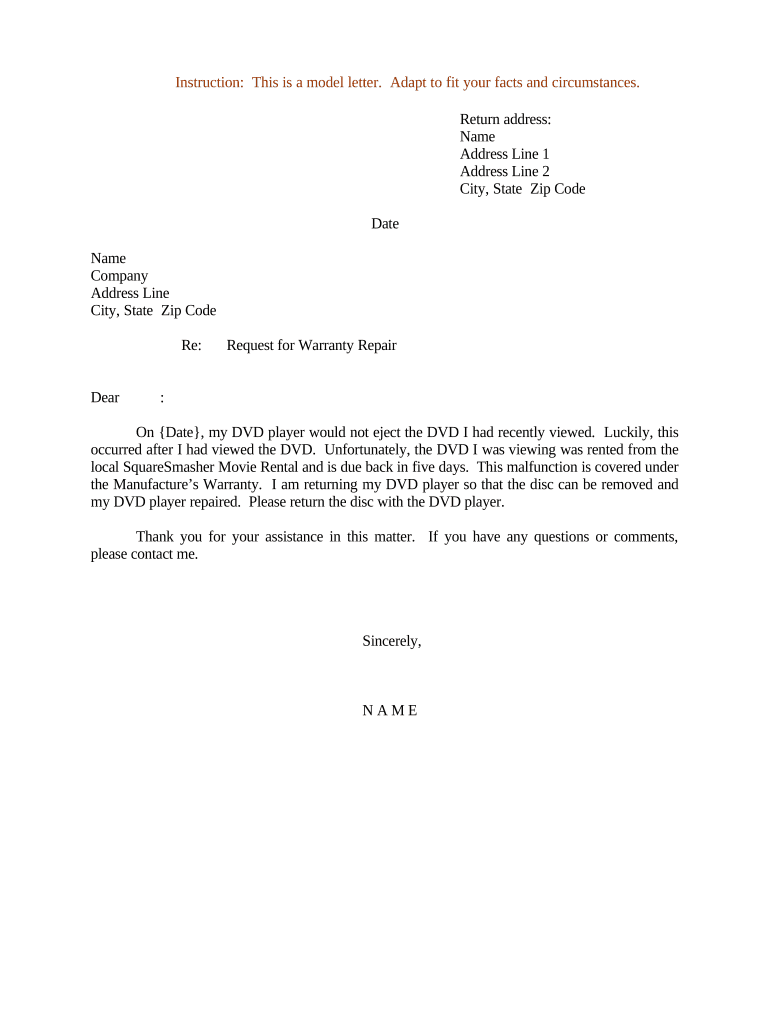
Repair Form
What a Repair Form Is and when it’s used
Why a clear Repair Form matters
A complete Repair Form standardizes requests, limits misunderstandings, and supports compliance with warranty, lease, and service-level requirements. It documents consent to work, helps calculate costs and timelines, and creates a verifiable record useful for billing, insurance, or future disputes.
Who typically fills out and signs Repair Forms
Accurate role assignment on the form—requester, approver, and performing party—reduces processing delays and supports later audits or warranty claims.
- Property managers and landlords who document repair requests, approvals, and landlord/tenant responsibilities for leased premises.
- Maintenance technicians and service vendors who record diagnostics, parts required, labor estimates, and completion notes.
- Customers or occupants who report issues and provide authorization for entry, parts replacement, or billing approvals.
Step-by-step: How to complete a Repair Form
-
01Describe issue: Record symptoms, location, and date observed.
-
02Identify item: Enter serial/model numbers and owner details.
-
03Estimate cost: List parts, labor hours, and total estimate.
-
04Sign and date: Requester and approver sign and add dates.
How to configure an online Repair Form workflow
| Field | Configuration |
|---|---|
| Requester field | Required; validation for phone or email |
| Item fields | Optional serial validation; allow attachments |
| Approval routing | Route to manager email or group inbox |
| Notifications | Send confirmations and completion notices |
Typical submission and processing flow
-
Submit request: Requester completes the form and uploads photos.
-
Review: Manager or vendor reviews scope and cost.
-
Approve: Approver signs or authorizes electronically.
-
Complete work: Technician records completion notes and parts used.
Digital signing and platform considerations
Choose settings that capture intent, attribution, and retention to satisfy ESIGN/UETA tests and support later evidence for billing, warranty, or regulatory review.
- File types: Accept PDF, DOCX, and images
- Authentication: Email, SMS code, or multi-factor
- Integrations: CRM and document storage links
Common timelines and processing expectations
Initial response window:
Typically 24–72 hours after submission
Repair scheduling:
Scheduled within 7–14 days depending on parts
Warranty claim window:
Follow manufacturer terms; often 30–90 days
Tenant notice period:
Landlord response depending on local law
Record update:
Post-repair summary added within 3 business days
Key milestones from request to closure
Request logged
Timestamp and requester recorded at submission.
Diagnosis complete
Technician documents findings and parts list.
Approval obtained
Written or electronic authorization captured.
Work completed
Completion notes, signature, and final invoice attached.
Common mistakes when preparing a Repair Form
- Incomplete item identifiers: missing serial or asset numbers delay parts ordering and may void warranty coverage.
- Vague problem descriptions: brief, nontechnical notes force on-site reinspection and increase labor costs.
- Missing authorization: work performed without documented approval can create billing disputes and payment rejections.
- Poor attachment quality: blurry photos or missing receipts impede diagnosis and insurance claim acceptance.
Penalties and risks of incorrect or incomplete forms
Real-world examples of Repair Forms in use
Martin Properties
Property manager digitized repair requests to centralize approvals and scheduling.
- Reduced onsite follow-ups by capturing photos with each request.
- "I can process and execute all of these documents online with 100% compliance and built-in security. Whether on mobile or working offline, I can get forms back to their necessary parties efficiently."
Optica Ventures
Small commercial landlord standardized a Repair Form to clarify cost responsibility and timelines.
- Added conditional fields for emergency vs routine repairs.
- "The interface is simple and easy-to-use for our team; more importantly, it is just as easy for our customers."
Tips for accurate and efficient Repair Form completion
Sample eSignature vendor comparison relevant to Repair Form workflows
| signNow | DocuSign | Adobe Sign | PandaDoc | HelloSign | |
|---|---|---|---|---|---|
| Starting Price | $8/user/mo | $15/user/mo | $14/user/mo | $19/user/mo | $15/user/mo |
| Free Trial | 7-day free trial | Varies | Varies | Varies | Varies |
| Bulk Send | Yes | Yes | Yes | Yes | No |
| Audit Trail | Yes | Yes | Yes | Yes | Yes |
| HIPAA Compliant | Yes | Yes | Yes | No | No |
Repair Form FAQs and troubleshooting
-
Can an electronic signature be used?
Yes. Electronic signatures are legally valid under the ESIGN Act (15 U.S.C. ch. 96) and UETA where adopted if intent, consent, attribution, and record retention are present.
-
Do Repair Forms require notarization?
Generally no. Most repair authorization forms do not need notarization, but specific vendor or insurance processes may request notarized affidavits for high-value claims.
-
What if names don’t match IDs?
Mismatched names can delay approvals or insurance claims. Use the full legal name on the form and include an ID copy when requested to ensure attribution.
-
How long must I keep forms?
Retention depends on purpose: at least 3 years for tax records (IRC §6501(a)), 6 years for HIPAA-related health documents (45 CFR §164.530(j)), and longer for real estate matters.
-
Can you revise a submitted form?
Yes. Create an amendment or replacement form that references the original, captures the reason for revision, and collects new signatures to preserve the audit trail.
-
What authentication is recommended?
Use at minimum an emailed signing link with audit trail; stronger workflows may add SMS codes, ID credential analysis, or multi-factor authentication for higher-risk repairs.