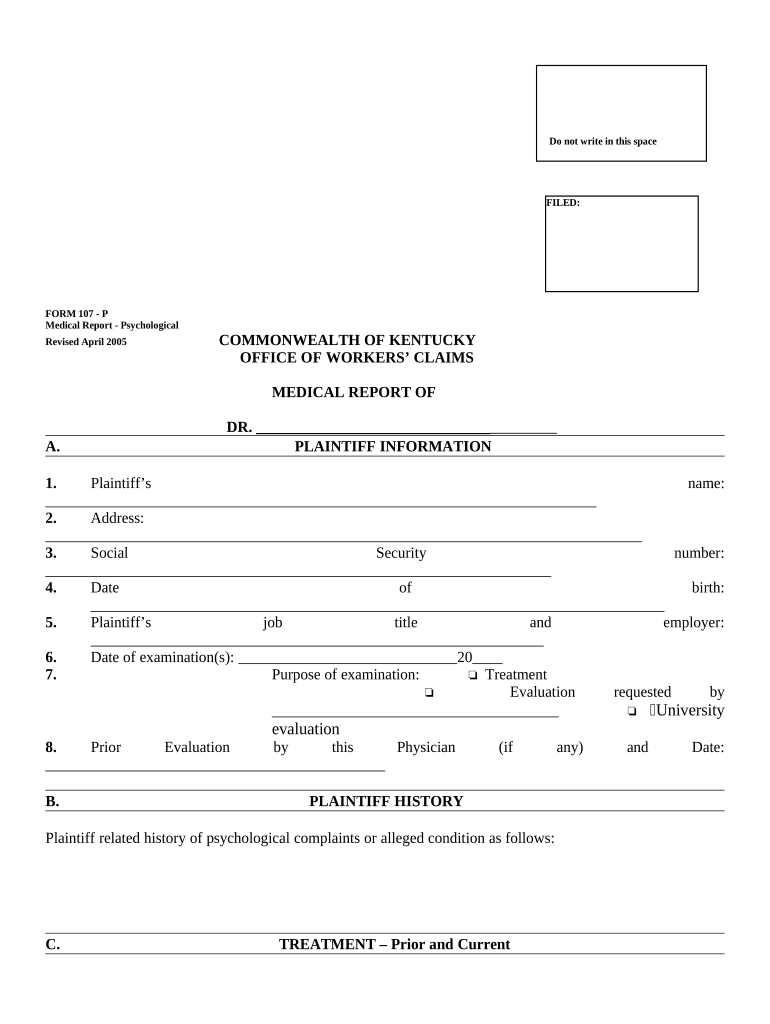
Kentucky Medical Report - Psychological
What the Kentucky Medical Report - Psychological is and when it's used
Why accurate psychological reports matter for decisions and compliance
A complete, well-documented Kentucky Medical Report - Psychological provides concise clinical evidence for administrative, legal, and insurance decisions, reduces processing delays, and helps protect patient privacy by meeting HIPAA and recordkeeping expectations.
Primary users and stakeholders for this report
Primary users include licensed psychologists, psychiatrists, and authorized medical examiners who prepare psychological evaluations for administrative, legal, or clinical review in Kentucky.
- Licensed psychologists and clinical social workers conducting formal assessments for disability, treatment, or legal referral.
- Forensic evaluators preparing court-ordered competency, risk, or custody-related psychological reports.
- Insurers and disability reviewers using structured clinical data to adjudicate claims or determine benefit eligibility.
Step-by-step: completing the Kentucky Medical Report - Psychological
-
01Prepare: Gather records, referrals, test results, and prior evaluations.
-
02Assess: Conduct interview, mental status exam, and standardized testing as appropriate.
-
03Document: Describe findings, include scores, diagnoses, and treatment recommendations.
-
04Review: Verify identifiers, dates, and signature before submission.
How the report moves from clinician to recipient
-
Upload: Prepare PDF and supporting files for submission.
-
Authenticate: Use required signer verification or institution authentication.
-
Transmit: Send via secure portal, email with encryption, or e-sign platform.
-
Archive: Store final report with audit trail for compliance.
Recommended electronic workflow settings for consistent submissions
| Field | Configuration |
|---|---|
| Signature Type | Electronic signature with audit trail, optional RON when notarization required |
| Authentication | Email link, SMS code, or institution SSO per recipient |
| Required Fields | Patient identifiers, evaluation date, DSM/ICD codes, clinician license |
| Retention Setting | Automated archival for minimum required retention period with audit log |
Technical requirements for secure submission and storage
Digital submission options include secure eSignature platforms, secure portals, and RON notarization when required for official filings.
- Integrations: Salesforce, NetSuite, Microsoft 365, Google Workspace
- Formats: PDF, DOCX, or structured XML accepted
- Security: AES-256 encryption at rest, TLS 1.2/1.3 in transit
eSignature vendor comparison for medical reports and compliance needs
| signNow | DocuSign | Adobe Sign | PandaDoc | HelloSign | |
|---|---|---|---|---|---|
| Starting Price | $8/user/mo | $15/user/mo | $14/user/mo | $19/user/mo | $15/user/mo |
| Free Trial | 7-day free trial | Varies | Varies | Varies | Varies |
| Bulk Send | Yes | Yes | Yes | Yes | No |
| Audit Trail | Yes | Yes | Yes | Yes | Yes |
| HIPAA Compliant | Yes | Yes | Yes | No | No |
| Envelope Cap | No cap | 100 envelopes/user/year | No cap | No cap | No cap |
Common risks and potential consequences of an incorrect report
Real-world use cases for the Kentucky Medical Report - Psychological
Workers' Compensation
A licensed psychologist prepares a structured psychological report for a claimant alleging work-related PTSD to document functional impairment and treatment needs for the insurer.
- Objective testing and clear rationale
- The completed Kentucky Medical Report - Psychological informs benefit determinations, supports negotiated treatment plans, and provides a defensible clinical record; accurate coding and complete documentation reduce administrative appeals and expedite service authorization.
Driver Fitness Evaluation
State licensing agencies may request a psychological report to assess cognitive or psychiatric fitness to operate a motor vehicle after an incident or medical concern.
- Focus on risk, insight, and recommended restrictions
- Clear documentation of testing methods, functional limitations, and suggested accommodations helps licensing boards make targeted decisions, balances public safety with individual rights, and limits the need for repeated evaluations and appeals.
Typical timelines and processing expectations
Initial report completion timeframe by clinician:
Often completed within 7–21 days of assessment depending on complexity.
Routine submission to insurer or payer:
Allow insurer review 14–30 days; prior authorization may extend timeline.
Court-ordered evaluation submission deadline to clerk:
Follow the court scheduling order; deadlines vary by jurisdiction.
Driver licensing review submission window:
Agencies often allow 30–60 days for review; urgent assessments shorten timelines.
Record retention expectation for submitted reports:
Maintain records per HIPAA and state rules; typically 6+ years for health documents.
Practical best practices to improve accuracy and speed
How to download, export, and archive the report
Export a flattened, signed PDF/A version that preserves visible signatures and an embedded audit trail where possible; PDF/A is preferred for long-term archival and compatibility with legal or administrative review processes.
DOCX
Provide an editable DOCX copy only when the recipient requires source material; avoid sharing editable clinical documents unless protected by secure transmission and explicit consent.
CSV export
Export structured data (demographics, scores, codes) as CSV for analytics or EHR import; remove PHI before sharing with third parties to comply with privacy rules.
Archive
Store final signed reports in a secure, access-controlled repository with redundancy and audit logging to meet HIPAA and institutional retention policies and disaster recovery plans with regular testing.
Frequently asked questions about completing and submitting the report
-
Is an electronic signature acceptable?
Electronic signatures are legally valid under the ESIGN Act (15 U.S.C. ch. 96) and UETA in most states if intent, consent, attribution, and record retention are satisfied. For consumer-facing or healthcare forms, provide required consumer disclosures and ensure HIPAA protections and BAAs as applicable.
-
Does the report require notarization in Kentucky?
Notarization requirements depend on the document’s purpose and recipient. Routine clinical reports rarely require notarization, but affidavits or court-directed submissions may. Verify the requesting agency or court order; if notarization is needed, RON may be accepted per state rules where authorized.
-
What must be included for legal defensibility?
Include clear patient identifiers, observation-based findings, standardized test scores with norms, DSM-5/ICD-10 diagnostic codes and rationale, clinician credentials, dates, and a signed statement of truth. Attach supporting documents and document consent for release where required by HIPAA.
-
How to handle patient privacy and HIPAA
Limit disclosures to the minimum necessary, obtain written authorizations for release when required, de-identify data for secondary use, and use secure transmission and storage. For e-sign workflows, ensure the vendor supports HIPAA and sign a BAA before exchanging protected health information.
-
Can RON be used for this report?
Remote online notarization may be acceptable when a notarized affidavit or jurat is required and the state authorizes RON. Check the state notary commission rules and retain the required audio-video recording and journal entries for the legally mandated retention period.
-
What if the recipient requires a paper original?
Provide a printed, signed original when requested. If the clinician signs electronically, consider printing a certified copy bearing the signature certificate or obtaining a wet-ink signature. Document chain-of-custody and keep a scanned copy for records and compliance.